 PlantAlong

In short
- Clemson Extension says flower buds need 14 or more hours of continuous darkness a night, kept up for at least 6 weeks for complete bud set.
- As little as 2 hours of light during the dark period can block bud set, per Clemson.
- Iowa State says temperatures above 70°F prevent flowering and calls 60 to 65°F nights ideal.
- UF/IFAS says plants given its six-week dark treatment bloom in about ten weeks.
- Iowa State says most plants sold as Christmas cactus are actually Thanksgiving cactus or hybrids.
- Clemson recommends Epsom salts only as monthly growing-season feeding; we found no extension source for coffee grounds or baking soda.
On this page
- Christmas cactus not blooming? The two triggers
- The 6-week fix, step by step
- Bud drop: why buds fall off
- Thanksgiving vs Christmas vs Easter cactus
- Fertilizer, repotting and other myths
- Watering while it sets buds
- FAQ
- What triggers a Christmas cactus to bloom?
- Do coffee grounds make a Christmas cactus bloom?
- Why are the buds falling off my Christmas cactus?
- Is it too late to get my Christmas cactus to bloom this year?
- Sources
In extension guides, a Christmas cactus not blooming usually comes down to two fall signals: long, unbroken nights and cool temperatures. Clemson Extension says flower buds need 14 or more hours of continuous darkness a night for at least 6 weeks, and Iowa State says temperatures above 70°F prevent flowering even with short days.
Christmas cactus not blooming? The two triggers#
Holiday cacti are short-day plants: Iowa State says they form flower buds as the days shorten in fall. The sources agree on the two signals but not on the exact numbers.
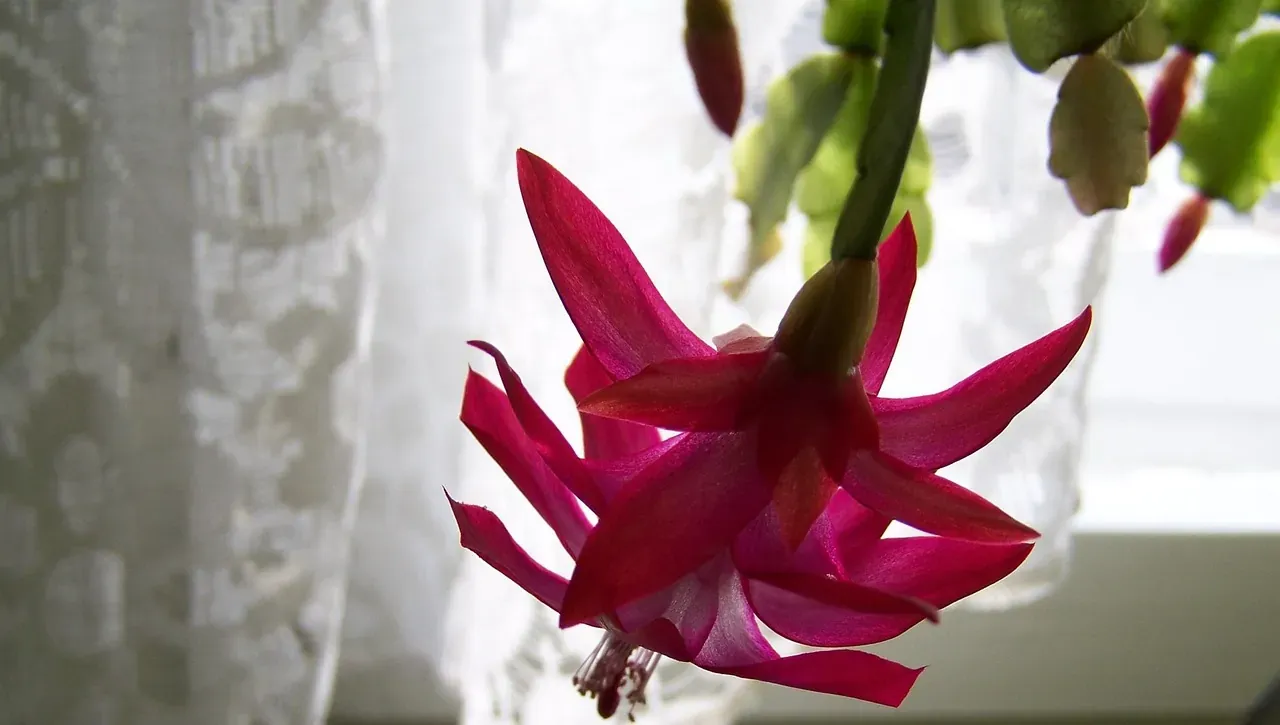 Magenta holiday cactus flower hanging near a window with a white lace curtain behind it
Photo: ArmbrustAnna / Pixabay
1. Long, unbroken nights. Clemson's factsheet (HGIC 1554) says "Fourteen hours or more of continuous darkness each day is required before flower bud set will occur." It also warns that "as little as 2 hours of interrupted lighting will inhibit flower bud set." Iowa State says most plants need 14 to 16 hours, while some cultivars bloom with as little as 12. Penn State says at least 12 hours.
2. Cool temperatures. Iowa State says temperatures above 70°F prevent flowering and calls nights of 60 to 65°F ideal. Clemson adds that plants kept at night temperatures between 50 and 59°F "will set flower buds regardless of day length." Purdue says plants also bloom with cool nights of about 50 to 55°F.
Clemson says a lack of flowering is often due to light breaking the long night. Iowa State names lamps, kitchen lights and even streetlights.
| Source | Darkness per night | Temperature | How long |
|---|---|---|---|
| Clemson (HGIC 1554) | 14+ hours, unbroken | Fall 60 to 68°F; nights of 50 to 59°F set buds on their own | At least 6 weeks for complete bud set |
| Iowa State | 14 to 16 hours (some cultivars 12) | Above 70°F prevents flowering; 60 to 65°F nights ideal | Not stated |
| Penn State | At least 12 hours | Winter: 68°F days, 60°F nights | Not stated |
| UF/IFAS | 5 p.m. to 8 a.m. in a dark spot | "Cooler temperatures also help" | Six weeks; bloom in about ten |
| Purdue | Long, uninterrupted dark periods | Cool nights of about 50 to 55°F also work | Start dark mid-October, or cool nights by early November, for the holidays |
The 6-week fix, step by step#
For a Christmas cactus not blooming, the fix is 6 weeks of long nights and cool temperatures. The 6 weeks comes from two extension sources: Clemson says long nights should continue "for at least 6 continuous weeks for complete bud set," and UF/IFAS says its dark treatment "should last for six weeks."
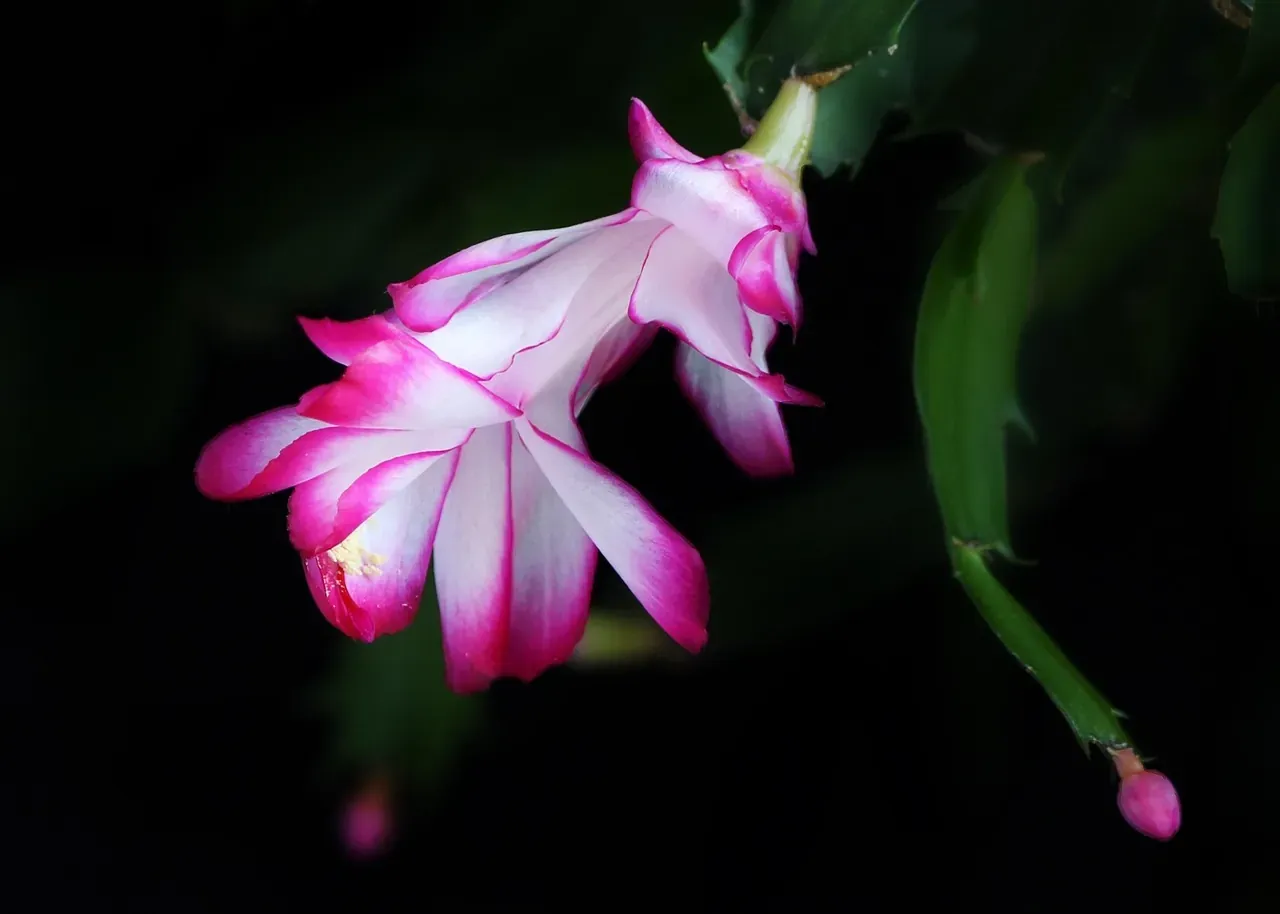 Pink and white holiday cactus flower beside an unopened pink bud at a stem tip
Photo: Foto-Rabe / Pixabay
- Choose the spot. Iowa State suggests a cool place (55 to 65°F) with bright daytime light and no artificial light at night, such as an unused bedroom or basement. If the plant summered outside, Clemson says to bring it in before nights drop below 50°F, which comes well before the first frost on your frost alerts.
- Give it long nights. UF/IFAS moves plants into a dark area, like a closet, from 5 p.m. to 8 a.m. each day. That is 15 hours, inside Iowa State's 14 to 16.
- Do not skip a night. Clemson says as little as 2 hours of light during the dark period can block bud set.
- Keep it cool, not cold. Stay below Iowa State's 70°F limit. Clemson notes that bud drop may occur at 50°F.
- Look for buds. Clemson says buds are normally visible in 3 to 4 weeks.
- Finish the 6 weeks, then wait. Clemson says day length "has no effect on flowering once the buds are set."
The 6 weeks is how long it takes to set buds. Flowers open later. UF/IFAS says plants treated this way "will bloom in about ten weeks," and gives the example of starting around Oct 14 for full bloom around Dec 23. A UGA Extension article says flowering follows about eight weeks of the treatment.
One trade-off: Iowa State warns that moving the plant during bud development can make buds drop, so a room that stays dark at night may be gentler than daily closet trips.
Shop the essentials
What you'll need
Supplies for the steps in this guide.
 FeedHouseplant fertilizerLiquid food for indoor flowering plants. Follow the label rate.: check price on Amazon (opens in a new tab)
 RepotCactus potting mixA fast-draining mix for holiday cactus and succulents.: check price on Amazon (opens in a new tab)
 To plantPots with drainage holesPlanters with drainage holes for herbs, bulbs and houseplants.: check price on Amazon (opens in a new tab)
 Before wateringSoil moisture meterA probe that shows whether a pot is wet or dry.: check price on Amazon (opens in a new tab)
As an Amazon Associate I earn from qualifying purchases. Photos show the type of product, not a specific listing. How we choose
Bud drop: why buds fall off#
Buds that form and then fall are a different problem from a Christmas cactus not blooming at all. Common causes:
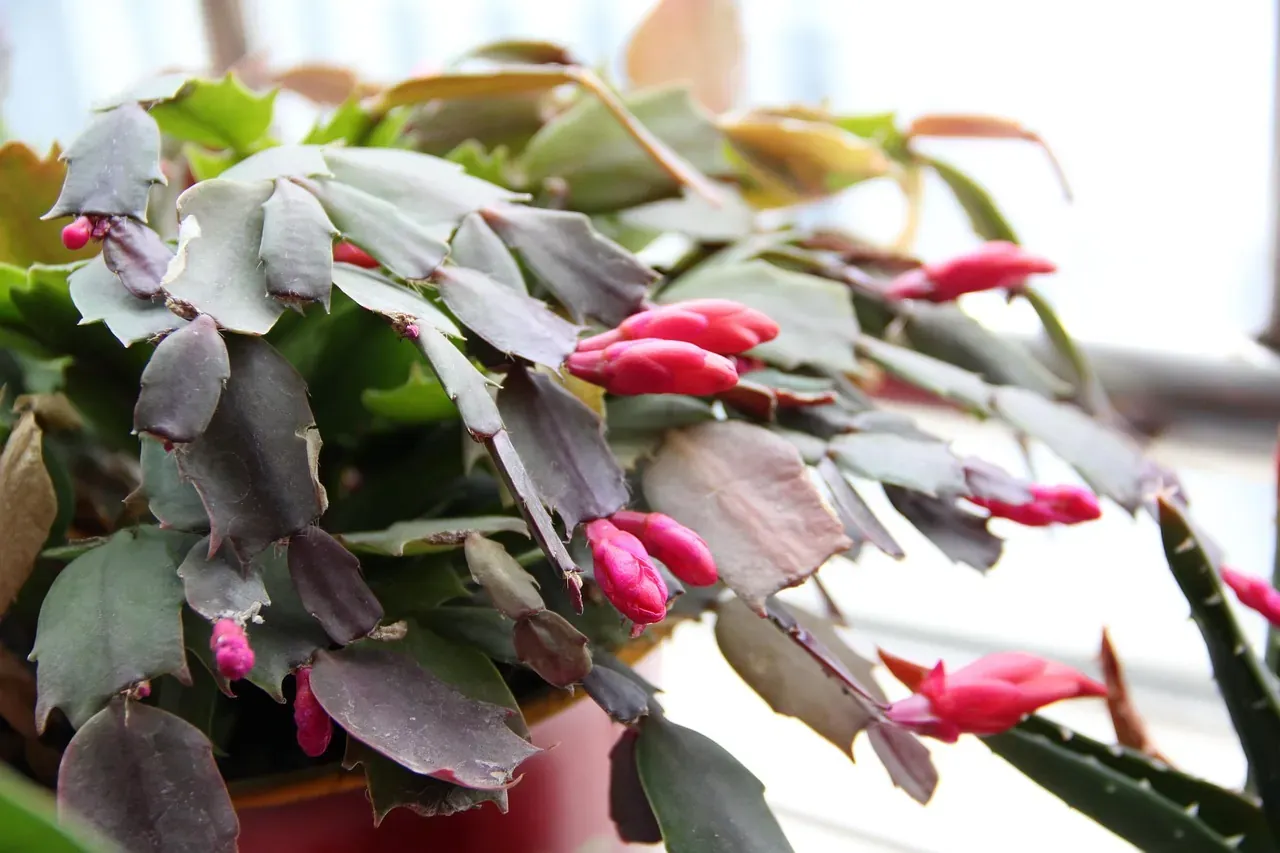 Holiday cactus with reddish stem segments and many closed pink flower buds near a window
Photo: shinichi4849 / Pixabay
- Sudden change. Clemson says bud drop "may be induced by an excessive number of buds or a sudden change in temperature, light or other environmental factors, such as drying out of the growing medium."
- Moving the plant. Iowa State says not to move it until the first flowers open.
- Heat and drafts. Clemson says "continuous warm temperatures can cause flower buds to drop." UF/IFAS says to keep the plant away from drafts and heat sources such as a vent, fireplace or television.
- Watering. Iowa State says dryness can cause buds or flowers to drop, and so can overwatering. UF/IFAS also names improper watering.
- Cold. Iowa State says cold exposure in transit can cause buds to drop.
Thanksgiving vs Christmas vs Easter cactus#
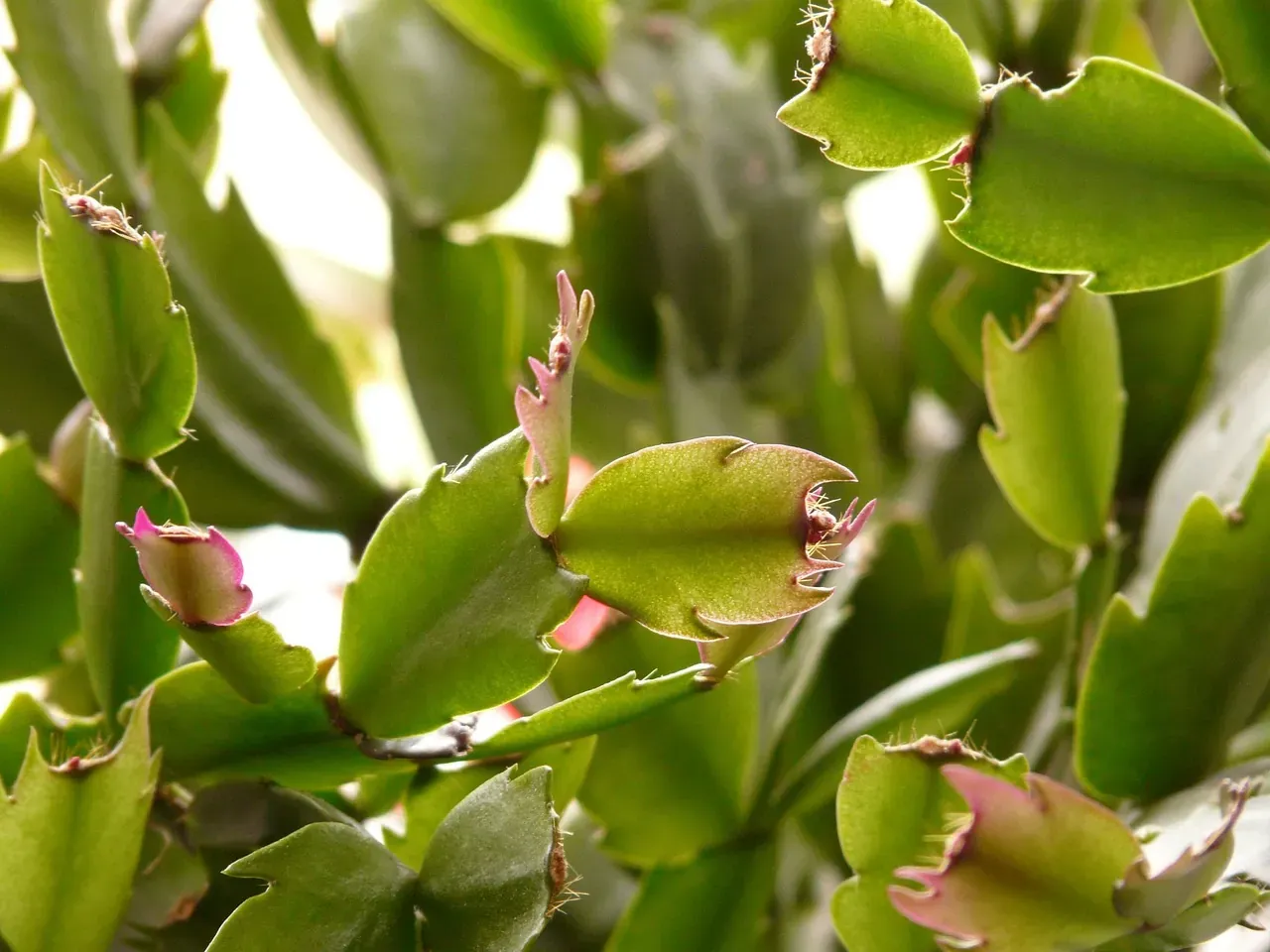
Sometimes a Christmas cactus not blooming at Christmas is not a Christmas cactus. Iowa State says most plants sold as "Christmas cactus" are actually Thanksgiving cactus or hybrids.
 Close view of holiday cactus stem segments with pointed teeth along their edges
Photo: Hans / Pixabay
- Thanksgiving cactus (Schlumbergera truncata): stem segments with 2 to 4 upward-pointing teeth. Iowa State says it typically blooms from mid-November to late December. Clemson says its anthers (the pollen-bearing tips) are yellow.
- Christmas cactus (Schlumbergera × buckleyi): scalloped segments without pointed teeth. Iowa State gives its bloom time as late November to early February. Clemson says its anthers are purplish-brown.
- Easter cactus (Schlumbergera gaertneri, formerly Hatiora gaertneri): smoother segments that bloom mainly from March to May, per Iowa State.
Clemson says Thanksgiving cacti normally flower about a month before Christmas cacti. So a plant that bloomed in November may simply be a Thanksgiving cactus.
The Easter cactus has a stricter routine. Iowa State says it needs 14 to 16 hours of darkness at 60 to 70°F for 3 to 4 weeks, then 47 to 55°F for 4 to 6 weeks. An Easter cactus without flowers in December is behaving normally.
Fertilizer, repotting and other myths#
Popular fixes for a Christmas cactus not blooming include fertilizer, Epsom salt, coffee grounds and baking soda. Here is what the sources say.
Fertilizer timing. Clemson feeds monthly at half strength from late winter or early spring through summer, then says to "stop fertilization during the late summer for greater flower bud production in the fall." Penn State lists overfertilization while buds develop as one cause of poor blooming.
Epsom salt. There is a source for this one, but not as a bloom trigger. Clemson says holiday cacti "have a higher requirement for magnesium than many plants" and suggests Epsom salts (magnesium sulfate) at 1 teaspoon per gallon of water, monthly during the growing season, never in the same week as regular fertilizer. That is spring and summer feeding, not a fall fix for a Christmas cactus not blooming.
Coffee grounds and baking soda. We found no university extension source that recommends either one for a Christmas cactus not blooming. The sources above point to darkness and temperature instead.
Repotting. Clemson says holiday cacti flower best when somewhat pot-bound and need repotting only about once every three years, in spring. Penn State says never to repot a plant that is actively blooming.
Penn State's list of reasons for poor blooming also includes root rot from saturated soil, drought stress and too much light.
Watering while it sets buds#
Watering matters most once buds appear, because a dry pot can leave you with a Christmas cactus not blooming after all. Clemson says that after bud set "the growing medium must be kept evenly moist to prevent flower bud abscission," and to never let water stand in the saucer. Iowa State also says to keep the soil evenly moist while the plant is budding and flowering.
UF/IFAS waters when the top inch of soil feels dry, until water runs out the bottom, then empties the saucer. For the season-by-season schedule, see how often to water a Christmas cactus.
FAQ#
What triggers a Christmas cactus to bloom?#
Long nights and cool temperatures: 14 or more hours of unbroken darkness for at least 6 weeks (Clemson), with temperatures below 70°F (Iowa State). Clemson says nights of 50 to 59°F can set buds even without long nights.
Do coffee grounds make a Christmas cactus bloom?#
We found no evidence for it. No extension source we checked recommends coffee grounds for blooming. The sourced triggers are darkness and cool temperatures, and Clemson's feeding advice (including Epsom salts) applies to the growing season, not to bud set.
Why are the buds falling off my Christmas cactus?#
Usually a sudden change. Clemson names changes in temperature or light, drying out and too many buds. Iowa State says moving the plant before the first flowers open can cause it, and UF/IFAS points to drafts, heat sources and improper watering.
Is it too late to get my Christmas cactus to bloom this year?#
A Christmas cactus not blooming by mid-November can still flower this winter, but likely not by Christmas Day. Clemson suggests starting long nights about mid-September, and Purdue says to start cool nights by early November for holiday blooms. UF/IFAS expects bloom about ten weeks after the start, so a mid-November start points to flowers in late January. Check for buds first: if they are already there, keep conditions steady.
Sources#
Every number in this article comes from the sources below. Read more about how PlantAlong checks its facts.
- Thanksgiving & Christmas Cacti (HGIC 1554) (Clemson Cooperative Extension, HGIC)
- All About Holiday Cacti (Iowa State University Extension and Outreach)
- My Christmas cactus doesn't bloom well. Why? (Iowa State University Extension and Outreach)
- Holiday Cacti Care (Penn State Extension)
- Christmas Cactus Preparation (UF/IFAS Gardening Solutions)
- Getting Christmas Cactus to Rebloom (Purdue Extension, Indiana Yard and Garden)
- Christmas or Thanksgiving Cactus? (UGA Cooperative Extension, Paulding County)
Featured photo: Schwoaze / Pixabay.




Check your inbox
We sent a confirmation link to . Click it and your planting calendar PDF is on its way. Nothing there in a few minutes? Check your spam or promotions folder.



No comments yet. Tried this in your garden, or found a date that worked better? Start the thread.
Leave a comment