 PlantAlong

In short
- Clemson, CSU and USU say poinsettias need at least six hours of bright, indirect light a day.
- Iowa State and CSU put the ideal room temperature at 60 to 70°F; USU and Penn State say never below 50°F.
- Iowa State says freezing temperatures, even for a few minutes, may blacken and drop the bracts and leaves.
- To rebloom, CSU, Clemson, Penn State and USU call for at least 14 hours of uninterrupted darkness nightly from about October 1.
- NC State says poinsettia is winter hardy only in USDA zones 9 to 11, and PlantAlong's NOAA analysis finds 799 of 6,491 ZIPs in zones 9a to 11b are rare-frost.
- The ASPCA says poinsettia sap irritates the mouth and stomach of pets but is generally over-rated in toxicity.
On this page
- Pick a healthy plant at the store
- Light and temperature
- Drafts, cold car rides and heat vents
- Watering in brief
- How to keep a poinsettia alive after Christmas
- Reblooming: the short-day schedule
- Can poinsettias grow outdoors? Only in the warmest ZIPs
- FAQ
- How long will a potted poinsettia last?
- Can poinsettias be grown outdoors?
- Are poinsettias poisonous to pets?
- Why are my poinsettia leaves falling off?
- Sources
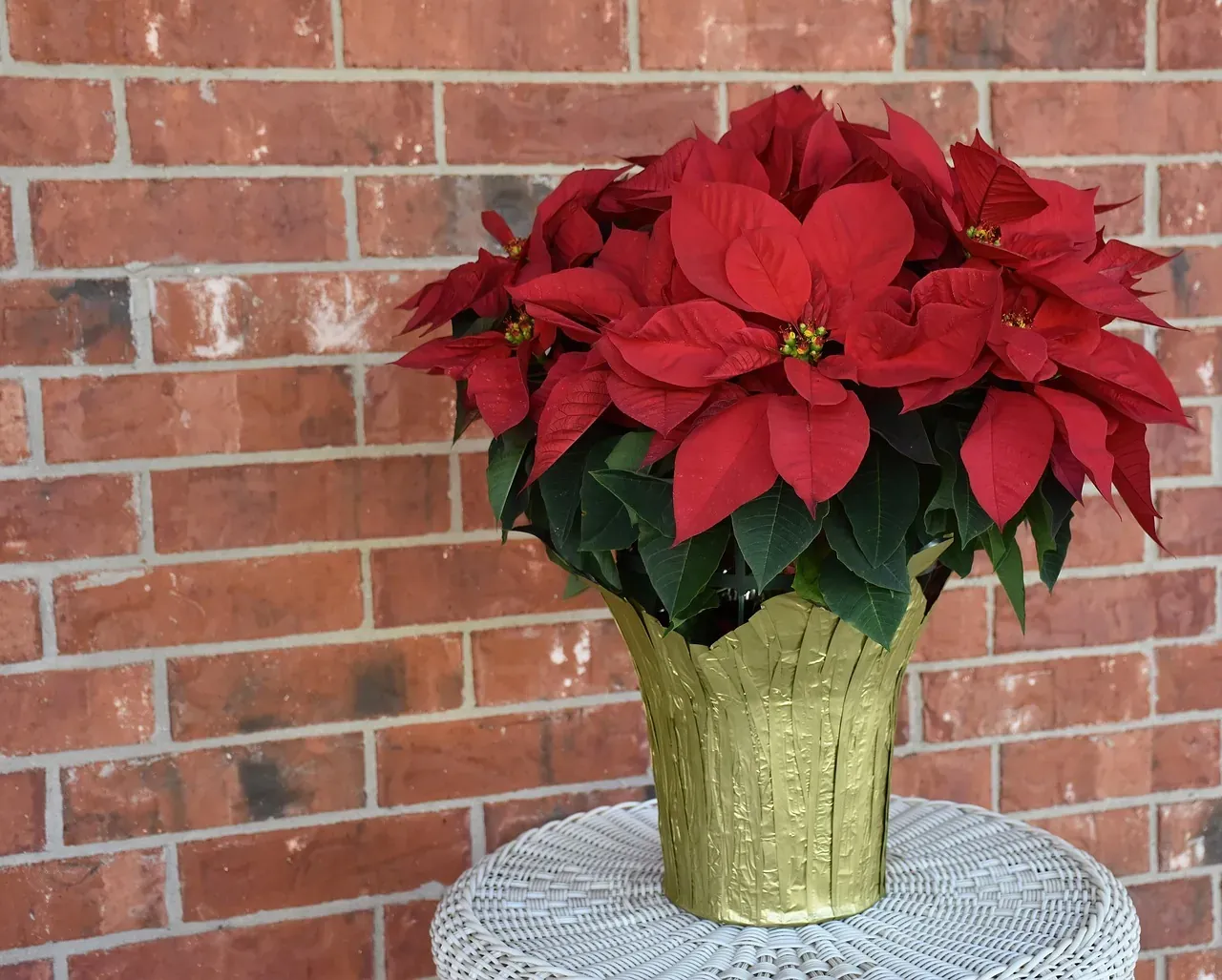
To keep a poinsettia alive through the holidays, give it bright indirect light, a room between about 60 and 70°F, no drafts, and water only when the soil surface feels dry, with the foil wrap opened so it drains. Those habits come straight from university extension advice. With them, a poinsettia bought in December can keep its color into March.
Pick a healthy plant at the store#
Keeping a poinsettia alive starts before you pay for it. Clemson's Home & Garden Information Center suggests fully colored bracts (the colored leaves most people call flowers), dark green leaves all the way down the stem with nothing drooping, and small yellow flowers in the center that are not quite open.
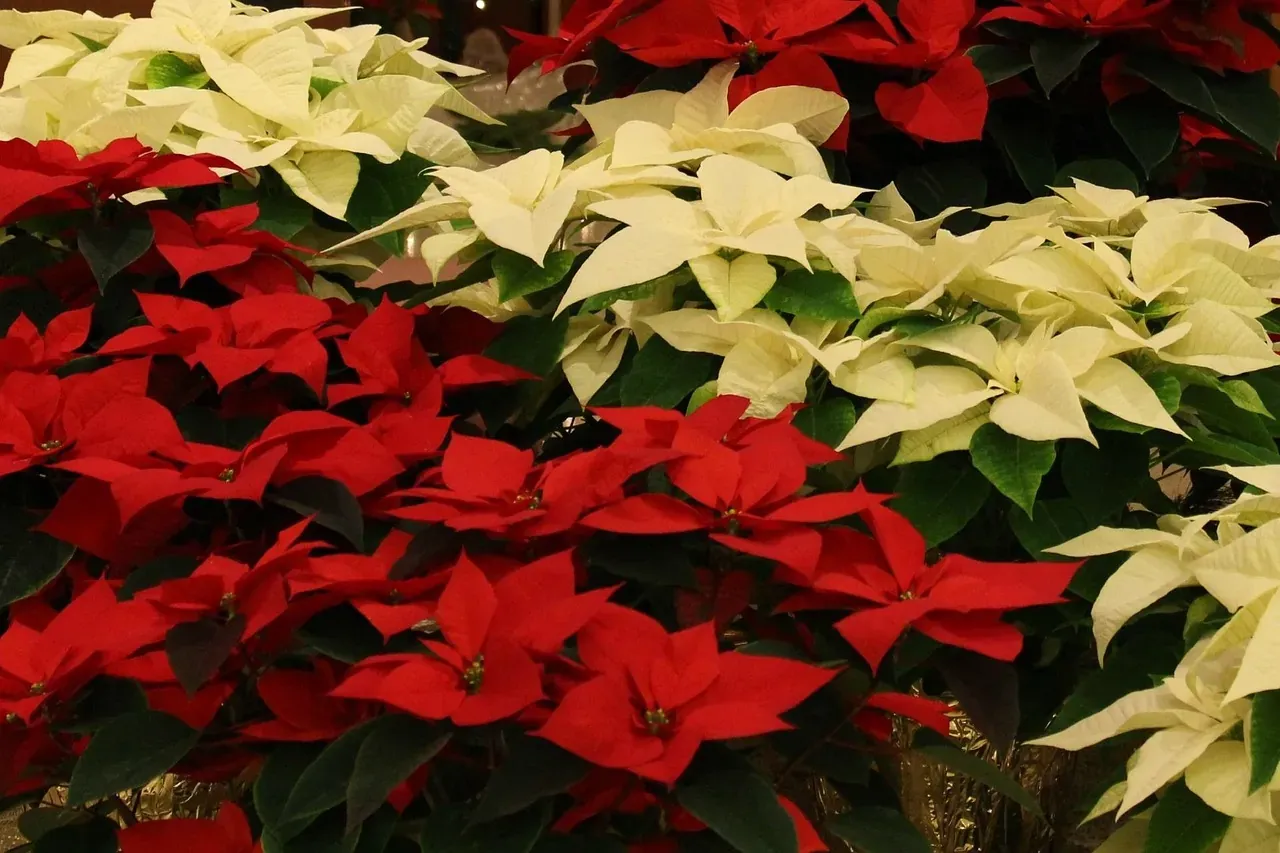 Dense display of red and cream-white poinsettias with dark green leaves
Photo: srsusan / Pixabay
CSU Extension's PlantTalk adds that plants whose tiny flowers are still tightly closed and have not shed pollen will last the longest. CSU's fact sheet says to pass on plants with missing lower leaves, since pale, yellow or fallen leaves can point to root disease or past watering problems.
Penn State Master Gardeners suggest pulling the foil wrapper down to check that the leaves at the base are healthy. Skip plants with very dry or very wet soil, and look under the leaves for insects.
Light and temperature#
To keep a poinsettia alive indoors, Clemson says it needs at least 6 hours of bright, indirect sunlight a day. Direct sun may fade the bract color, so filter it with a sheer curtain if needed. CSU and Utah State (USU) Extension give the same six-hour minimum.
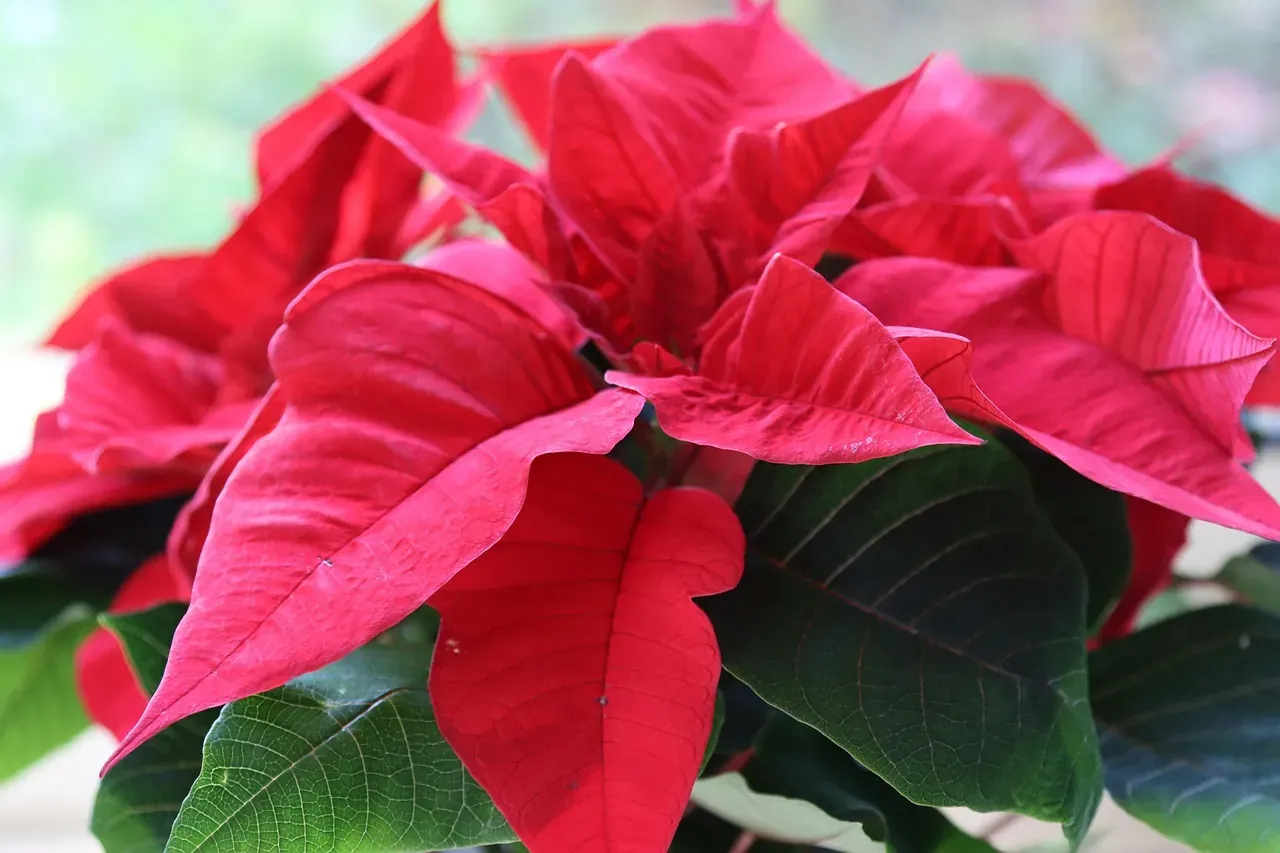 Bright red poinsettia bracts over dark green leaves in soft daylight
Photo: MLARANDA / Pixabay
Temperature advice is close across sources, with small differences:
- Iowa State and CSU: 60 to 70°F is ideal. CSU narrows it to 67 to 70°F by day and 60 to 62°F at night.
- USU and Penn State: 65 to 70°F by day and 55 to 65°F at night, never below 50°F.
- Illinois Extension: no lower than 55°F and no higher than 70°F, with 65°F ideal.
- Clemson: daytime should not exceed 70°F. Excess heat yellows the leaves and fades the bracts early.
One outlier: a University of Vermont Master Gardener article lists 65 to 80°F. The other sources cap it at 70°F, the range most extension advice gives for a poinsettia alive and colorful into spring.
Keep the plant near a window, but Iowa State and Purdue both say not to let leaves or bracts touch the cold glass.
Shop the essentials
What you'll need
Supplies for the steps in this guide.
 FeedHouseplant fertilizerLiquid food for indoor flowering plants. Follow the label rate.: check price on Amazon (opens in a new tab)
 RepotCactus potting mixA fast-draining mix for holiday cactus and succulents.: check price on Amazon (opens in a new tab)
 Before wateringSoil moisture meterA probe that shows whether a pot is wet or dry.: check price on Amazon (opens in a new tab)
 Start indoorsSeed-starting trays with lidsCell trays with clear domes for sowing seeds indoors.: check price on Amazon (opens in a new tab)
As an Amazon Associate I earn from qualifying purchases. Photos show the type of product, not a specific listing. How we choose
Drafts, cold car rides and heat vents#
The trip home is the first risk to keeping a poinsettia alive. Iowa State says that exposure to freezing temperatures, even for a few minutes, may blacken the bracts and leaves and make them drop. Penn State Master Gardeners put the plant in a loose-fitting bag when it is below 50°F or windy, and make sure it is well covered or sleeved when outside temperatures approach 35°F.
Purdue Extension suggests preheating the car and taking the plant straight home, because plants left in an unheated car can be injured or killed quickly. Once home, remove the sleeve promptly. Penn State says a sleeve left on can cause epinasty, a downward bending of the stalks that hold the bracts.
CSU's PlantTalk says to avoid cold drafts, radiators and heat vents. Purdue notes that both hot and cold drafts can cause leaf drop, so keep the plant away from doors and heating vents.
Watering in brief#
To keep a poinsettia alive, Clemson, UF/IFAS and Iowa State all say to water when the soil surface feels dry to the touch, then let the excess drain. Remove the foil cover when watering or punch holes in it, and never let the pot sit in water.
Our full guide on how often to water poinsettia plants has a source-by-source table, the sink method, and how to tell wilting from overwatering.
How to keep a poinsettia alive after Christmas#
Poinsettia care after Christmas starts with knowing how long the show lasts. UF/IFAS says poinsettias can hold their color until March if they are not exposed to freezing temperatures. Penn State and USU say bracts can last until about March or April, while Illinois Extension gives 6 to 8 weeks in the home.
Do not fertilize while the plant is in bloom (Clemson, Illinois, CSU). After the holidays, CSU and Penn State suggest a balanced houseplant fertilizer about once a month to keep the foliage green.
When the bracts fade, extension sources describe two ways to keep a poinsettia alive until next season. They do not agree, so pick one:
Keep it growing. Clemson says to prune the plant back to about 8 inches around March to April and keep it by a sunny window, watering regularly. Penn State adds to leave a few leaves and about six buds. New growth appears by May, and Clemson and Penn State suggest a complete fertilizer such as 10-10-10 every two to three weeks.
Let it rest. Illinois Extension says to reduce watering until the soil is completely dry once about half the leaves and bracts have dropped. Store the dormant plant in a cool, dark place and water just enough to keep the stems from shriveling. When new growth begins, usually in early May, cut it back to 4 to 6 inches.
In early June, Clemson and Penn State suggest moving the plant to a container 2 to 4 inches larger. Clemson says not to pinch back shoot tips after September 1.
The plant can spend summer outdoors once the danger of frost has passed and nights stay above 50°F (Clemson, Illinois, Penn State). Look up your last frost date by ZIP before moving it out. Sources differ on light outside: USU and Penn State suggest shade or partial shade, while Illinois suggests 6 to 8 hours of direct sun with afternoon shade. Bring it back in when nights cool to 55 to 60°F.
Reblooming: the short-day schedule#
Poinsettias are short-day plants: they set buds and color their bracts as autumn nights lengthen (CSU, Clemson). Keeping a poinsettia alive and blooming again means giving it long, completely dark nights.
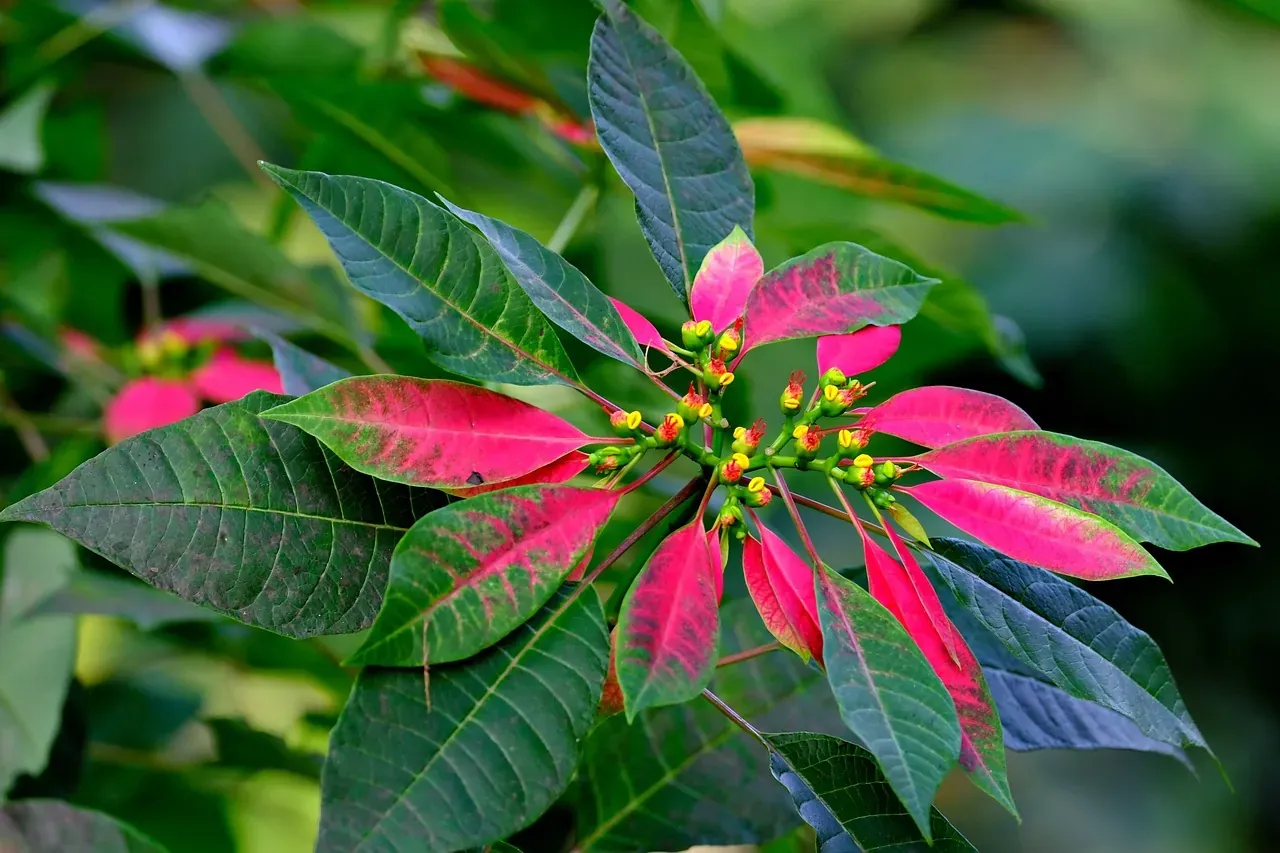 Poinsettia with green leaves and pink-tinged bracts around clusters of small yellow flowers
Photo: ignartonosbg / Pixabay
The schedule, according to extension sources:
- Start date: about October 1 (CSU, Penn State, USU); the first week of October for 8 to 10 weeks (Clemson); or about the end of September (Illinois).
- Darkness: at least 14 hours of uninterrupted darkness each night (CSU, Clemson, Penn State, USU). Illinois uses 5 pm to 8 am. NC State gives a stricter 16 hours of darkness and 8 hours of bright light.
- Daytime: Clemson says the plant also needs six to eight hours of bright sunlight daily.
- Temperature: 60 to 70°F during the dark period (CSU, Penn State). Illinois says night temperatures above 70 to 75°F may delay or prevent flowering.
Use a closet or cover the plant with a box. CSU and Penn State warn that stray light of any kind, such as streetlights or indoor lamps, can delay or stop reflowering. Keep going until color shows in the bracts, usually around Thanksgiving (CSU, Penn State) or early to mid-December (Illinois).
If you also grow a holiday cactus that refuses to flower, see why a Christmas cactus is not blooming.
Can poinsettias grow outdoors? Only in the warmest ZIPs#
NC State Extension says poinsettia is winter hardy in USDA hardiness zones 9 to 11. A University of Vermont Extension article gives the same range. UF/IFAS calls poinsettias tropical plants that must be protected from frosts and freezing weather, and Penn State says they cannot tolerate frost.
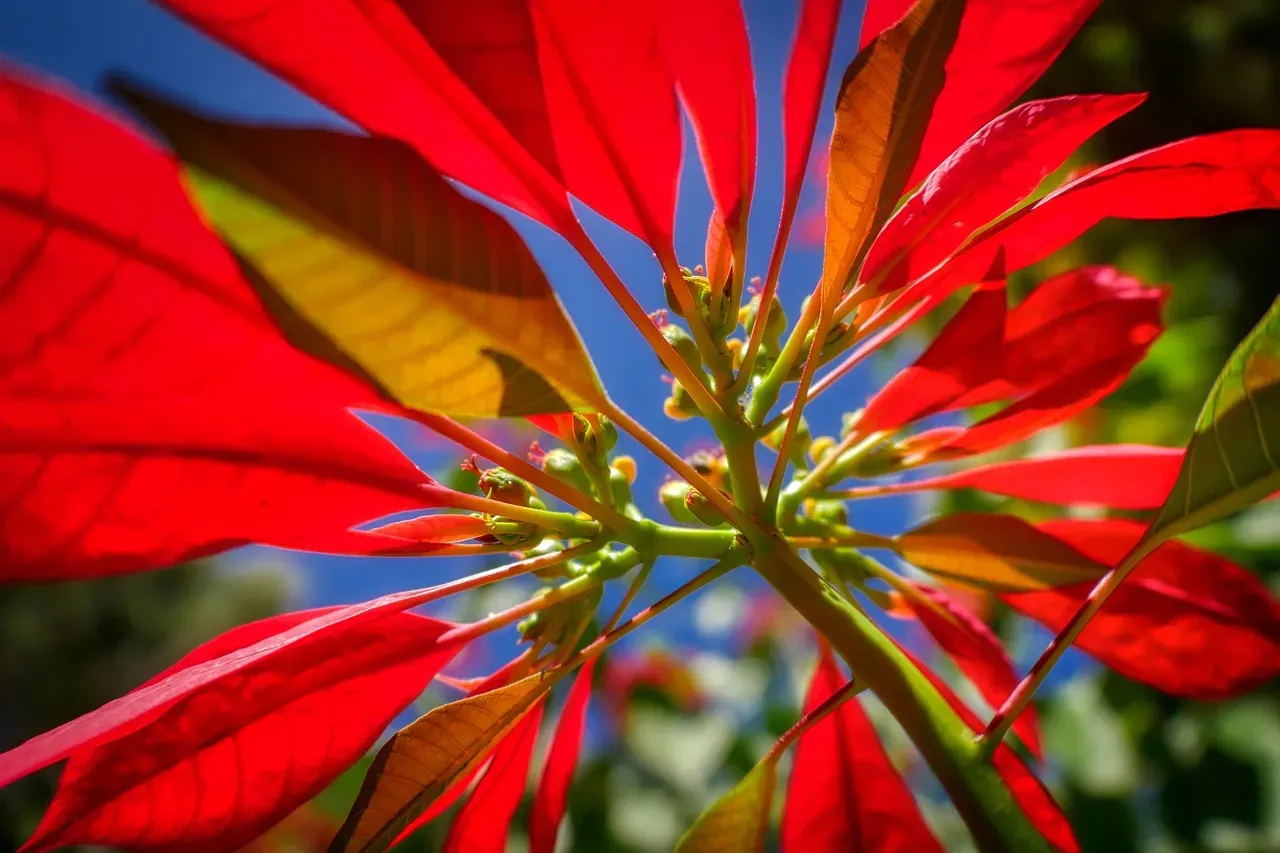 Looking up through red poinsettia bracts and flower clusters toward a blue sky
Photo: fietzfotos / Pixabay
A zone describes average winter lows, not frost dates. Even inside zones 9 to 11, most ZIPs still have a frost date. PlantAlong analysis of NOAA 1991-2020 climate normals shows how few ZIPs in these zones sit near a weather station where freezes are too rare for NOAA to date:
| Zone | ZIPs | Rare-frost ZIPs | Median last frost, typical range |
|---|---|---|---|
| 9a | 2,199 | 0 | Feb 16 to Mar 18 |
| 9b | 2,085 | 4 | Jan 12 to Feb 26 |
| 10a | 1,234 | 106 | Jan 2 to Jan 30 |
| 10b | 752 | 478 | Jan 4 to Jan 24 |
| 11a | 205 | 195 | Jan 16 to Jan 22 |
| 11b | 16 | 16 | No dated stations |
The typical range is the 10th to 90th percentile across ZIPs; see our methodology. Across zones 9a to 11b, only 799 of 6,491 ZIPs are rare-frost. Rare-frost is not frost-free: it means a freeze happens too seldom to date, not never.
So keeping a poinsettia alive outdoors year-round is realistic only in the warmest parts of zones 9 to 11, and even there a cold night can damage it. Check your zone page, such as zone 10a, and your ZIP's frost dates before planting one in the ground.
FAQ#
How long will a potted poinsettia last?#
Illinois Extension says a well-cared-for poinsettia stays attractive for 6 to 8 weeks in the home. UF/IFAS says color can last until March, and Penn State and USU say bracts can last until about March or April.
Can poinsettias be grown outdoors?#
Year-round, only where winters are mild: NC State lists hardiness zones 9 to 11, and even many ZIPs in those zones get frost. Anywhere else, the plant can summer outdoors once frost danger has passed and nights stay above 50°F, then come back inside.
Are poinsettias poisonous to pets?#
The ASPCA lists poinsettia as toxic to dogs, cats and horses because of its irritant sap. It says the plant irritates the mouth and stomach, sometimes causing vomiting, but is "generally over-rated in toxicity." Poison Control (poison.org) says it is not fatal if eaten. Keep it out of reach, and call your vet or ASPCA Poison Control at (888) 426-4435 (a fee may apply) if your pet seems ill.
Why are my poinsettia leaves falling off?#
Clemson lists temperatures below 50°F, poor light and poor nutrition, and Purdue adds drafts and wilting. CSU says yellow lower leaves that drop may mean root rot from wet soil. Our poinsettia watering guide covers the water-related causes.
Sources#
- Selecting and Planting Poinsettias, Fact Sheet 7.412 (Colorado State University Extension)
- 1325: Poinsettia (CSU Extension PlantTalk Colorado)
- Ask an Expert: Poinsettia Care During the Holidays and Beyond (Utah State University Extension)
- Poinsettia (UF/IFAS Gardening Solutions)
- Poinsettias (Penn State Extension Master Gardeners, Luzerne County)
- Holiday Plants and Pets (Penn State Extension)
- Poinsettia, HGIC 1561 (Clemson Cooperative Extension Home & Garden Information Center)
- Euphorbia pulcherrima (NC State Extension Gardener Plant Toolbox)
- Caring for Poinsettias (Purdue Extension)
- Caring for Poinsettias (University of Illinois Extension)
- How do I care for a poinsettia? (Iowa State University Extension)
- The Perennial Poinsettia (University of Vermont Extension)
- Poinsettia (ASPCA Animal Poison Control)
- Are poinsettias poisonous? (Poison Control, National Capital Poison Center)
Featured photo: ErikaWittlieb / Pixabay.




Check your inbox
We sent a confirmation link to . Click it and your planting calendar PDF is on its way. Nothing there in a few minutes? Check your spam or promotions folder.



No comments yet. Tried this in your garden, or found a date that worked better? Start the thread.
Leave a comment