 PlantAlong

In short
- Norfolk Island pine is not a true pine; it belongs to the conifer family Araucariaceae (Illinois Extension).
- Decorate with lightweight ornaments and cool LED lights, because heavy ornaments can permanently bend branches and hot lights burn needles (University of Missouri).
- Give it bright light near an east, west or south window and rotate it weekly (Iowa State Extension).
- It prefers humidity around 50 percent, so use a humidifier or pebble tray in winter (Nevada Extension).
- Extension sources list it as hardy outdoors in zones 10 to 11, and UF/IFAS says it cannot tolerate temperatures below 35°F.
- In PlantAlong's analysis of NOAA normals, 106 of 1,234 zone 10a ZIPs and 478 of 752 zone 10b ZIPs are rare-frost, which is not the same as frost-free.
On this page
- What a Norfolk Island pine is (not a true pine)
- Decorating a Norfolk pine Christmas tree: weight, lights, heat
- Light and placement
- Watering and humidity
- After the holidays: year-round houseplant care
- Can it live outdoors? Only where frost is rare
- Common problems: drooping, brown needles, leaning
- FAQ
- How do you decorate a Norfolk pine for Christmas?
- How long does a Norfolk pine live indoors?
- Why are the branches drooping?
- Can I plant my Norfolk pine outside?
- Sources
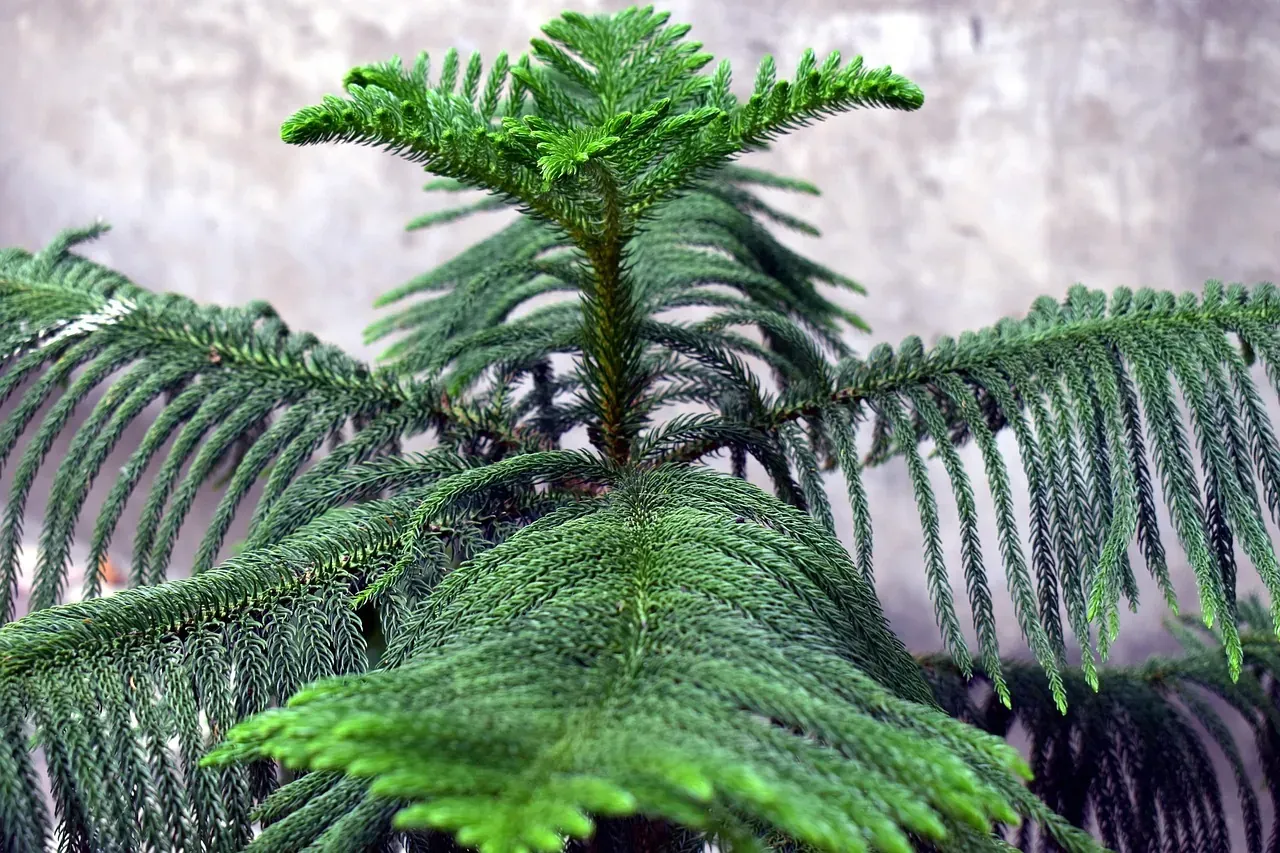
A Norfolk pine Christmas tree is a living Norfolk Island pine, a tropical conifer you can decorate for the holidays and then keep as a houseplant for years. Treat it gently in December: lightweight ornaments, cool LED lights, bright light, steady watering and extra humidity. Outdoors, it only survives where frost is rare, which in the US means a small slice of zones 10 through 13.
What a Norfolk Island pine is (not a true pine)#
Despite the name, the Norfolk Island pine (Araucaria heterophylla) is not a pine. It belongs to the ancient conifer family Araucariaceae, which today grows wild only in the Southern Hemisphere, according to Illinois Extension.
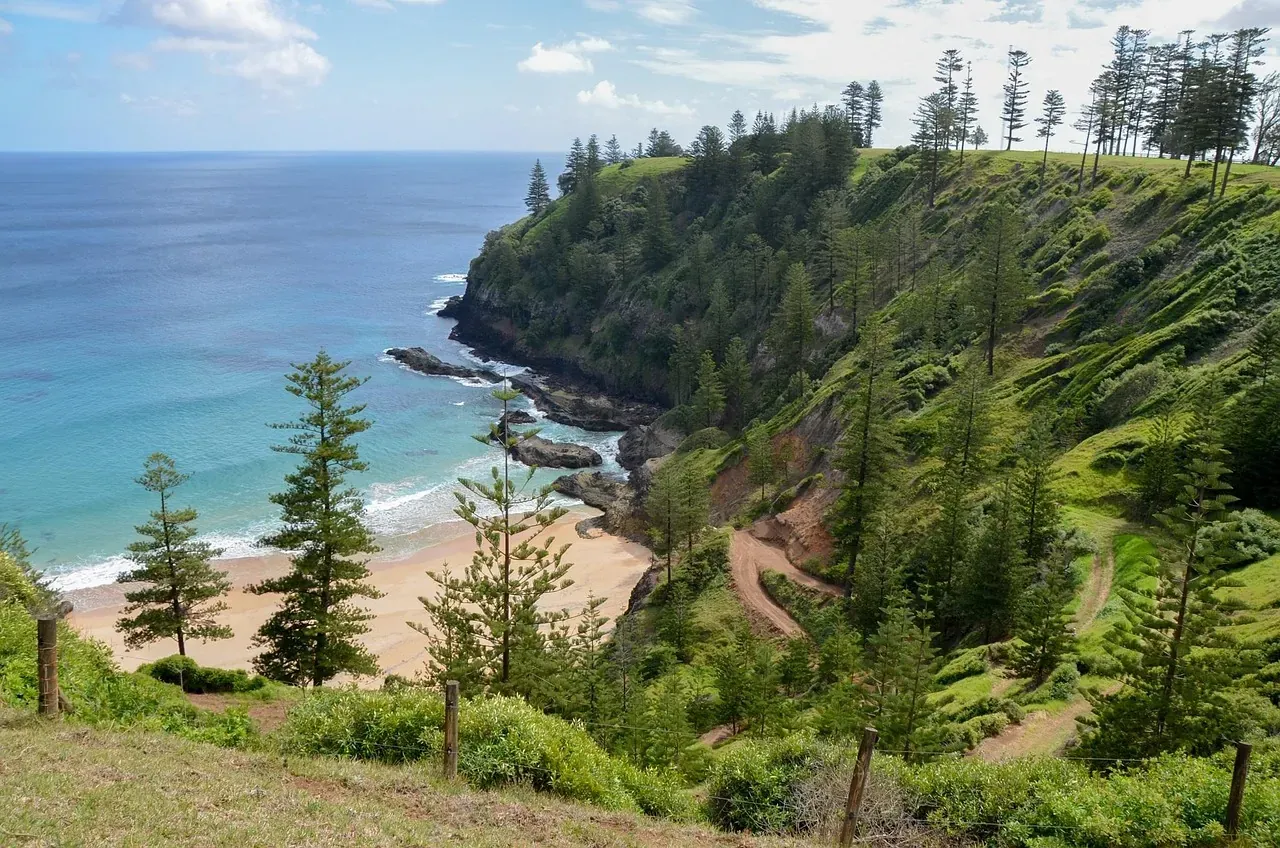 Tall, narrow Norfolk Island pines on a green coastal hillside above a sandy cove
Photo: pen_ash / Pixabay
It is native to Norfolk Island in the South Pacific, where trees can reach about 200 feet tall with trunks up to 10 feet across. As a houseplant it grows slowly, about 3 to 6 inches a year, and typically reaches 6 to 8 feet, Illinois Extension says.
UF/IFAS notes that a potted plant may reach only 5 to 8 feet after about a decade, so a tabletop tree stays manageable for years.
Decorating a Norfolk pine Christmas tree: weight, lights, heat#
The branches of a Norfolk Island pine are soft, so a Norfolk pine Christmas tree needs a lighter touch than a cut fir. University of Nevada, Reno Extension recommends lightweight ornaments and lights, and LED lights so the foliage does not burn.
The University of Missouri gives the reasons in more detail:
- Heat: lights that get hot can burn the tender needles and cause permanent damage. LEDs stay cool and are light in weight.
- Weight: heavy ornaments bend branches downward. If they hang there too long, the branches lose the ability to spring back, and the tree's symmetry is ruined.
- Timing: Nevada Extension advises removing decorations soon after the holidays to prevent damage to needles and branches.
In practice: small, light ornaments, a strand of LED mini lights, ribbon instead of heavy garland, and everything off in early January.
Shop the essentials
What you'll need
Supplies for the steps in this guide.
 FeedHouseplant fertilizerLiquid food for indoor flowering plants. Follow the label rate.: check price on Amazon (opens in a new tab)
 IndoorsPebble humidity trayA tray of pebbles and water that raises humidity around a pot.: check price on Amazon (opens in a new tab)
 To plantPots with drainage holesPlanters with drainage holes for herbs, bulbs and houseplants.: check price on Amazon (opens in a new tab)
 Before wateringSoil moisture meterA probe that shows whether a pot is wet or dry.: check price on Amazon (opens in a new tab)
As an Amazon Associate I earn from qualifying purchases. Photos show the type of product, not a specific listing. How we choose
Light and placement#
UF/IFAS says that when a Norfolk pine Christmas tree is not thriving, it is most likely short on light or humidity. Iowa State University Extension recommends a brightly lit spot near an east, west or south window. The University of Missouri places it in the "high light" group of houseplants: several hours of direct sun a day is desirable, though bright, indirect light usually gives satisfactory growth.
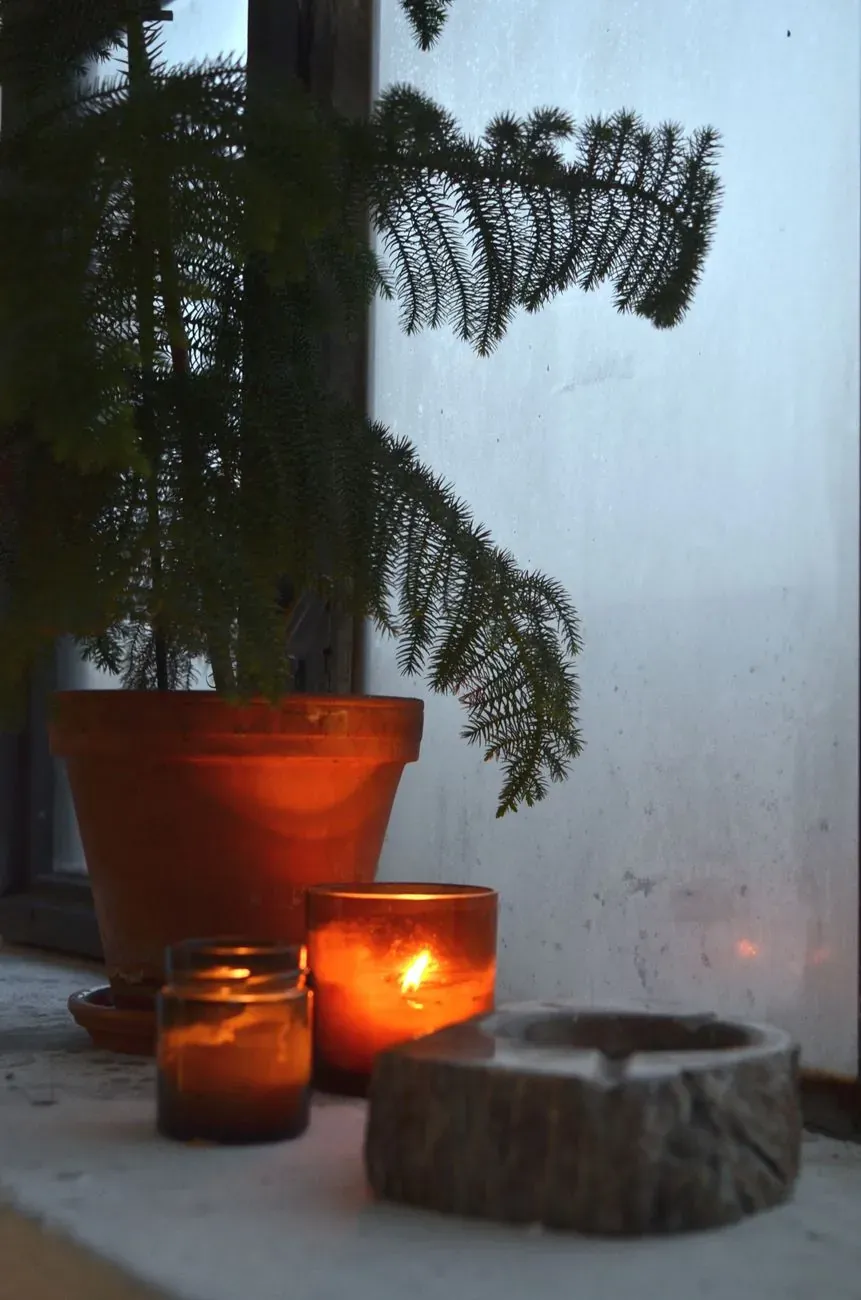 Potted Norfolk Island pine in a terracotta pot on a winter windowsill beside lit candles
Photo: Skylar Kang / Pexels
Your plant probably came from a sunny greenhouse. Illinois Extension notes it can tolerate lower light only after it has been acclimated; moved straight into a dim room, entire branches may yellow and die. If your brightest spot is not very bright, step the plant down gradually.
Turn the pot regularly. Iowa State suggests rotating it weekly so the plant does not grow toward the window and become lopsided.
Temperature advice varies by source. Iowa State and Nevada Extension say 55 to 70°F suits it, with winter nights no lower than 50°F (Nevada). NC State prefers a cool 55 to 65°F room, while an Illinois Extension educator puts the ideal at 65 to 75°F. Nevada Extension also advises avoiding extreme temperature swings.
Watering and humidity#
Water a Norfolk pine Christmas tree thoroughly when the soil surface feels dry, then pour off the water that drains into the saucer (Iowa State). Nevada Extension uses the top inch of soil as the test and says the soil should be moist but never wet.
Sources differ on how far the soil should dry. The University of Missouri says to keep the mix continually moist but not wet, while one Illinois Extension post says to let it dry out completely between waterings. What they agree on is the danger of soggy roots: Missouri warns that too much water can kill the plant through root rot, and Illinois Extension says wet feet can cost it branches. Use a pot with drainage holes.
In winter, humidity matters as much as water for a Norfolk pine Christmas tree. Nevada Extension says Norfolk Island pines prefer humidity at or around 50 percent, which most heated homes do not reach. Raise it with a humidifier or a pebble tray: fill a saucer with rocks, add water until it sits just below the tops of the rocks, and set the pot on top so it is not sitting in water (Illinois Extension).
After the holidays: year-round houseplant care#
With good care, the same plant can serve as your Norfolk pine Christmas tree for many Decembers. Illinois Extension says the trees can last for years as houseplants.
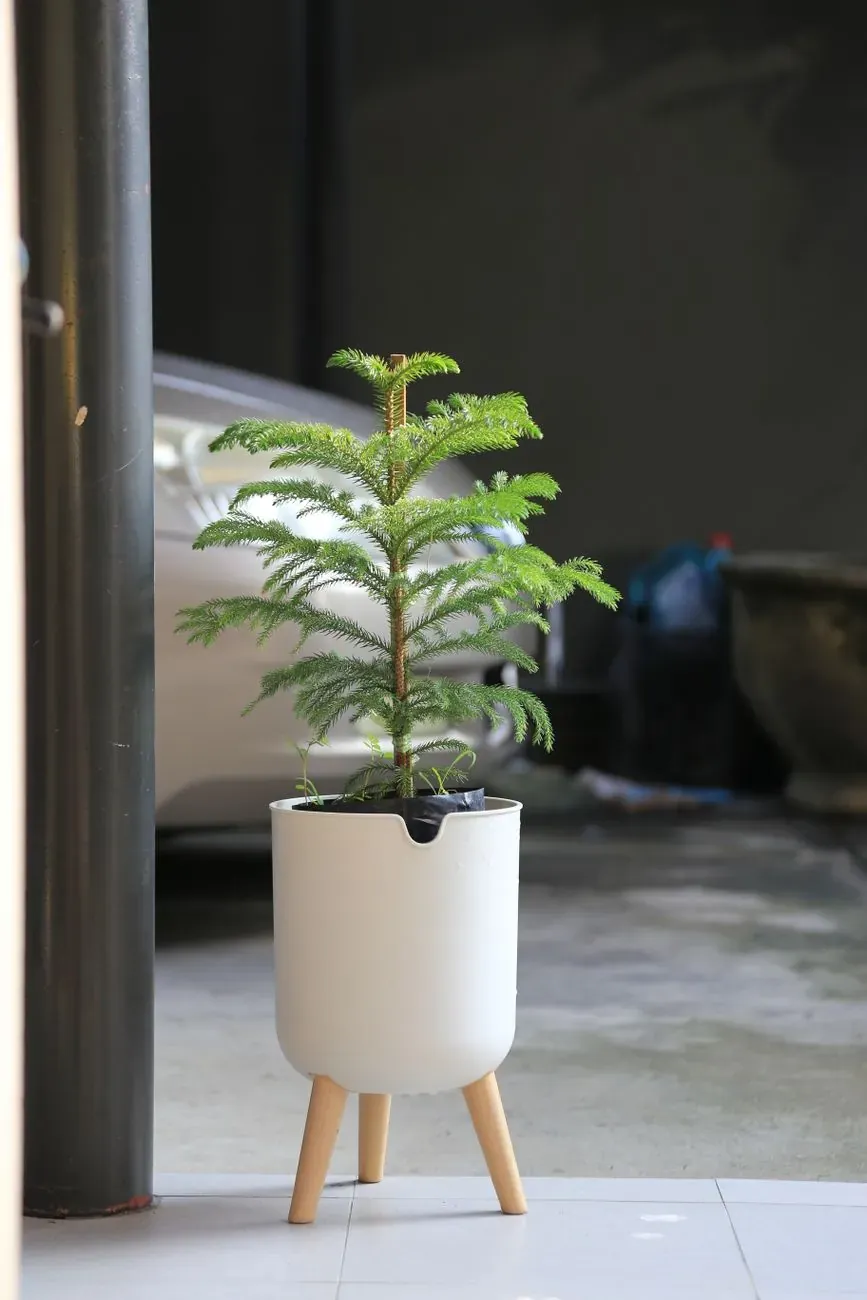 Young Norfolk Island pine growing in a white planter on wooden legs
Photo: wutthichai charoenburi / Pexels
After you take the decorations down, keep the same bright spot and weekly turn. Feed only while it is actively growing:
- Illinois Extension: a diluted liquid houseplant fertilizer every two weeks, typically March to September.
- Iowa State: a dilute fertilizer solution every 2 to 4 weeks from spring to early fall.
- University of Missouri: in winter, feeding about once every four weeks is usually enough.
Repotting is rarely urgent. The University of Missouri says moving up to a larger container is usually not needed for three or four years.
Can it live outdoors? Only where frost is rare#
Planting a Norfolk pine Christmas tree in the yard is only realistic in the warmest parts of the country. Extension sources give a narrow range: UF/IFAS Extension in Santa Rosa County lists USDA hardiness zones 10 to 11 outdoors, and Illinois Extension says it is considered hardy in zones 10 and 11, which limits it to southern Florida and specific locations in southern California. NC State Extension's plant database is a little more generous and lists 9a through 11b.
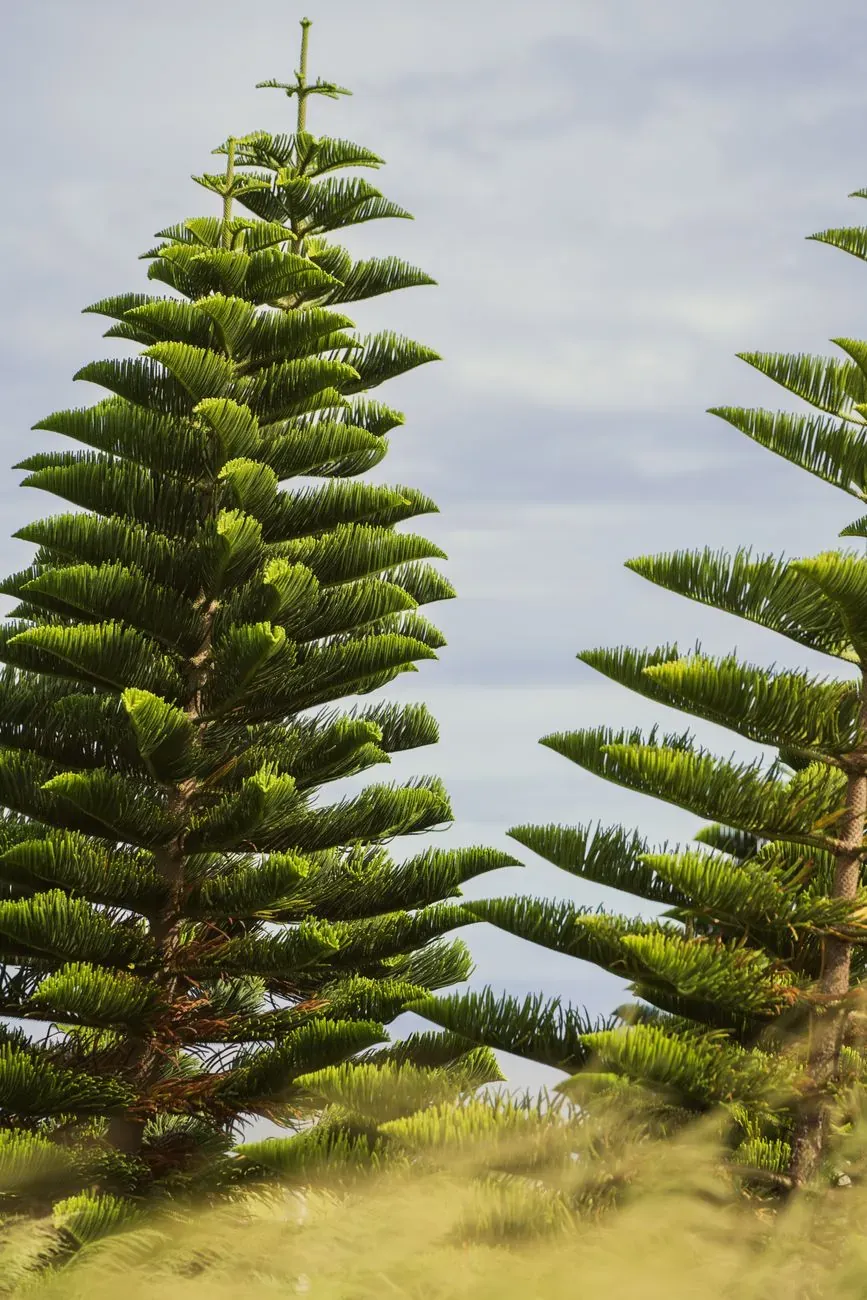 Two tall Norfolk Island pines growing outdoors with symmetrical tiered branches under a cloudy sky
Photo: Tim & Martin Klement / Pexels
The numbers behind that are tight. UF/IFAS Gardening Solutions says the tree cannot tolerate temperatures below 35°F and puts its approximate northern range at Orlando.
Hardiness zones only describe the average coldest winter night, so we checked how often frost happens inside each warm zone. PlantAlong matches every ZIP code to its nearest NOAA weather station. At some stations, a 32°F night happens in so few years that NOAA marks frost as too rare to date. We call those ZIPs "rare-frost."
| 2023 hardiness zone | ZIP codes | Rare-frost ZIPs | Share |
|---|---|---|---|
| 9b | 2,085 | 4 | 0.2% |
| 10a | 1,234 | 106 | 8.6% |
| 10b | 752 | 478 | 63.6% |
| 11a | 205 | 195 | 95.1% |
| 11b | 16 | 16 | 100% |
| 12a to 13b | 295 | 293 | 99.3% |
Source: PlantAlong analysis of NOAA 1991-2020 climate normals.
What this shows:
- Zone 10a is mostly not rare-frost. Only 106 of 1,234 ZIPs qualify, and 99 of those are in California. Most other zone 10a ZIPs match stations where frost is common enough for NOAA to publish dates, and for most of them the median last frost falls between Jan 2 and Jan 30.
- Zone 10b is mixed. 478 of 752 ZIPs are rare-frost (378 in California, 99 in Florida, 1 in Hawaii). See zone 10b for the frost dates in the rest.
- Zones 11 to 13 are almost all rare-frost. Zone 11 is mostly Florida ZIPs; the zone 12 and 13 ZIPs are in Hawaii and Puerto Rico.
Rare-frost is not frost-free. It means a freezing night is uncommon at the nearest station, not impossible, and that station may be miles away or at a different elevation. Since UF/IFAS says the tree cannot tolerate temperatures below 35°F, even a night that stays above freezing can be too cold.
Size is the other catch: UF/IFAS says Florida trees typically reach 60 to 80 feet and do not hold up well in hurricanes. Look up your own ZIP in the PlantAlong planting calendar to see whether your nearest station is dated or rare-frost before you plant.
Common problems: drooping, brown needles, leaning#
Most trouble with a Norfolk pine Christmas tree comes back to light, water or dry air.
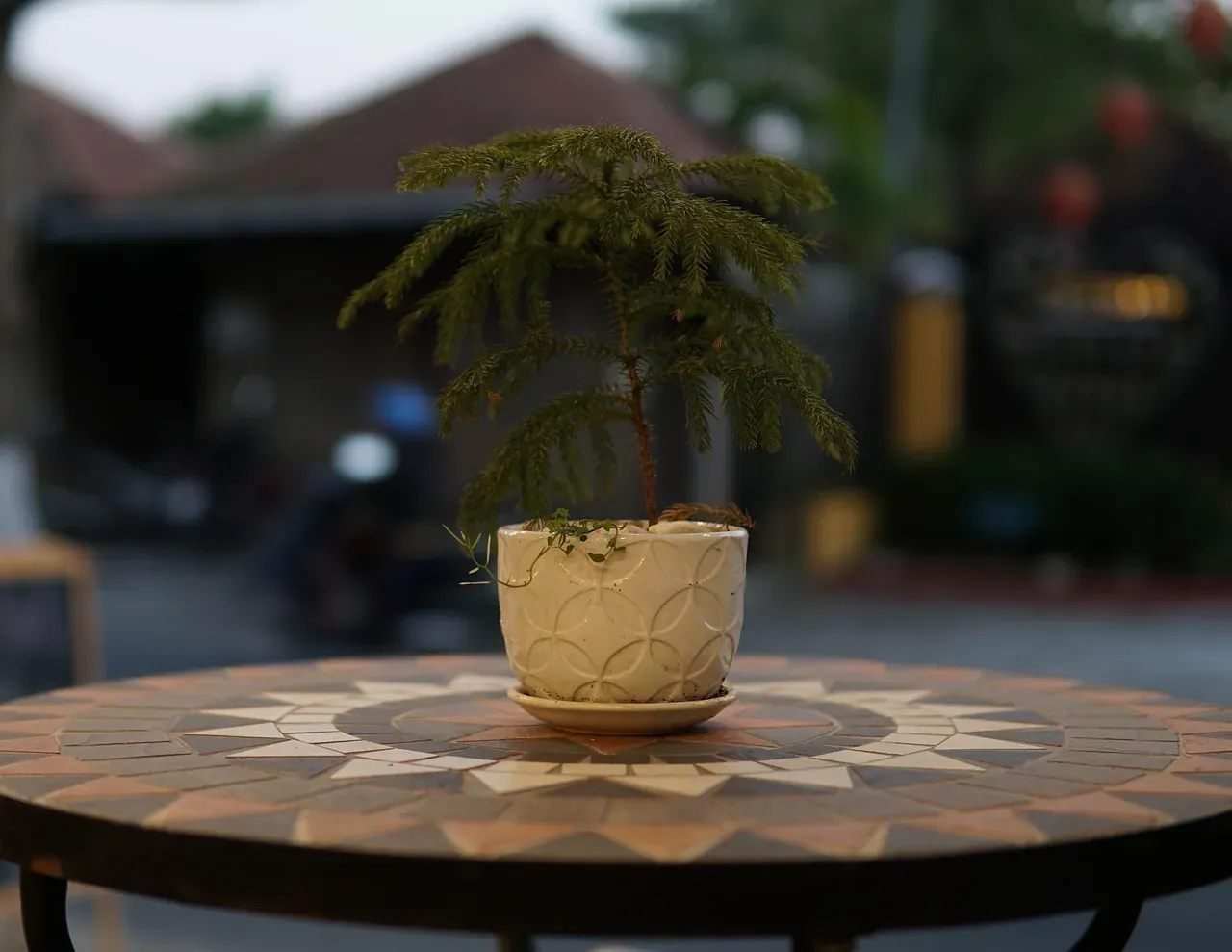 Small potted Norfolk Island pine on a mosaic table with one branch drooping to the side
Photo: 8088465 / Pixabay
Drooping branch tips. In poor light, the University of Missouri says branch tips weaken and droop, and Illinois Extension adds that low light makes branches long and droopy while growth slows. Move the plant to brighter light, gradually.
Drooping lower branches. If the whole lower tier sags and loses its horizontal shape, the plant is likely too dry. Missouri notes this wilting droop shows up lower on the plant than the tip droop caused by poor light.
Brown needles and lost lower branches. Iowa State lists low humidity, insufficient light and excessively dry soil as causes of brown branch tips and lower branch loss. UF/IFAS Extension in Santa Rosa County adds overwatering and dry indoor air as reasons potted trees drop lower foliage. Missouri warns that a plant left dry for a long time will lose lower branches entirely.
Needle drop right after you buy it. Missouri says this is normal while the plant adjusts to lower indoor light.
Leaning. A plant that always faces one window grows toward it. Rotate it weekly. UF/IFAS also notes that the species sometimes develops a natural, graceful lean.
FAQ#
How do you decorate a Norfolk pine for Christmas?#
Use lightweight ornaments and cool LED lights, spread out so no branch carries much weight. Heavy ornaments bend the soft branches and hot lights burn needles (University of Missouri). Remove everything soon after the holidays.
How long does a Norfolk pine live indoors?#
Extension sources say a well-kept plant lasts for years, but we found none that gives a typical indoor lifespan. Light is the usual limit: NC State notes indoor plants tolerate very low light for 2 to 3 years before dropping leaves and lower branches.
Why are the branches drooping?#
On a Norfolk pine Christmas tree, drooping at the branch tips usually means too little light. Drooping of the lower branches usually means the soil got too dry. Both come from University of Missouri guidance.
Can I plant my Norfolk pine outside?#
A Norfolk pine Christmas tree can go in the ground only in about zones 10 to 11 (NC State lists 9a to 11b), on a site that stays above 35°F. In PlantAlong's analysis, only 106 of 1,234 zone 10a ZIP codes are rare-frost, compared with 478 of 752 in zone 10b. Plan for a 60 to 80 foot tree.
Sources#
- Grow a living Christmas tree with Norfolk Island Pine (University of Illinois Extension)
- Norfolk Island pine, The Garden Scoop (University of Illinois Extension)
- How do I care for a Norfolk Island Pine? (Iowa State University Extension and Outreach)
- Norfolk Island pine: a living Christmas tree (University of Nevada, Reno Extension)
- A Holiday Tree from the South Pacific (University of Missouri, Missouri Environment and Garden)
- Araucaria heterophylla (NC State Extension Gardener Plant Toolbox)
- Norfolk Island Pine (UF/IFAS Gardening Solutions)
- Norfolk Island Pine fact sheet (UF/IFAS Extension Santa Rosa County)
- Methodology: frost dates and rare-frost stations (PlantAlong analysis of NOAA 1991-2020 climate normals)
Featured photo: SandeepHanda / Pixabay.




Check your inbox
We sent a confirmation link to . Click it and your planting calendar PDF is on its way. Nothing there in a few minutes? Check your spam or promotions folder.



No comments yet. Tried this in your garden, or found a date that worked better? Start the thread.
Leave a comment