 PlantAlong

In short
- Colorado State transplants tomatoes typically 2+ weeks after the average last frost, once days stay above 60°F and soil reaches at least 50°F at 4 inches.
- In PlantAlong's analysis of NOAA 1991-2020 normals, median last frost dates in zone 6a span Apr 16 to May 10 across ZIP codes, so use your own ZIP's date.
- Clemson and the University of Maryland say to bury transplants so only two or three sets of true leaves show.
- Spacing runs from 15 to 24 inches for staked plants (Illinois) to 2 to 4 feet in rows at least 3 feet apart for staked or caged plants (Texas A&M).
- Illinois Extension side-dresses after the first fruits reach golf-ball size, then 3 and 6 weeks later.
- Clemson lists 52 to 90 days to first harvest, and UMD recommends picking as soon as fruit color begins to change.
On this page
- Quick answer: how to grow tomatoes in 6 steps
- Choose a type: determinate, indeterminate, cherry, paste
- When to plant tomatoes: frost date and soil temperature
- Seed or transplant?
- How to plant tomatoes: depth and spacing
- Support: stakes, cages and trellis
- Watering and mulch
- Feeding tomatoes: soil test first
- Pruning and suckers
- Common problems: blossom end rot, yellow leaves, hornworms, early blight
- When and how to harvest tomatoes
- How to grow tomatoes in raised beds and containers
- FAQ
- How long does it take to grow tomatoes?
- Do tomatoes need full sun?
- How often should tomatoes be watered?
- Can you grow tomatoes in pots?
- Sources
Here is how to grow tomatoes in one sentence: set out stocky transplants about two weeks after your average last frost, once the soil has warmed, give them full sun, deep and even watering, a sturdy support and a light side-dressing once fruit sets, then pick as soon as the color turns. Everything below comes from university extension guides, and every date is tied to your own frost date rather than a guess.
In this guide: the 6-step tomato year, choosing a type, when to plant by frost date, seed or transplant, depth and spacing (table), support, watering and mulch, feeding, pruning, common problems, harvest, and raised beds and containers.
Quick answer: how to grow tomatoes in 6 steps#
- Pick a type. Determinate plants stay compact; indeterminate vines keep growing until frost (Clemson Extension).
- Start seeds or buy plants. Clemson says to sow indoors six to eight weeks before the last frost date. Texas A&M notes most families need only a few plants, so buying transplants is fine.
- Wait for warmth. Colorado State plants tomatoes typically 2+ weeks after the average last spring frost, when daytime temperatures stay above 60°F.
- Plant deep. Bury the stem so only two or three sets of true leaves show (Clemson, University of Maryland).
- Support, water and mulch. Stake, cage or trellis soon after planting, water deeply, and mulch to hold moisture.
- Feed lightly and harvest early. Side-dress after the first fruits form, and pick when fruit color begins to change.
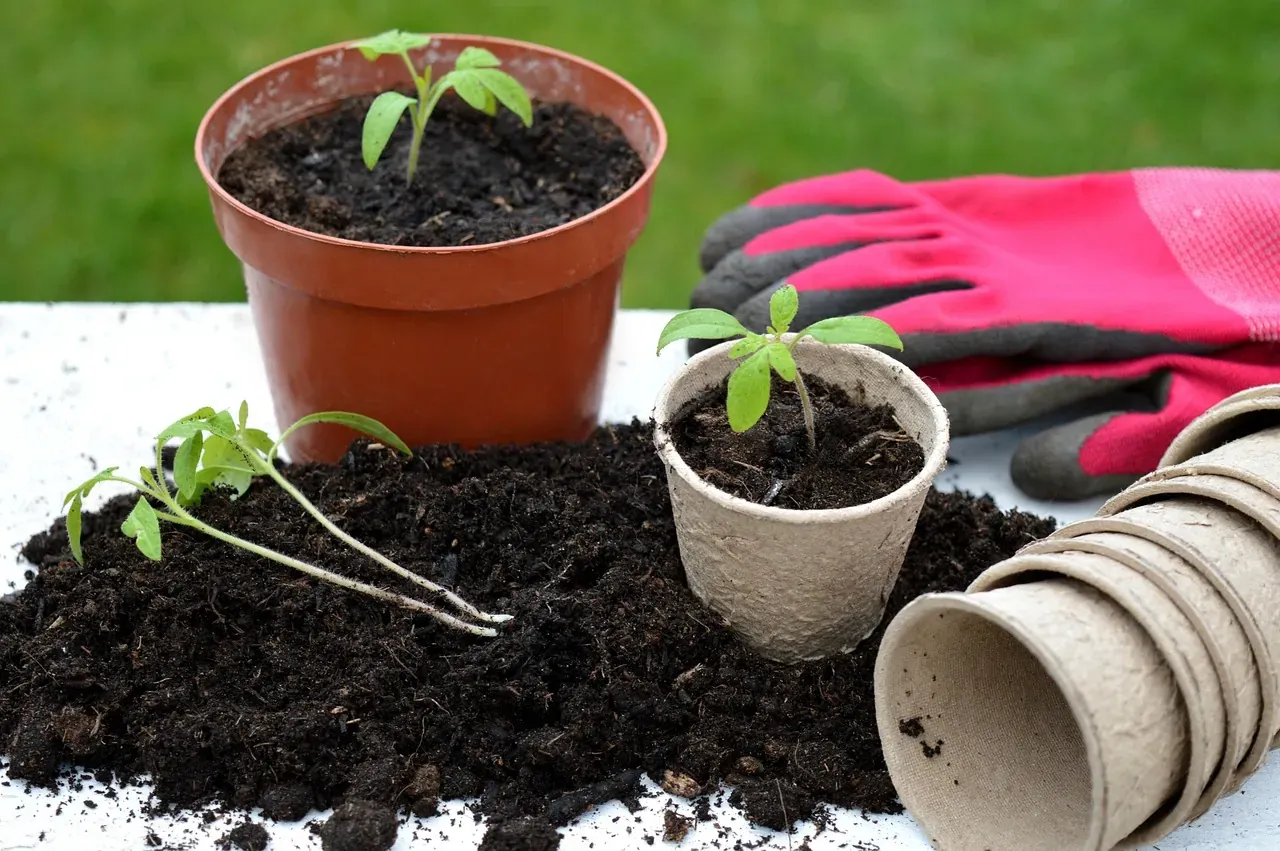 Young tomato seedlings in peat and plastic pots beside potting soil and garden gloves
Photo: neelam279 / Pixabay
That is how to grow tomatoes in brief; each step gets its own section below. For tomato data by zone, see the tomato crop page.
Choose a type: determinate, indeterminate, cherry, paste#
Learning how to grow tomatoes starts with growth habit. Clemson Extension describes determinate plants as growing to a certain size, setting fruit, and then declining. Indeterminate plants keep growing and producing, and fruit production may continue until the first frost. Most heirloom cultivars are indeterminate.
Illinois Extension says most modern determinates grow 3 to 4 feet tall, while indeterminates easily reach at least 6 feet.
Fruit types, as described by the University of Maryland Extension (UMD) and Clemson:
- Cherry and grape: small fruit for salads. UMD says one standard cherry tomato plant is usually sufficient for a family.
- Beefsteak: large slicers; UMD notes individual fruits often weigh more than one pound but are prone to cracking and usually late to ripen.
- Paste (Roma or plum): meaty, few seeds, preferred for drying, canning and sauces.
- Heirloom: older open-pollinated cultivars. Clemson notes most have little to no disease resistance.
Check the label for disease resistance: Clemson explains that VFN after a name means resistance to Verticillium wilt, Fusarium wilt and root-knot nematodes.
When to plant tomatoes: frost date and soil temperature#
Timing is the part of how to grow tomatoes that varies most by place. Tomatoes are very tender. Colorado State University Extension (CSU) says very tender vegetables need daytime temperatures above 60°F, and that a week of daytime temperatures below 55°F may stunt the crop. Its planting guide lists 50°F as the minimum soil temperature for tomatoes, measured at 8 a.m., 4 inches deep.
Extension sources tie the transplant date to the average last frost in slightly different ways:
- Colorado State: typically 2+ weeks after the average last spring frost date.
- Utah State: about 2 weeks after the average last frost.
- Oregon State (central Oregon): on the frost-free date.
- Texas A&M: 1 to 8 weeks after the frost-free date, and only after all danger of frost has passed.
Planting early rarely pays. Illinois Extension warns that a plant set out too early can stall, taking up to two weeks to resume normal growth after cold nights.
Your zone alone will not give you the date. In PlantAlong's analysis of NOAA 1991-2020 climate normals (methodology), median last frost dates across ZIP codes in zone 6a run from Apr 16 to May 10 (10th to 90th percentile). Two weeks after those dates is Apr 30 to May 24, a spread of more than three weeks inside a single zone. In zone 7a the median last frost runs Apr 4 to Apr 28, which puts the 2-week mark at Apr 18 to May 12.
That spread is why knowing how to grow tomatoes where you live starts with your own ZIP code's frost date in the planting calendar.
For a fall crop in warm regions, Texas A&M says to transplant fall tomatoes about 100 days before the first expected frost.
Seed or transplant?#
Both work, and how to grow tomatoes from seed is mostly a matter of timing. Clemson says to sow seed indoors six to eight weeks before the last frost date, use a light soil mix and give plants plenty of light, because low light produces tall, spindly transplants. CSU lists a typical transplant age of 5 to 7 weeks and 6 to 14 days to germination.
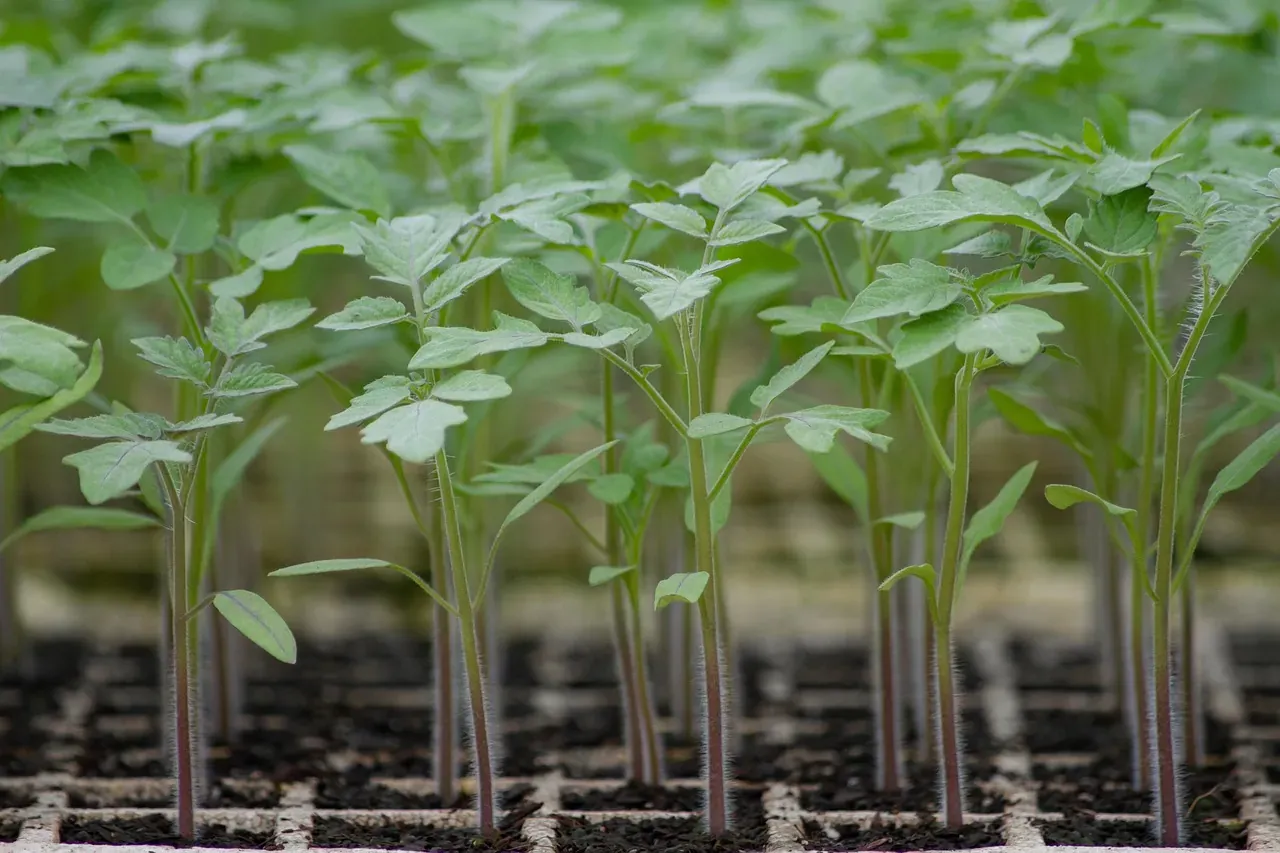 Rows of tomato seedlings growing in a cell tray before transplanting
Photo: Carlos2016 / Pixabay
Clemson says to start hardening off a week before transplanting, with more hours outdoors each day.
Our guide on when to start tomato seeds indoors turns those rules into dates by zone, and how to start seeds indoors covers lights, trays and hardening off step by step.
If you buy plants, choose stocky ones. Clemson and UMD both suggest transplants about 6 to 10 inches tall; Texas A&M says healthy, green plants 6 to 8 inches tall.
Shop the essentials
What you'll need
Supplies for the steps in this guide.
 Start indoorsSeed-starting trays with lidsCell trays with clear domes for sowing seeds indoors.: check price on Amazon (opens in a new tab)
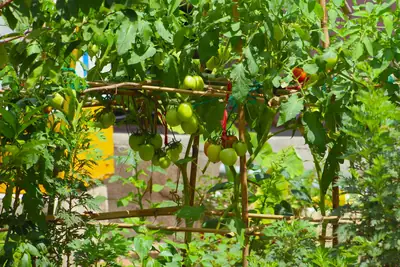 At transplantTomato cagesSturdy supports for tall tomato plants.: check price on Amazon (opens in a new tab)
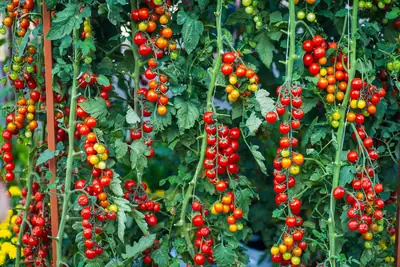 To sowTomato seedsSeed packets from many sellers: compare varieties and days to maturity.: check price on Amazon (opens in a new tab)
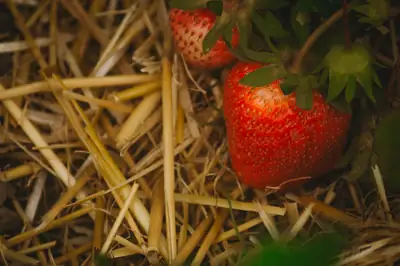 After plantingStraw mulchStraw for covering beds after planting.: check price on Amazon (opens in a new tab)
As an Amazon Associate I earn from qualifying purchases. Photos show the type of product, not a specific listing. How we choose
How to plant tomatoes: depth and spacing#
Depth is the step most guides on how to grow tomatoes skip. Tomatoes can root along a buried stem, so plant them deeper than they grew in the pot. Clemson and UMD both say to set transplants deep enough that only two or three sets of true leaves are exposed. For leggy plants, horizontal planting works: lay the stem on its side in a trench and roots will form along the buried portion.
UMD adds one caution: avoid setting the root ball deeply into cold soil.
Clemson suggests planting on overcast days or in the evening, in a well-drained spot where tomatoes, peppers, eggplant or potatoes have not grown for at least three years.
Spacing depends on how you support the plant. Sources differ, so here they are side by side:
| Setup | Space between plants | Space between rows | Source |
|---|---|---|---|
| Dwarf plants | 12 in | not stated | Illinois Extension |
| Staked | 15 to 24 in | not stated | Illinois Extension |
| Trellised | 24 to 36 in | not stated | Illinois Extension |
| Trellised, in a bed | 24 in each way | 24 in | Colorado State |
| Staked or caged | 2 to 4 ft | at least 3 ft | Texas A&M |
| Caged | cages at least 4 ft apart | not stated | Univ. of Maryland |
| Unsupported (sprawling) | 2 to 4 ft | 4 to 5 ft | Texas A&M |
| Vigorous indeterminate | up to 4 ft | 5 to 6 ft | Illinois Extension |
Clemson's general rule sits in the middle: plants 24 inches apart in rows 3 feet apart.
Support: stakes, cages and trellis#
Any plan for how to grow tomatoes should include support. Clemson says supported plants are easier to pick and get better airflow, an important disease management strategy. UMD adds that staking or caging uses less space and reduces fruit rots.
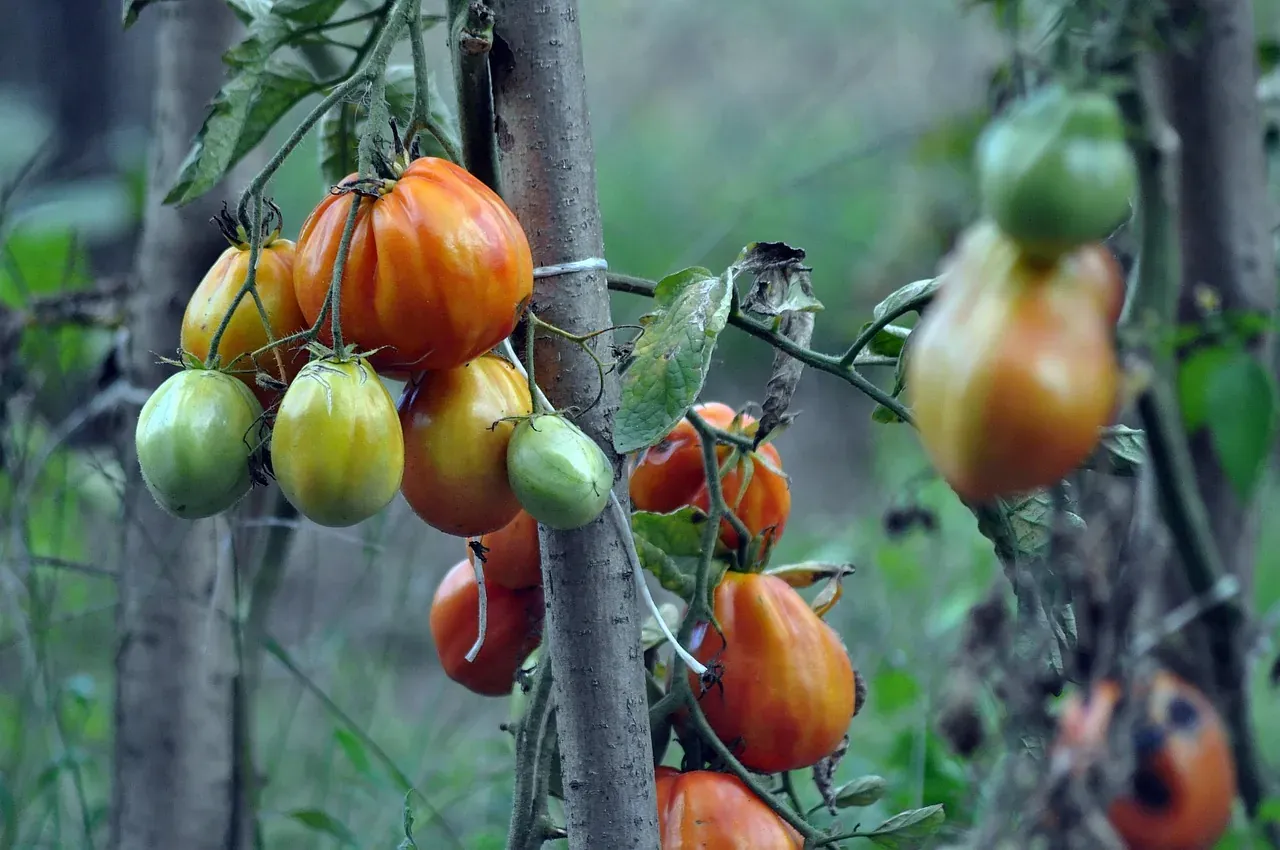 Ripening tomatoes hanging from plants tied to wooden stakes in a garden
Photo: artellliii72 / Pixabay
Stakes. Clemson uses wooden stakes 6 feet tall and 1½ to 2 inches wide, driven 1 foot into the soil about 4 to 6 inches from the plant soon after transplanting. Tie stems with twine or cloth strips every 10 inches of height. UMD allows stakes 6 to 8 feet long.
Cages. UMD suggests 5-foot-wide fencing with 6-inch mesh, so you can reach in to harvest, and staking cages down so summer storms do not tip them. Texas A&M makes cages from concrete reinforcement wire 5 feet tall and 6 feet wide, and says caged tomatoes do not need pruning. Illinois warns that the short, narrow cages sold at many garden centers are useful only for the smallest dwarf types.
Florida weave. Clemson's trellis method drives 6-foot stakes between each plant or every other plant, then runs twine along both sides of the row, adding a new row of twine about every 10 inches of growth.
Arizona Extension notes fruit production is roughly the same staked or sprawling, though fruit on the ground loses more to rot and insects.
Watering and mulch#
If one habit defines how to grow tomatoes well, it is steady moisture. UMD says to keep the root zone moist by watering deeply and regularly during dry periods: at least once weekly, and more often in dry spells and once blossoms develop.
UGA Extension recommends wetting the soil to a depth of six to eight inches. In hot summers that may mean watering two to three times a week; in heavier clay soils, once a week may be enough, especially with rain. Water at the base of the plant and keep leaves dry to cut disease.
Mulch holds that moisture. Texas A&M recommends a 2- to 3-inch layer of organic material such as compost, leaves or hay around growing plants. Illinois Extension adds a timing tip: delay organic mulch until the soil has warmed completely in early summer, so cool soil does not slow early growth.
Feeding tomatoes: soil test first#
Feeding is where how to grow tomatoes gets overcomplicated. Clemson's advice is to start with a soil test and maintain a soil pH between 6.0 and 6.5. Lime is best worked in at least 3 months before planting.
Before planting, Texas A&M suggests 2 to 3 pounds of a fertilizer such as 10-10-10 per 100 square feet, mixed into the top 3 to 4 inches of soil. Illinois recommends a starter fertilizer at transplanting.
Then side-dress, but not too early; this is where many first tries at how to grow tomatoes go wrong. Illinois says to side-dress after the first tomatoes reach golf-ball size and repeat 3 and 6 weeks later. UMD says to side-dress after the first fruits appear. Clemson times its calcium nitrate side-dressing three to four weeks after planting.
Too much nitrogen early on gives leaves instead of fruit. UMD warns that excess nitrogen causes lush leaf growth at the expense of fruit. It also says not to add Epsom salts unless a soil test shows a magnesium deficiency.
Pruning and suckers#
Suckers are the shoots that form where a leaf meets the main stem. UMD says they will eventually flower and fruit, but moderate pruning increases fruit size, hastens ripening and keeps plants manageable.
How much to prune depends on support:
- Staked plants: Clemson prunes to one or two main stems and removes suckers weekly; UMD allows one to three stems.
- Caged plants: Clemson prunes once, to three or four main stems. Texas A&M says caged tomatoes do not need pruning.
Do not overdo it. Illinois notes that pruning stress may increase blossom-end rot and severe pruning increases cracking. Arizona Extension says tomatoes do not require pruning, and in hot climates extra leaves shield fruit from sunscald.
Common problems: blossom end rot, yellow leaves, hornworms, early blight#
Blossom end rot. A water-soaked spot on the bottom of the fruit that turns black. Clemson says the cause is a calcium deficiency in the developing fruit, made worse by extreme swings in soil moisture. UGA adds that there is usually enough calcium in the soil; the plant just cannot take it up without even moisture. Mulch and uniform watering are the main fixes (Illinois).
Yellow leaves. Several causes look alike. Cornell Cooperative Extension says nitrogen deficiency yellows the lower, older leaves first. Clemson notes Fusarium wilt often turns leaves on only one side of the stem golden yellow, and early blight spots can have yellow tissue around them. A soil test helps separate a nutrient problem from a disease.
Hornworms. Illinois describes them as large green caterpillars, 2 to 3 inches long, with a horn at the rear. They are hard to see, but you can scout at night with a handheld blacklight, which makes them glow. Hand-pick them, but leave any with small white cocoons on their backs: those are parasitic insects already killing the hornworm.
Early blight. Clemson describes small brown spots on older leaves that enlarge into bull's-eye rings. Its prevention list: resistant cultivars, crop rotation, mulch, spacing so plants do not touch, and not wetting the foliage when you water. Trim off infected lower leaves.
Flowers that drop without fruit are usually weather. Illinois says fruit does not set when nights fall below 55°F or days top 95°F with drying winds, and NC State Extension notes reduced fruit set when days consistently exceed 90°F.
Companion plants will not fix these problems, but the tomato companion planting guide shows which neighbors the evidence supports.
When and how to harvest tomatoes#
Clemson says it takes 52 to 90 days to reach the first harvest, depending on the cultivar. CSU lists a typical 65 days from transplant, and UMD 65 to 90 days from transplant.
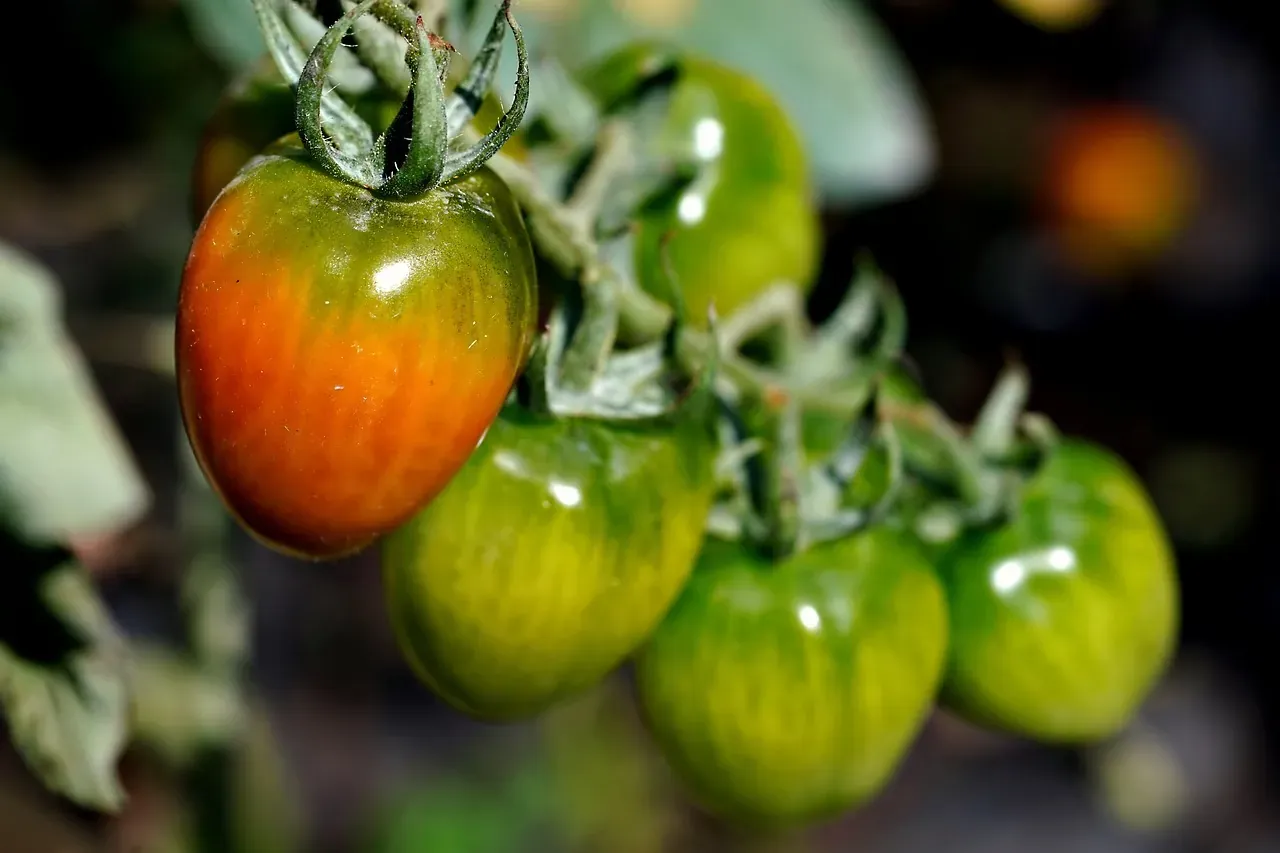 Cluster of tomatoes on the vine with one fruit turning from green to orange-red
Photo: ignartonosbg / Pixabay
The last step in how to grow tomatoes is picking at the right moment. UMD recommends picking as soon as fruit color begins to change. This prevents cracking, splitting, insect feeding and disease, and the fruit finishes ripening on the counter with no difference in quality. Texas A&M prefers full color for best quality. Both agree you should not refrigerate tomatoes that are still ripening.
Heat changes the plan. Illinois says that when air temperatures reach 90°F or more, ripe fruit softens faster and color develops slower, so pick every day or two once color starts and ripen indoors at 70 to 75°F.
Before the first killing frost, pick mature green fruit. UMD and Clemson both say green tomatoes keep for 1 to 3 weeks at 50 to 70°F and ripen at about 70°F.
How to grow tomatoes in raised beds and containers#
Raised beds suit tomatoes well. Texas A&M even recommends setting out tomatoes on beds raised about 6 inches. If your bed sits on pavement or compacted soil, depth matters more: see raised bed depth for tomatoes, where UMD's guidance is a 12- to 24-inch bed on hardscape.
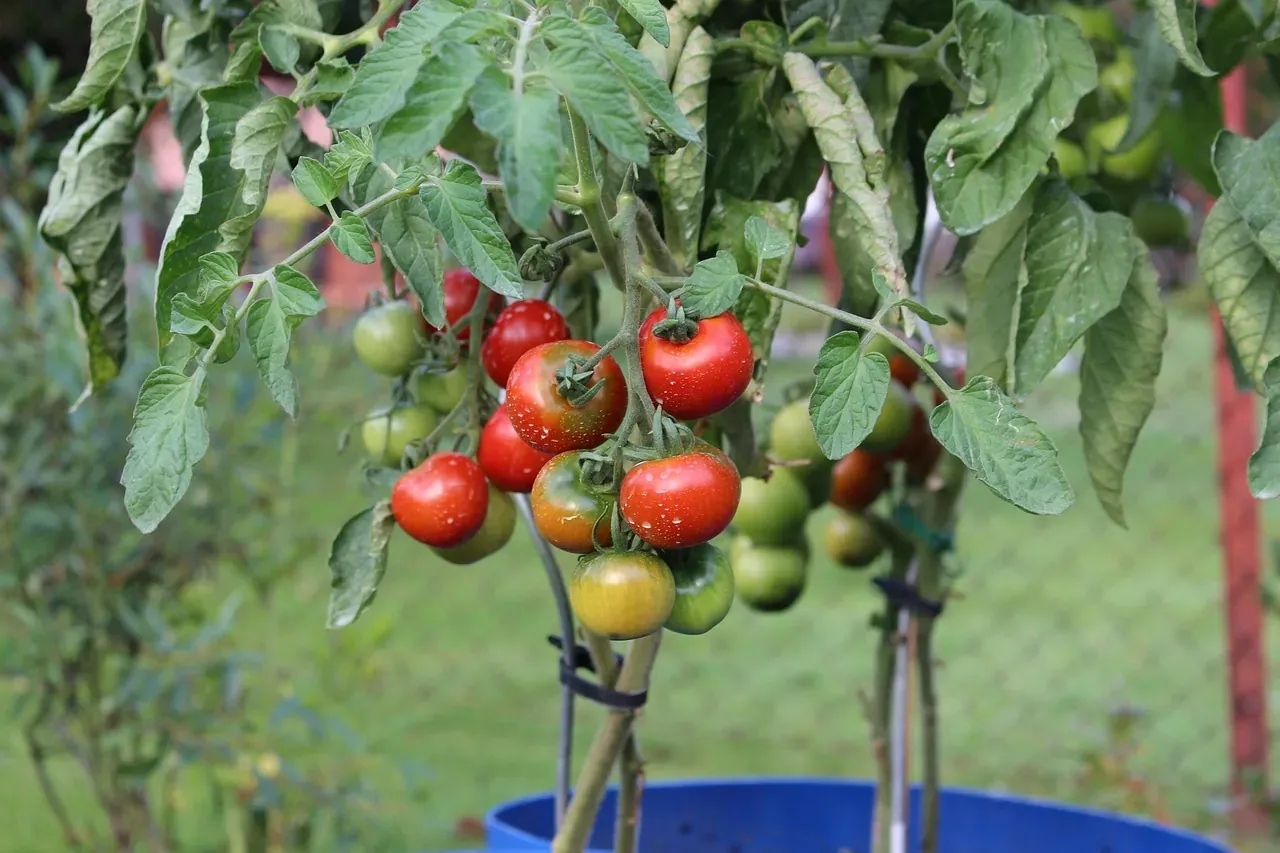 Staked tomato plant with red and green fruit growing from a large blue container
Photo: Vnukko / Pixabay
Containers work too, if they are big enough. Iowa State Extension says cherry tomatoes need at least a 2-gallon pot (about 10 inches across) and standard tomatoes at least a 4-gallon pot (about 12 to 14 inches). Clemson suggests a 14- to 20-inch container or a five-gallon bucket with drainage holes for compact cultivars.
Clemson says container plants may need daily watering in summer and suggests compact "patio" or "bush" types, and Iowa State recommends a soluble fertilizer every week or two.
FAQ#
How long does it take to grow tomatoes?#
Plan on about two to three months from transplanting. Clemson gives 52 to 90 days to first harvest depending on cultivar, and UMD 65 to 90 days from transplant. From seed, UF/IFAS lists 90 to 110 days.
Do tomatoes need full sun?#
Yes. Full sun is central to how to grow tomatoes: UMD says they need at least 6 hours of direct light a day and prefer 8 to 10. Texas A&M and Iowa State also set the minimum at 6 hours. Arizona Extension notes that in very hot desert sun, light shade can protect fruit from sunburn.
How often should tomatoes be watered?#
UMD says at least once a week, more often in dry spells and once blossoms form. UGA suggests wetting the soil 6 to 8 inches deep, which may mean two to three times a week in hot weather but only once a week in clay soil. Containers may need water daily (Clemson, Iowa State).
Can you grow tomatoes in pots?#
Yes. Iowa State says use at least a 2-gallon pot for cherry tomatoes and a 4-gallon pot for standard types. Knowing how to grow tomatoes in pots mostly means steady water and regular feeding, since Iowa State notes container plants dry out quickly and have less soil to draw nutrients from.
Sources#
- Tomato (HGIC 1323) (Clemson Cooperative Extension)
- Tomato Diseases & Disorders (HGIC 2217) (Clemson Cooperative Extension)
- Tomatoes in Containers (Clemson Cooperative Extension)
- Growing Tomatoes in a Home Garden (University of Maryland Extension)
- Fertilizing Vegetable Gardens (University of Maryland Extension)
- Tomato (University of Illinois Extension)
- Tomatoes (E-517) (Texas A&M AgriLife Extension)
- Vegetable Planting Guide (CMG GardenNotes #720) (Colorado State University Extension)
- Suggested Vegetable Planting Dates for Utah (Utah State University Extension)
- When to start seeds indoors in central Oregon (Oregon State University Extension Service)
- Growing Tomatoes in Containers (Iowa State University Extension and Outreach)
- Good Watering Practices Help Keep Tomatoes Healthy (UGA Cooperative Extension, Fulton County)
- Tomato Planting, Growing and Harvest (University of Arizona Cooperative Extension)
- Coffee Grounds for Nitrogen (Cornell Cooperative Extension)
- Florida Vegetable Gardening Guide (VH021) (UF/IFAS Extension)
- Tired Summer Tomatoes (N.C. Cooperative Extension, Hoke County Center)
- PlantAlong analysis of NOAA 1991-2020 climate normals (methodology)
Featured photo: MrGajowy3 / Pixabay.
A 12-part series
Everything tomatoes, chapter by chapter
- Chapter 1
How to Grow Tomatoes: Planting to Harvest by Frost Date
A complete, extension-sourced tomato guide: when to plant by your frost date, how deep and how far apart, support, watering, feeding, pruning, common problems and harvest.
You're reading this✓ Read - Chapter 2
Raised Bed Depth for Tomatoes: How Deep Is Enough?
On concrete or compacted soil, tomatoes need a raised bed 12 to 24 inches deep; on loose soil the roots grow on into the ground. Root depth data, fixes for shallow beds and a soil volume table.
✓ Read - Chapter 3
When to Start Tomato Seeds Indoors: Dates by Zone and ZIP
Start tomato seeds indoors 6 to 8 weeks before your last frost. Here are example sow windows for zones 4a to 9a from NOAA frost data, and how to get the exact window for your ZIP code.
✓ Read - Chapter 4
Fertilizer for Tomato Plants: What, When and How Much
Extension-sourced tomato feeding: soil test first, pre-plant rates per 100 square feet, side-dressing once fruit sets, organic options, container feeding and a simple season schedule.
Coming soon · November 27✓ Read - Chapter 5
How Many Tomato Plants per Person? Fresh vs Canning
Extension charts suggest 2 to 5 tomato plants per person for fresh eating and 5 to 10 for canning. Here is each source side by side, family-of-4 math and the bed space you need.
Coming soon · December 1✓ Read - Chapter 6
Growing Tomatoes Indoors in Winter: Light and Pollination
Small varieties, 16 or more hours of light, 70 to 80°F days and a daily shake for pollination: an extension-sourced guide to winter tomatoes indoors, from pot size to harvest timing.
Coming soon · December 2✓ Read - Chapter 7
Tomato Hornworm: How to Spot, Remove and Prevent It
How to identify tomato and tobacco hornworms, read the damage and droppings, find them at night with a blacklight, remove them, spare the wasp-parasitized ones, and stop next year's crop.
Coming soon · December 3✓ Read - Chapter 8
How to Prune Tomato Plants (and When Not To)
Which tomato suckers to pinch, how many stems to keep on staked and caged plants, why determinate types need little pruning, and when to top plants late in the season.
Coming soon · December 6✓ Read - Chapter 9
Determinate vs Indeterminate Tomatoes: Which to Grow
Bush or vine? How determinate and indeterminate tomatoes differ in height, harvest window, support and pruning, plus semi-determinate types and how to pick by season length.
Coming soon · December 9✓ Read - Chapter 10
Yellow Leaves on Tomato Plants: 7 Causes and Fixes
Where the yellow starts tells you the cause. A quick diagnosis table for nitrogen shortage, watering, early blight, Septoria, wilt and transplant shock, with sourced fixes.
Coming soon · December 12✓ Read - Chapter 11
How Often to Water Tomato Plants (Beds vs Pots)
Extension guides put tomatoes at about 1 to 2 inches of water a week. How that translates for beds, raised beds and pots, how to check the soil, and why steady moisture prevents cracking and blossom end rot.
Coming soon · December 15✓ Read - Chapter 12
Blossom End Rot on Tomatoes: Causes and How to Stop It
Blossom end rot is a calcium problem inside the fruit, usually caused by uneven watering, not poor soil. How to spot it, prevent it, and which popular fixes extension specialists say do not work.
Coming soon · December 18✓ Read
3 of 12 chapters are out; new ones appear here as they publish.


Check your inbox
We sent a confirmation link to . Click it and your planting calendar PDF is on its way. Nothing there in a few minutes? Check your spam or promotions folder.
Crops in this article

No comments yet. Tried this in your garden, or found a date that worked better? Start the thread.
Leave a comment