 PlantAlong

In short
- Clemson says to start tomato seeds 6 weeks before the last frost, Purdue 7 weeks and Oregon State 8 weeks.
- In PlantAlong's analysis of NOAA 1991-2020 normals, median last frost dates inside one zone spread over 18 to 30 days for zones 4a to 9a.
- Example sow windows run from Mar 10 to Apr 12 in zone 4a down to Dec 22 to Feb 4 in zone 9a.
- Purdue lists 6 to 10 days for tomato germination, and Clemson and Purdue both call 65 to 75°F ideal for germination.
- Colorado State transplants tomatoes typically 2+ weeks after the average last frost and lists a typical transplant age of 5 to 7 weeks.
On this page
- The rule: 6 to 8 weeks before your last frost
- When to start tomato seeds indoors by zone
- Why one zone spans 3 to 4 weeks
- When to start tomato seeds indoors for your ZIP
- Germination temperature and days
- Too early? Leggy seedlings and potting up
- Transplant timing
- FAQ
- Is February too early to start tomato seeds?
- What month should I start tomato seeds indoors?
- How long do tomato seeds take to germinate?
- Can I start tomato seeds in January?
- Sources
When to start tomato seeds indoors comes down to one date: your last spring frost. Count back 6 to 8 weeks from it. Clemson Extension says 6 weeks, Purdue Extension 7 and Oregon State 8, which puts the example windows for zones 4a to 9a between late December and mid-April.
The rule: 6 to 8 weeks before your last frost#
Here is what three university extension services say about when to start tomato seeds indoors:
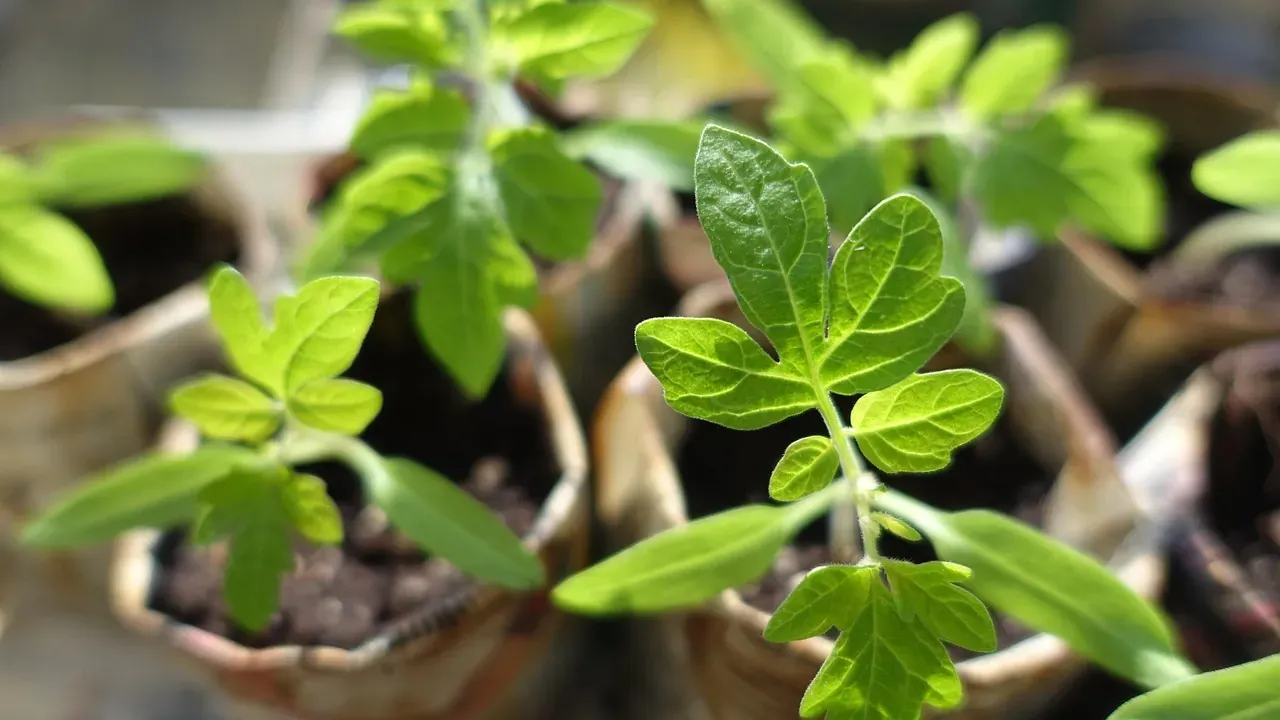 Tomato seedlings with their first true leaves growing in small paper pots indoors
Photo: AlchemillaMollis / Pixabay
- Clemson Extension (South Carolina): 6 weeks, in its table of weeks "to seed before last frost." It adds that popular warm-season vegetables "should be sown 4 to 8 weeks before planting outside."
- Purdue Extension (Indiana): 7 weeks before the last frost (HO-14-W, Table 1).
- Oregon State Extension (central Oregon): 8 weeks of growing indoors, with tomatoes set out on the frost-free date. That makes it 8 weeks before the frost date.
So the window is 6 to 8 weeks, or 42 to 56 days. The 8-week end gives older transplants; the 6-week end means less time under lights.
The date you count back from should be your own. PlantAlong uses the median (50% chance) last spring frost at 32°F from NOAA's 1991-2020 climate normals, taken from a weather station matched to your ZIP code.
When to start tomato seeds indoors by zone#
The table applies the rule to the spread of frost dates inside each hardiness zone. For every ZIP, we took the median last frost of its matched NOAA station, dropped low-confidence matches, and listed the 10th to 90th percentile across ZIPs (the middle 80%). The sow window runs from 8 weeks before the early end to 6 weeks before the late end.
These are examples of when to start tomato seeds indoors, not your dates. Your own frost date is one ZIP code away in the planting calendar.
| Zone | ZIPs in analysis | Median last frost (most ZIPs) | Sow tomato seeds indoors |
|---|---|---|---|
| 4a | 720 | May 5 to May 24 | Mar 10 to Apr 12 |
| 4b | 1,127 | May 1 to May 25 | Mar 6 to Apr 13 |
| 5a | 2,089 | Apr 26 to May 20 | Mar 1 to Apr 8 |
| 5b | 2,445 | Apr 21 to May 17 | Feb 24 to Apr 5 |
| 6a | 4,375 | Apr 16 to May 10 | Feb 19 to Mar 29 |
| 6b | 4,372 | Apr 10 to May 3 | Feb 13 to Mar 22 |
| 7a | 3,807 | Apr 4 to Apr 28 | Feb 7 to Mar 17 |
| 7b | 2,958 | Mar 30 to Apr 17 | Feb 2 to Mar 6 |
| 8a | 2,528 | Mar 20 to Apr 7 | Jan 23 to Feb 24 |
| 8b | 2,535 | Mar 6 to Apr 1 | Jan 9 to Feb 18 |
| 9a | 1,671 | Feb 16 to Mar 18 | Dec 22 to Feb 4 |
Source: PlantAlong analysis of NOAA 1991-2020 climate normals (methodology), with Oregon State's 8 weeks and Clemson's 6 weeks. Dates assume a non-leap year such as 2027. In a leap year, a January or February sow date counted back from a frost date in March or later lands one day later.
How to read a row: in zone 6a, a ZIP with an Apr 16 frost date could sow as early as Feb 19 (8 weeks before). A ZIP with a May 10 frost date could wait until Mar 29 (6 weeks before). Most of zone 6a sits in between; see tomatoes in zone 6a for that zone's full calendar.
Shop the essentials
What you'll need
Supplies for the steps in this guide.
 Start indoorsSeed-starting trays with lidsCell trays with clear domes for sowing seeds indoors.: check price on Amazon (opens in a new tab)
 Start indoorsSeedling heat matWarms seed trays from below. Pick one with a thermostat.: check price on Amazon (opens in a new tab)
 To sowTomato seedsSeed packets from many sellers: compare varieties and days to maturity.: check price on Amazon (opens in a new tab)
 At transplantTomato cagesSturdy supports for tall tomato plants.: check price on Amazon (opens in a new tab)
As an Amazon Associate I earn from qualifying purchases. Photos show the type of product, not a specific listing. How we choose
Why one zone spans 3 to 4 weeks#
Hardiness zones are based on winter low temperatures. Frost dates come from spring weather records, and two ZIPs with the same winter lows can have very different springs.
In our analysis, the middle 80% of ZIPs in a single zone spread their median last frost over 18 to 30 days for zones 4a to 9a. Zones 7b and 8a are the tightest at 18 days. Zone 9a is the widest at 30 days (Feb 16 to Mar 18).
Add the two-week width of the 6-to-8-week rule, and each zone's sow window is 32 to 44 days long. The zones also overlap. An early-frost 6a ZIP (Apr 16) is ready to sow before a late-frost 6b ZIP (May 3), even though 6b is the warmer zone.
That is why a zone chart alone can be off by three weeks or more on when to start tomato seeds indoors.
When to start tomato seeds indoors for your ZIP#
The ZIP tool answers when to start tomato seeds indoors with your own frost date instead of a zone average.
- Enter your ZIP code in the PlantAlong planting calendar. It shows your median last frost date from a matched NOAA station.
- Count back 56 days for the early end (8 weeks) and 42 days for the late end (6 weeks).
- Sow on any day in that window.
Worked example: with a last frost of Apr 20, count back 20 days to Mar 31, 31 more to Feb 28, and 5 more to Feb 23 (8 weeks). Six weeks before Apr 20 is Mar 9.
A median date still means a 50% chance of a frost after it, which matters for transplanting (below). For the full tomato calendar, including transplant and harvest timing, see the tomatoes crop page.
Germination temperature and days#
Knowing when to start tomato seeds indoors is half the job. The other half is warm soil.
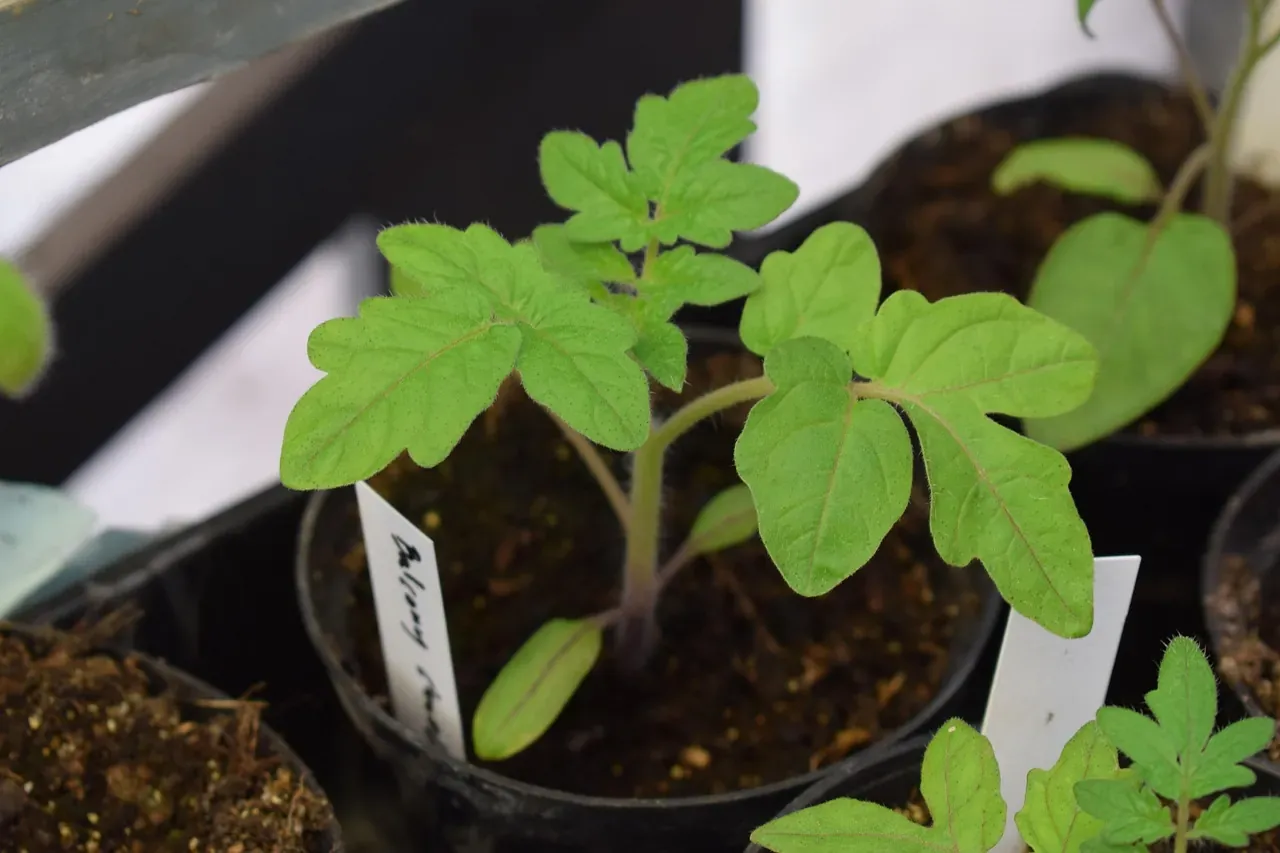
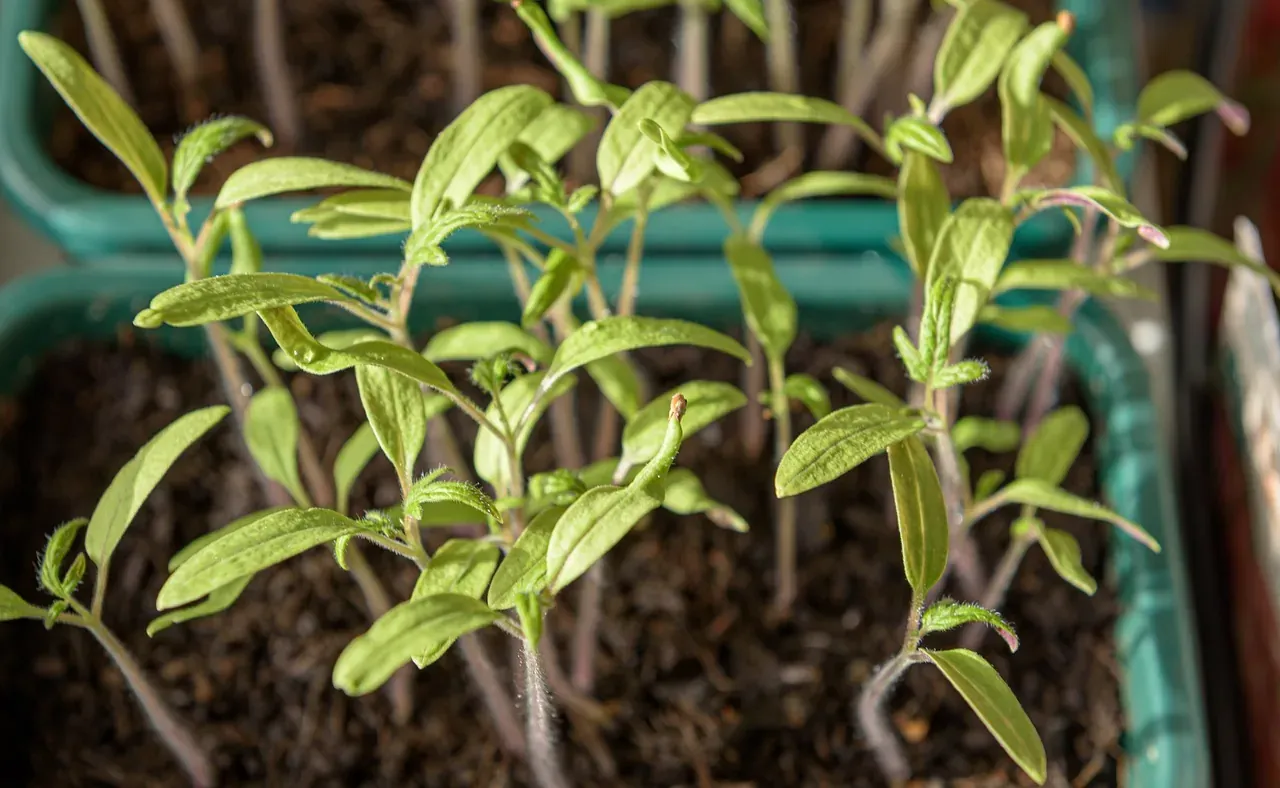 Tray of young tomato seedlings with long seed leaves and fuzzy stems in dark potting mix
Photo: AndreasGoellner / Pixabay
- Soil temperature: Clemson says 65 to 75°F is ideal for germination in general, and Purdue gives the same 65 to 75°F range. Colorado State lists tomato's minimum germination soil temperature as 50°F and its optimum as 80°F, and notes that its optimum temperatures "are useful for starting seeds indoors."
- Days to sprout: Purdue lists 6 to 10 days for tomatoes. Colorado State lists 6 to 14 days, and Texas A&M 6 to 12 days under good growing conditions.
- Depth: Colorado State lists ¼ inch for tomato seed.
Clemson's tip: drape clear plastic over the light frame to hold warmth, without letting it touch the fixture. For the full setup (containers, mix and lights), see our guide on how to start seeds indoors.
Too early? Leggy seedlings and potting up#
None of the three sources gives tomatoes more than 8 weeks indoors before the frost date, and Colorado State lists a typical tomato transplant age of 5 to 7 weeks. Getting when to start tomato seeds indoors right keeps seedlings from sitting inside too long, where they tend to turn tall and weak, or "leggy."
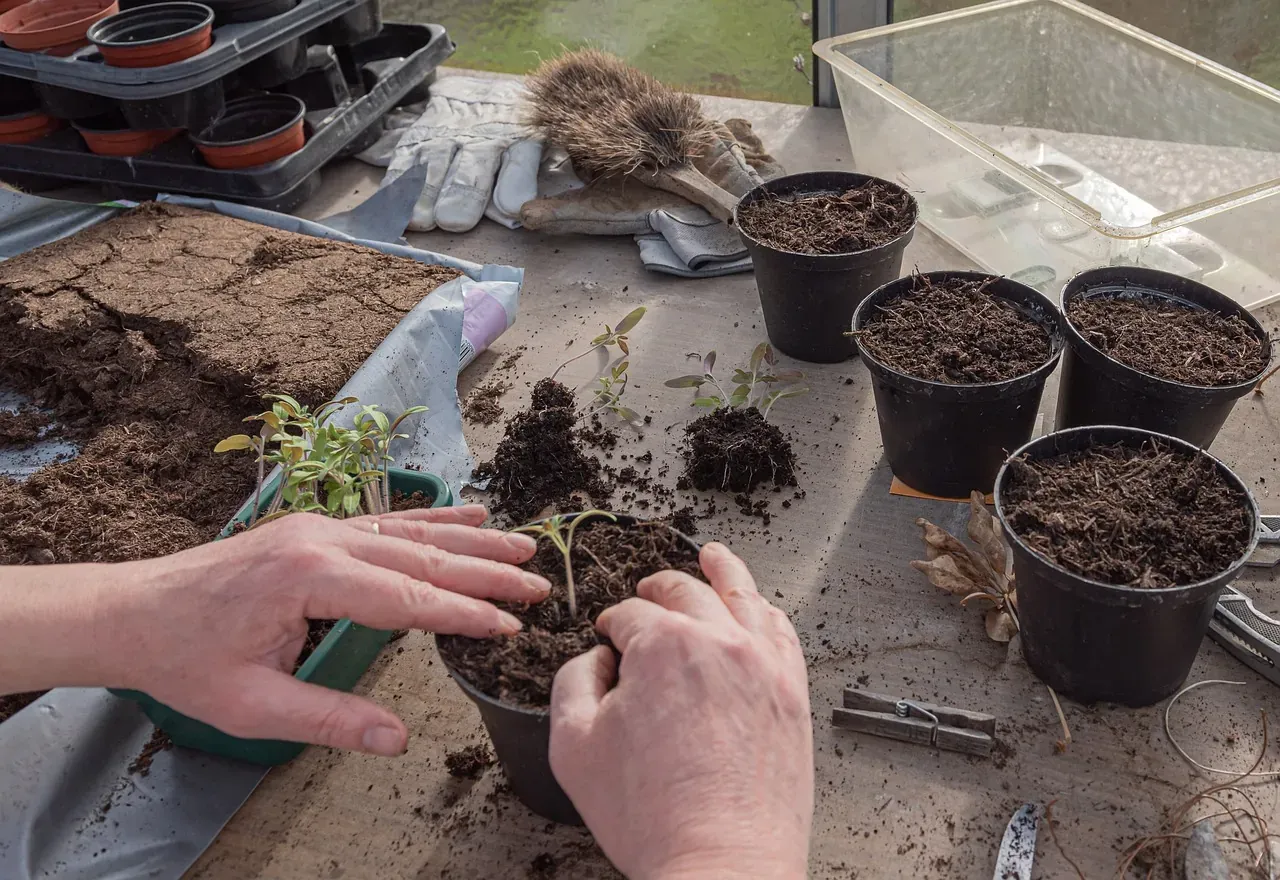 Hands potting up small tomato seedlings into individual black plastic pots on a potting bench
Photo: AndreasGoellner / Pixabay
The sources point to three causes:
- Too little light. Clemson says window light is usually not enough and produces "leggy" seedlings that lean toward the light. It puts fluorescent lights 2 to 4 inches above the seedlings for 12 to 16 hours a day. Purdue says 3 to 4 inches for 14 to 16 hours, and notes that old fluorescent tubes lose intensity (two years is a typical bulb life).
- Too much warmth. Purdue prefers night temperatures of 60 to 65°F, with days about 10°F higher. "If temperatures are warmer than this, leggy plants result."
- Late potting up. Purdue says to move seedlings into individual pots once they have at least one set of true leaves and are large enough to handle. "Failure to transplant promptly results in crowded, spindly seedlings."
If your tomato seedlings are already leggy, there is a fix at planting time. Purdue notes that tomatoes can grow roots along the stem, so leggy plants "may be planted deeper than they were previously growing."
Transplant timing#
Decide when to start tomato seeds indoors with your planting-out date in mind. The sources differ here too:
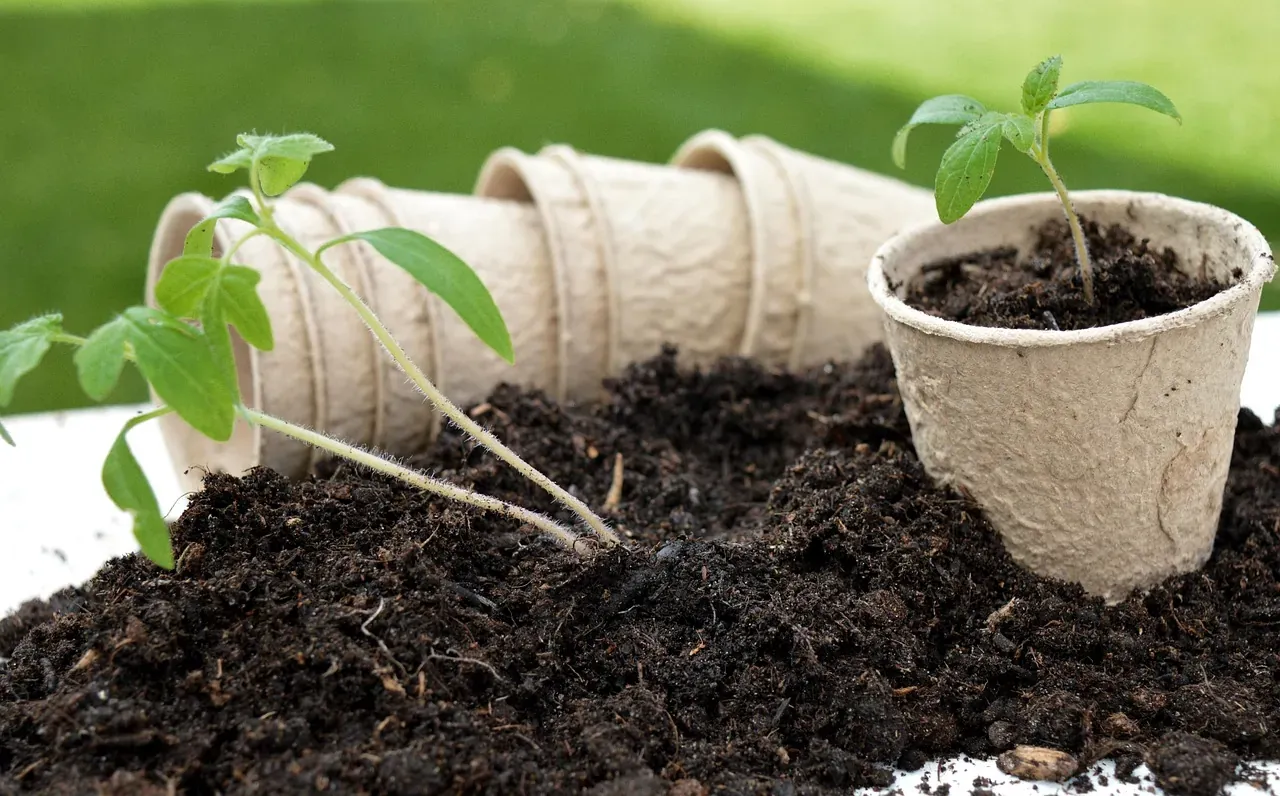 Tomato seedling in a biodegradable fiber pot beside another seedling laid on dark potting soil
Photo: neelam279 / Pixabay
- Colorado State: "Typically 2+ weeks after the average last spring frost date."
- Utah State: about 2 weeks after the average last frost, "when the soil is warm."
- Oregon State: on the frost-free date.
- Texas A&M: "Do not set out tomato plants until all danger of frost has passed."
The timing math adds up. Sow 8 weeks before your frost date and plant 2 weeks after it, and the seedlings spend 10 weeks indoors. That is well past Colorado State's 5 to 7 weeks. If you plan to transplant 2 weeks after your frost date, sowing at the 6-week end of the window keeps indoor time shorter.
Before planting, harden the seedlings off. Clemson and Purdue both start 2 weeks before planting, moving plants from shade into more sun each day. Clemson brings plants in each evening until nights stay at or above 50°F, and both say to avoid wind and temperatures below 45°F.
Related: How to Grow Tomatoes: Planting to Harvest by Frost Date
FAQ#
Is February too early to start tomato seeds?#
It depends on your frost date. A February sowing fits the 6-to-8-week rule when your median last frost falls between about Mar 15 and Apr 25. In the table above, that covers zones 7a to 8a, most of 8b, and the earlier-frost ZIPs in 6a and 6b. In zones 4a to 5a, February is earlier than the rule allows.
What month should I start tomato seeds indoors?#
For when to start tomato seeds indoors, the table gives: March in zones 4a to 5b (late-frost ZIPs run into early April), late February to March in 6a, February to March in 6b and 7a, February to early March in 7b, and late January to February in zone 8 (8b from Jan 9). Zone 9a runs from late December to early February. Your ZIP's frost date in the planting calendar gives the exact window.
How long do tomato seeds take to germinate?#
About 6 to 14 days. Purdue lists 6 to 10 days, Texas A&M 6 to 12 and Colorado State 6 to 14. Warm soil helps: Clemson and Purdue both say 65 to 75°F is ideal for germination.
Can I start tomato seeds in January?#
Only where the last frost comes early. A January sowing fits the 6-to-8-week rule when your median last frost falls between about Feb 12 and Mar 28. That matches zone 9a, many zone 8b ZIPs and the earliest 8a ZIPs. Further north, January seeds would sit indoors longer than any of the three sources recommends.
Sources#
- FAQs about Starting Vegetable Seeds Indoors (Clemson Cooperative Extension, HGIC)
- HO-14-W: Starting Seed Indoors (Purdue Extension)
- When to start seeds indoors in central Oregon (Oregon State University Extension Service)
- Vegetable Planting Guide (CMG GardenNotes #720) (Colorado State University Extension)
- Suggested Vegetable Planting Dates for Utah (Utah State University Extension)
- Texas Home Vegetable Gardening Guide (E-502) (Texas A&M AgriLife Extension)
- Tomatoes (E-517) (Texas A&M AgriLife Extension)
- PlantAlong analysis of NOAA 1991-2020 climate normals (methodology)
Featured photo: JennyJohansson / Pixabay.
A 12-part series
Everything tomatoes, chapter by chapter
- Chapter 1
How to Grow Tomatoes: Planting to Harvest by Frost Date
A complete, extension-sourced tomato guide: when to plant by your frost date, how deep and how far apart, support, watering, feeding, pruning, common problems and harvest.
✓ Read - Chapter 2
Raised Bed Depth for Tomatoes: How Deep Is Enough?
On concrete or compacted soil, tomatoes need a raised bed 12 to 24 inches deep; on loose soil the roots grow on into the ground. Root depth data, fixes for shallow beds and a soil volume table.
✓ Read - Chapter 3
When to Start Tomato Seeds Indoors: Dates by Zone and ZIP
Start tomato seeds indoors 6 to 8 weeks before your last frost. Here are example sow windows for zones 4a to 9a from NOAA frost data, and how to get the exact window for your ZIP code.
You're reading this✓ Read - Chapter 4
Fertilizer for Tomato Plants: What, When and How Much
Extension-sourced tomato feeding: soil test first, pre-plant rates per 100 square feet, side-dressing once fruit sets, organic options, container feeding and a simple season schedule.
Coming soon · November 27✓ Read - Chapter 5
How Many Tomato Plants per Person? Fresh vs Canning
Extension charts suggest 2 to 5 tomato plants per person for fresh eating and 5 to 10 for canning. Here is each source side by side, family-of-4 math and the bed space you need.
Coming soon · December 1✓ Read - Chapter 6
Growing Tomatoes Indoors in Winter: Light and Pollination
Small varieties, 16 or more hours of light, 70 to 80°F days and a daily shake for pollination: an extension-sourced guide to winter tomatoes indoors, from pot size to harvest timing.
Coming soon · December 2✓ Read - Chapter 7
Tomato Hornworm: How to Spot, Remove and Prevent It
How to identify tomato and tobacco hornworms, read the damage and droppings, find them at night with a blacklight, remove them, spare the wasp-parasitized ones, and stop next year's crop.
Coming soon · December 3✓ Read - Chapter 8
How to Prune Tomato Plants (and When Not To)
Which tomato suckers to pinch, how many stems to keep on staked and caged plants, why determinate types need little pruning, and when to top plants late in the season.
Coming soon · December 6✓ Read - Chapter 9
Determinate vs Indeterminate Tomatoes: Which to Grow
Bush or vine? How determinate and indeterminate tomatoes differ in height, harvest window, support and pruning, plus semi-determinate types and how to pick by season length.
Coming soon · December 9✓ Read - Chapter 10
Yellow Leaves on Tomato Plants: 7 Causes and Fixes
Where the yellow starts tells you the cause. A quick diagnosis table for nitrogen shortage, watering, early blight, Septoria, wilt and transplant shock, with sourced fixes.
Coming soon · December 12✓ Read - Chapter 11
How Often to Water Tomato Plants (Beds vs Pots)
Extension guides put tomatoes at about 1 to 2 inches of water a week. How that translates for beds, raised beds and pots, how to check the soil, and why steady moisture prevents cracking and blossom end rot.
Coming soon · December 15✓ Read - Chapter 12
Blossom End Rot on Tomatoes: Causes and How to Stop It
Blossom end rot is a calcium problem inside the fruit, usually caused by uneven watering, not poor soil. How to spot it, prevent it, and which popular fixes extension specialists say do not work.
Coming soon · December 18✓ Read
3 of 12 chapters are out; new ones appear here as they publish.



Check your inbox
We sent a confirmation link to . Click it and your planting calendar PDF is on its way. Nothing there in a few minutes? Check your spam or promotions folder.
Crops in this article


No comments yet. Tried this in your garden, or found a date that worked better? Start the thread.
Leave a comment