 PlantAlong
In short
- Purdue and Clemson put the best germination temperature for most seeds at 65 to 75°F.
- Tomatoes and peppers are sown about 6 to 8 weeks before the last frost (Clemson, Purdue, Oregon State); Oregon State sows onions 16 weeks before it.
- PlantAlong's analysis of NOAA 1991-2020 normals finds median last frost dates spread over three to four weeks inside most hardiness zones, so count from your ZIP's date.
- Extension sources keep lights a few inches above seedlings for 12 to 16 hours a day and raise them as plants grow.
- Purdue transplants seedlings once they have at least one set of true leaves and starts hardening off 2 weeks before planting out.
On this page
- Why start seeds indoors (and which crops not to)
- Zone vs frost date: where your countdown starts
- How to start seeds indoors: your countdown by crop
- How to start seeds indoors: containers, mix, light and heat
- Sowing: depth and germination temperature
- Light and temperature after sprouting
- Watering, airflow and damping off
- Potting up and feeding
- Hardening off and transplanting
- Common mistakes in how to start seeds indoors
- FAQ
- When should I start seeds indoors?
- Do seedlings need fertilizer?
- How do I harden off seedlings?
- What are common mistakes when starting seeds indoors?
- Sources
Here is how to start seeds indoors without guessing: find your average last spring frost date, count back the right number of weeks for each crop, then sow in a clean, soilless mix kept at 65 to 75°F. Give seedlings 12 to 16 hours of light a day and harden them off for about 2 weeks before they go outside (Purdue and Clemson Extension).
Most advice on how to start seeds indoors skips the countdown. Below: a sourced table for the 12 PlantAlong crops, the zone versus frost date problem in numbers, then each step.
Why start seeds indoors (and which crops not to)#
Indoor starts buy time for crops that cannot go outside until frost is past. Iowa State calls early to mid-March "the best time to start many vegetables and annual flowers indoors for transplanting outside once the threat of frost has passed" (in Iowa).
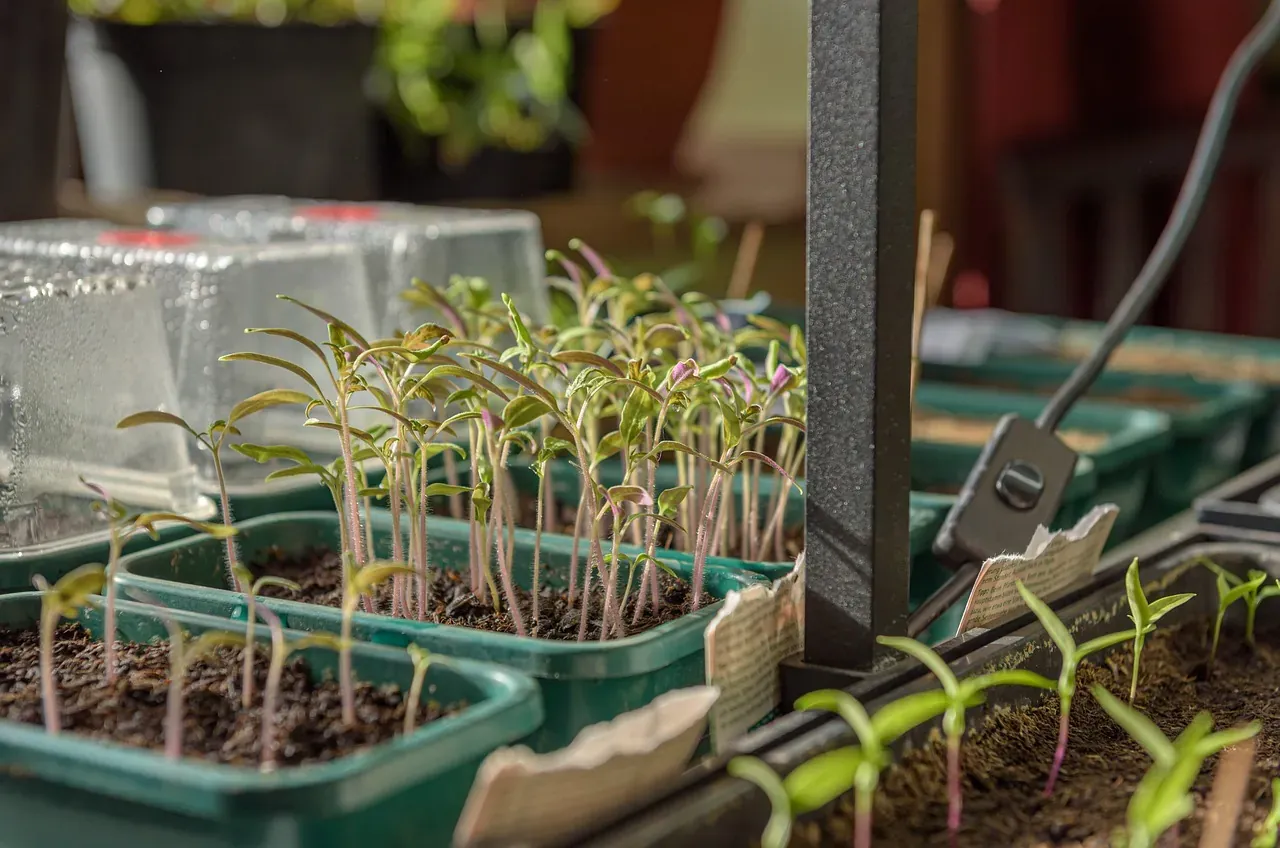 Young seedlings in green trays beside clear plastic covers and a lamp stand indoors
Photo: AndreasGoellner / Pixabay
Colorado State lists a typical transplant age of 5 to 7 weeks for tomatoes and 6 to 8 weeks for peppers, and both go out only after the last frost. Iowa State sows onions 8 to 10 weeks before planting out.
Knowing how to start seeds indoors also means knowing which crops to skip. These are better sown straight into the garden:
- Cucumbers and squash (zucchini): Purdue says they "do not transplant well and therefore are seeded in individual pots." Colorado State says that if you use transplants, pick young plants "not more than 2-3 weeks from seeding."
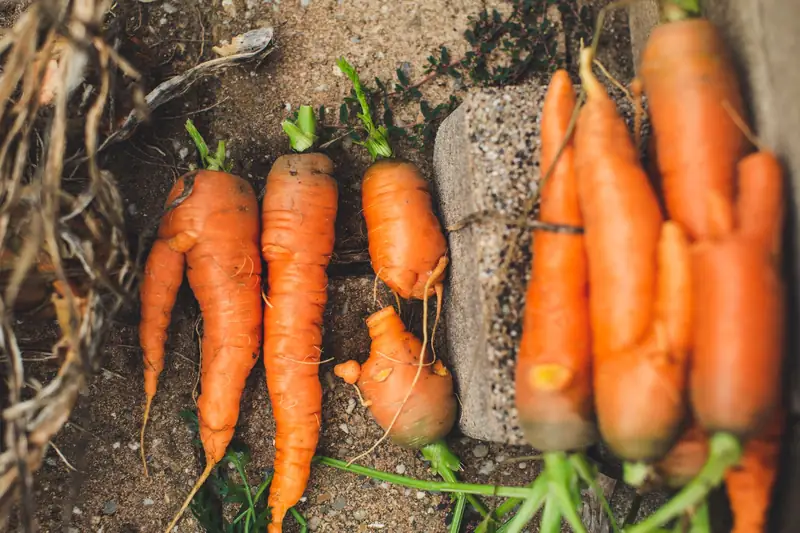
- Carrots: Oregon State's eastern Oregon schedule lists them as direct seed only.
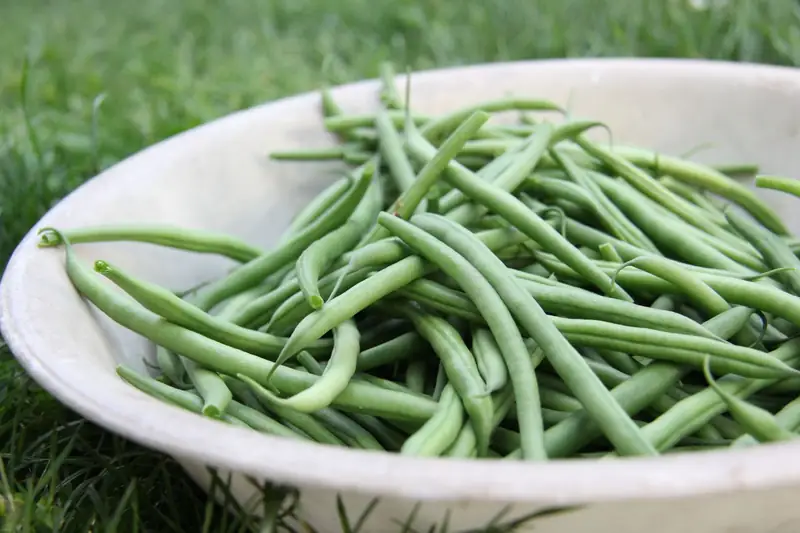
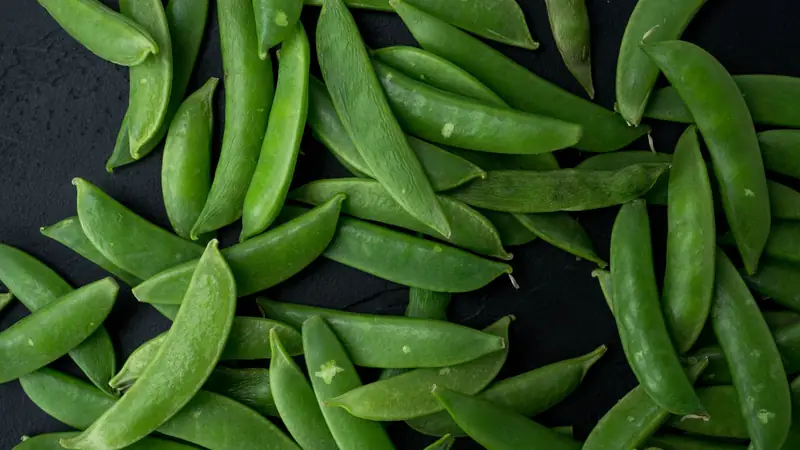
- Beans and peas: Colorado State and Utah State sow both outdoors (peas weeks before the frost date, beans around it).
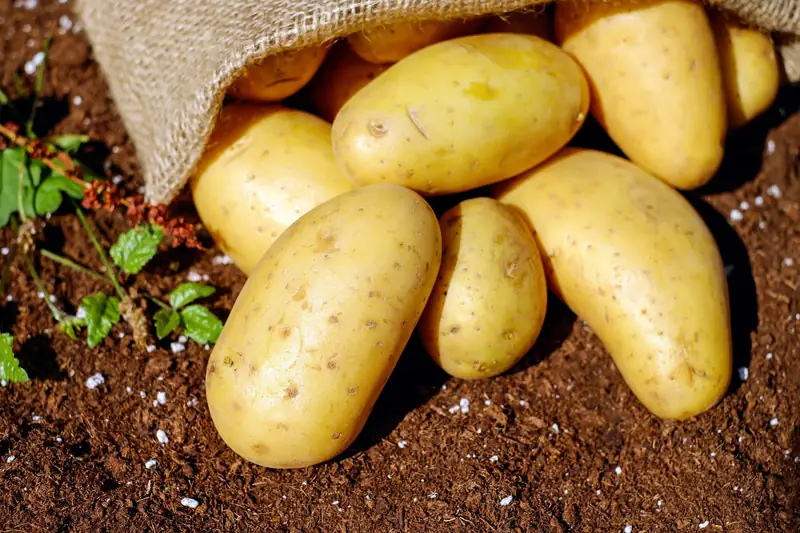
- Potatoes and garlic: potatoes go in as seed pieces and garlic as cloves in fall.
Zone vs frost date: where your countdown starts#
Every plan for how to start seeds indoors counts from the last frost date, not the hardiness zone. Zones come from winter low temperatures. Frost dates come from spring weather records, and they vary a lot inside one zone.
We measured how much. For each ZIP, PlantAlong matched a nearby NOAA weather station and took its median (50% chance) last spring frost date from the 1991-2020 climate normals, leaving out low-confidence matches. Across the middle 80% of ZIPs in each zone:
- Zone 4b (1,127 ZIPs): May 1 to May 25
- Zone 5b (2,445 ZIPs): Apr 21 to May 17
- Zone 6a (4,375 ZIPs): Apr 16 to May 10
- Zone 7a (3,807 ZIPs): Apr 4 to Apr 28
- Zone 8a (2,528 ZIPs): Mar 20 to Apr 7
- Zone 9a (1,671 ZIPs): Feb 16 to Mar 18
Source: PlantAlong analysis of NOAA 1991-2020 climate normals (how we built it). Most of these zones span three weeks or more, longer than the two-week tomato sowing window.
Enter your ZIP on the planting calendar to get your own date. Frost alerts can email you a few days before your seed-starting window opens. These are long-term averages, not forecasts, so check the weather before tender plants go out.
How to start seeds indoors: your countdown by crop#
This is how to start seeds indoors by the calendar, for all 12 PlantAlong crops. "Weeks before" means weeks before your median last frost date. Germination figures are soil temperatures (minimum and optimum) and days to sprout from Colorado State's planting guide unless noted.
| Crop | How to start | Sow indoors (weeks before last frost) | Germination |
|---|---|---|---|
| Onions (seed) | Indoors | 16 (Oregon State); Iowa State: 8 to 10 weeks before planting out | 35°F min, 80°F opt; 7 to 12 days |
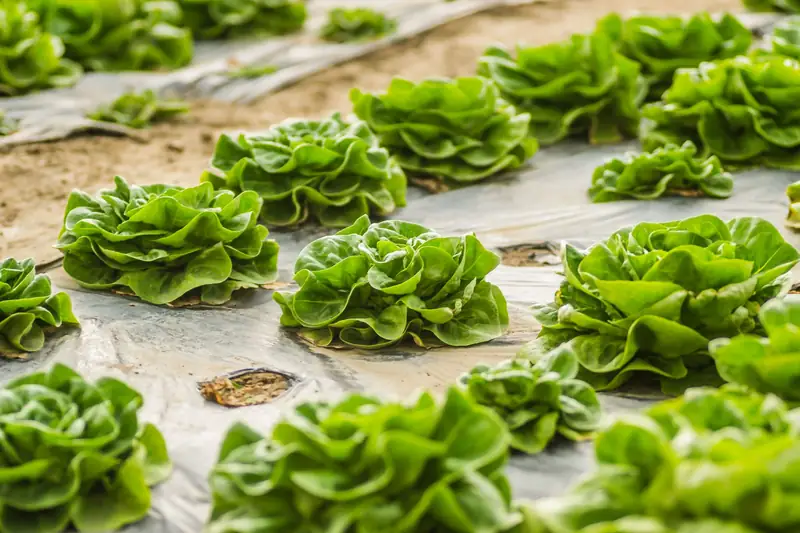
| Lettuce | Indoors or direct | 10 (Purdue, head lettuce); 7 (Oregon State) | 35°F min, 70°F opt; 4 to 10 days |
| Tomatoes | Indoors | 6 to 8 (Clemson 6, Purdue 7, Oregon State 8) | 50°F min, 80°F opt; 6 to 14 days |
| Peppers | Indoors | 6 to 8 (Oregon State 6, Purdue 7, Clemson 8) | 60°F min, 80°F opt; 10 to 20 days |
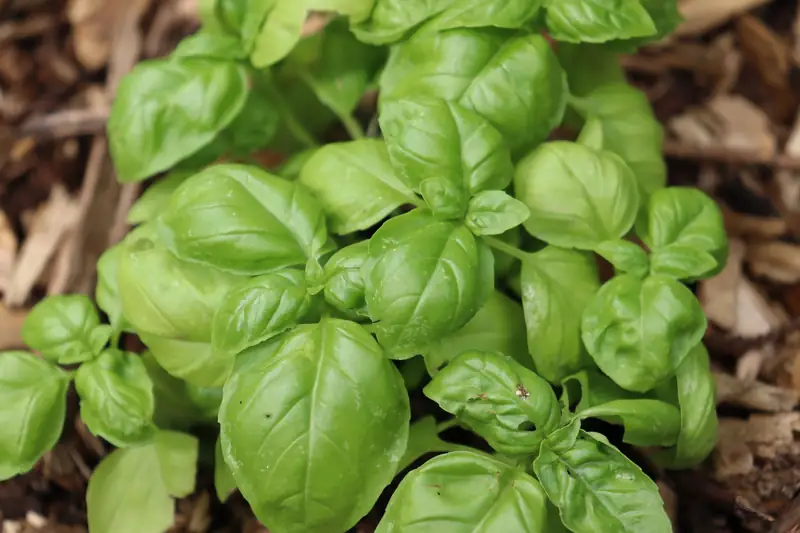
| Basil | Indoors | 4 to 6 weeks before planting out (Clemson); Illinois: 3 to 4 weeks | 5 to 10 days at 70°F (Clemson) |
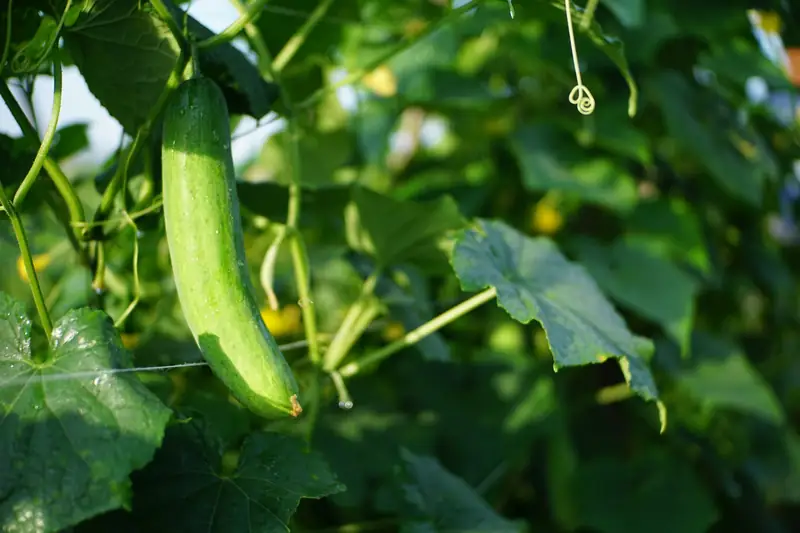
| Cucumbers | Direct; short indoor start possible | Direct around last frost (Colorado State, Utah State); indoors 4 (Purdue), "4 or less" (Clemson) | 60°F min, 90°F opt; 6 to 10 days |
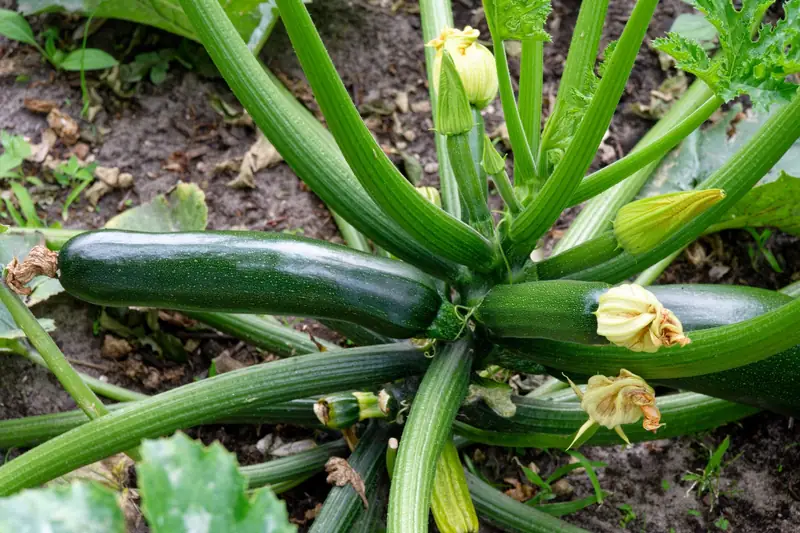
| Zucchini | Direct; short indoor start possible | Direct around last frost (Colorado State, Utah State); indoors 4 (Purdue), "4 or less" (Clemson) | 60°F min, 90°F opt; 3 to 12 days |
| Beans | Direct | Around last frost (Colorado State, Utah State) | 55°F min, 80°F opt; 6 to 14 days |
| Peas | Direct | As early as 4 to 2 weeks before, outdoors (Colorado State) | 40°F min, 70°F opt; 6 to 15 days |
| Carrots | Direct | As early as 2 to 0 weeks before, outdoors (Colorado State); "Direct seed" (Oregon State) | 40°F min, 80°F opt; 10 to 17 days |
| Potatoes | Seed pieces outdoors | No indoor seed start; as early as 2 to 0 weeks before (Colorado State) | 45°F minimum soil |
| Garlic | Cloves in fall | No indoor start; 1 to 2 weeks after the first killing frost (Minnesota, Wisconsin) | Not applicable |
Notes on the trickier rows:
- Onions: Oregon State (central Oregon, a short-season area) grows them 10 weeks indoors and sets them out 6 weeks before the frost-free date: 16 weeks in total. It is the only source we found that ties onion sowing to a frost date.
- Counting from planting out: Oregon State, Iowa State and Clemson's basil sheet count back from the day plants go outside. We converted Oregon State's numbers to weeks before the frost date.
- Basil: Clemson waits until days are "consistently in the 70s" and nights are "above 50 ºF"; Illinois waits for soil of at least 60°F.
- Optional starts: Oregon State also lists short indoor starts for peas, beans (4 weeks each), cucumbers and squash (3 weeks each). Most sources sow these directly.
When transplants go outside:
- Tomatoes and peppers: Colorado State says "typically 2+ weeks after the average last spring frost date." Utah State says about 2 weeks after it, once soil is warm. Oregon State sets tomatoes out on the frost-free date and peppers 2 weeks after.
- Lettuce: 2 weeks before the frost-free date (Oregon State).
- Onions: 6 weeks before the frost-free date (Oregon State).
Worked example: if your ZIP's median last frost is Apr 16 (early zone 6a), onions go in around Dec 25, lettuce Feb 5 to Feb 26, and tomatoes and peppers Feb 19 to Mar 5. At May 10 (late zone 6a), tomatoes and peppers move to Mar 15 to Mar 29. That is how to start seeds indoors on your own schedule rather than a zone average.
Crop pages for tomatoes, peppers, onions, lettuce and basil carry the full sourced rules.
Shop the essentials
What you'll need
Supplies for the steps in this guide.
 Start indoorsSeed-starting trays with lidsCell trays with clear domes for sowing seeds indoors.: check price on Amazon (opens in a new tab)
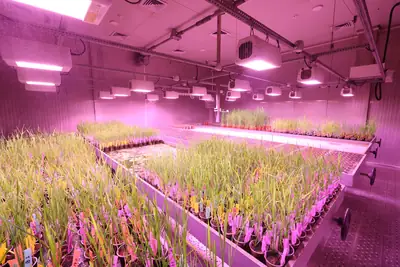 Start indoorsLED grow lightLight for seedlings while they grow indoors.: check price on Amazon (opens in a new tab)
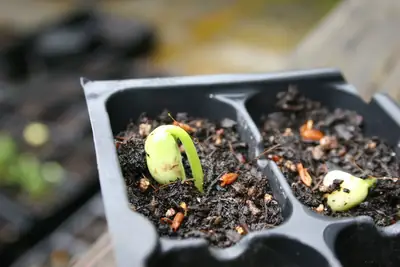 Start indoorsSeedling heat matWarms seed trays from below. Pick one with a thermostat.: check price on Amazon (opens in a new tab)
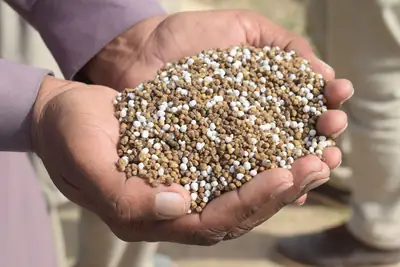 FeedOrganic vegetable fertilizerA balanced fertilizer for vegetable beds. Follow the bag rate.: check price on Amazon (opens in a new tab)
As an Amazon Associate I earn from qualifying purchases. Photos show the type of product, not a specific listing. How we choose
How to start seeds indoors: containers, mix, light and heat#
Containers. Clemson says any container works if it "is clean, has good drainage, and is at least 2-inches deep." Missouri Botanical Garden likes a plug flat with a clear cover, and washes reused trays in hot, soapy water, then rinses them in a 10% bleach solution.
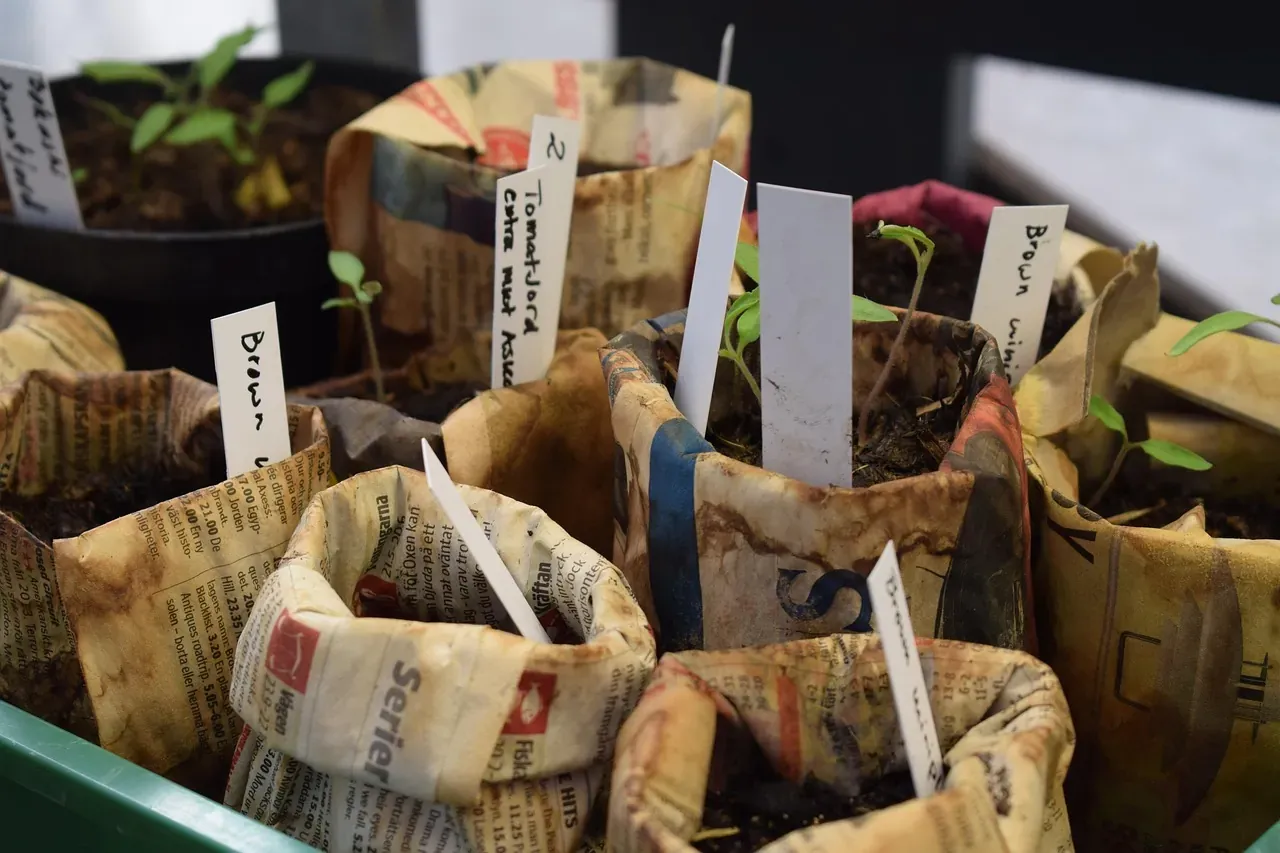 Seedlings in homemade newspaper pots with handwritten plant labels in a tray
Photo: JennyJohansson / Pixabay
Seed-starting mix. Clemson recommends "a soilless potting mix that consists of sphagnum peat moss, perlite, and vermiculite" and says not to use regular garden soil. Missouri Botanical Garden uses a new, soilless seed starter mix "to reduce the chances of your seedlings damping off." Purdue wants a medium that is "loose, well-drained, and of fine texture." Seed-starting mix is not bed fill; see raised bed soil vs potting soil.
Lights. Clemson says window light "is not sufficient and will produce 'leggy' seedlings." Iowa State says "a standard fluorescent shop fixture containing two 40-watt tubes provides sufficient light," with one cool white and one warm white tube, as does Purdue.
Heat. Iowa State says, "If possible, warm the germination mix/soil." Clemson drapes clear plastic over the frame holding the light, never touching the fixture. None of our sources gives a heat-mat setting, so aim for the germination temperatures below.
Sowing: depth and germination temperature#
Sowing is the quickest step in how to start seeds indoors.
Moisten the mix first. Clemson wants it "damp like a sponge" at planting time; Missouri Botanical Garden says "saturated like a sponge but not soggy."
Sowing depth. Purdue and Clemson both say to cover seeds to about two times their diameter. Missouri Botanical Garden sows pepper seed about 1/4 inch deep. Some seeds, such as lettuce, need light to germinate, so it places them on top of the mix without covering them.
Seeds per cell. Clemson sows two to three per cell and thins to one. Missouri Botanical Garden sows one, or 2 to 3 for older seed.
Germination temperature. Purdue says "65-75°F (18-24°C) is best" for most seeds, and Clemson calls a soil temperature of 65° to 75°F ideal. Missouri Botanical Garden keeps covered flats in a warm spot of about 75°F, out of direct sun.
Group by speed. In Missouri Botanical Garden's tray, tomatoes sprouted in 3 to 4 days and peppers in 7 to 10, so the tomatoes got leggy waiting. Sow crops with similar germination times together, and label each with the date, crop and variety.
Light and temperature after sprouting#
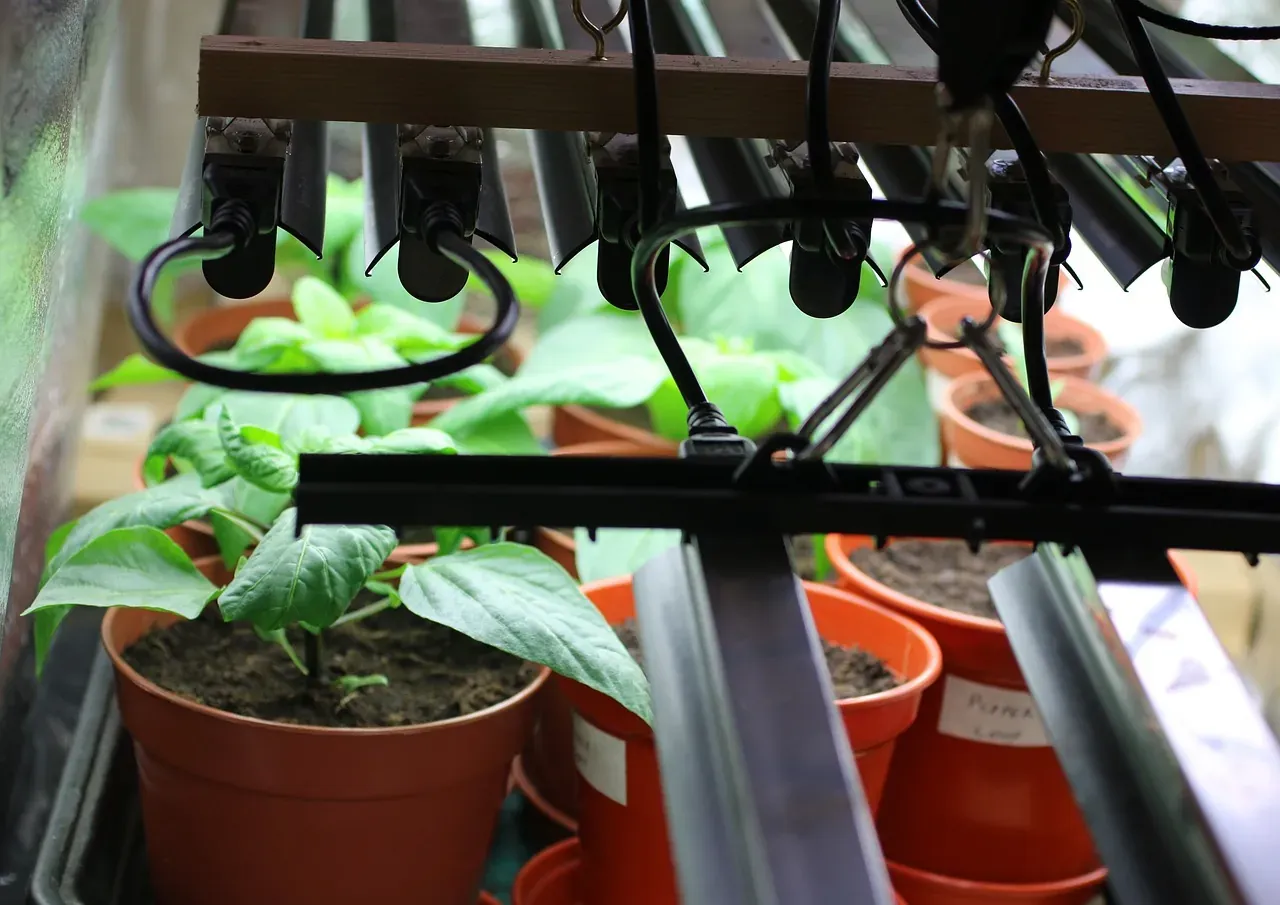
Light is the step in how to start seeds indoors where a windowsill falls short. As soon as plants emerge, Missouri Botanical Garden removes the cover and moves the flat to a cooler, brightly lit spot. Light distance and hours, by source:
 Young pepper plants in orange pots under a rack of clip-on grow lights
Photo: HarrietP / Pixabay
- Purdue: 3 to 4 inches below the tubes, lights on 14 to 16 hours a day.
- Clemson: 2 to 4 inches above the seedlings, raised as they grow, 12 to 16 hours a day.
- Iowa State: fluorescent lights "no more than 4 to 6 inches above the seedlings," 12 to 14 hours a day.
- Missouri Botanical Garden: 6 to 10 inches from fluorescent bulbs, 12 to 18 hours a day.
The overlap: a light a few inches above the leaves for 12 to 16 hours, raised as plants grow.
Temperature. Grow seedlings cooler than you sprouted them. Purdue gives nights of 60 to 65°F with days about 10°F warmer, and warns that warmer conditions make leggy plants; Iowa State says 60 to 70°F. Cool-season crops prefer nights no higher than 55°F (Purdue), and Iowa State grows onion seedlings at 55 to 65°F.
Watering, airflow and damping off#
Watering. This is where how to start seeds indoors gets fiddly, because the rule changes once seedlings emerge. Clemson says to keep the mix consistently moist during germination: if it dries out, the seed "will no longer be viable." After seedlings emerge, ease off. Purdue says "Allow drying between waterings, but do not allow seedlings to wilt at any time," and Iowa State lets the mix dry somewhat between waterings.
Water from below. Purdue sets the container in a pan of warm water and notes that bottom watering "helps avoid damping off by keeping the soil surface dry."
Damping off is the disease every guide on how to start seeds indoors warns about. Penn State describes two forms: one rots seeds before they come up, and the other causes "stem rot at or just below the soil line," so seedlings topple. Its causes are fungi and water molds: Pythium, Rhizoctonia, Fusarium and Phytophthora.
Penn State says it is "most severe under conditions of excessive soil moisture and high humidity," and crowding cuts airflow. Prevention (Penn State, Iowa State, Purdue):
- Use a sterile mix and clean, disinfected trays.
- Sow thinly and space plants so air can move.
- Do not overwater; use a well-drained mix.
- Remove the cover once seedlings emerge (Missouri Botanical Garden).
- Act fast. Purdue says to dig out and discard infected seedlings and their soil.
Potting up and feeding#
Potting up and feeding finish how to start seeds indoors before plants head outside.
 Tomato seedling potted up in a small plastic pot beside gloves and peat pots
Photo: neelam279 / Pixabay
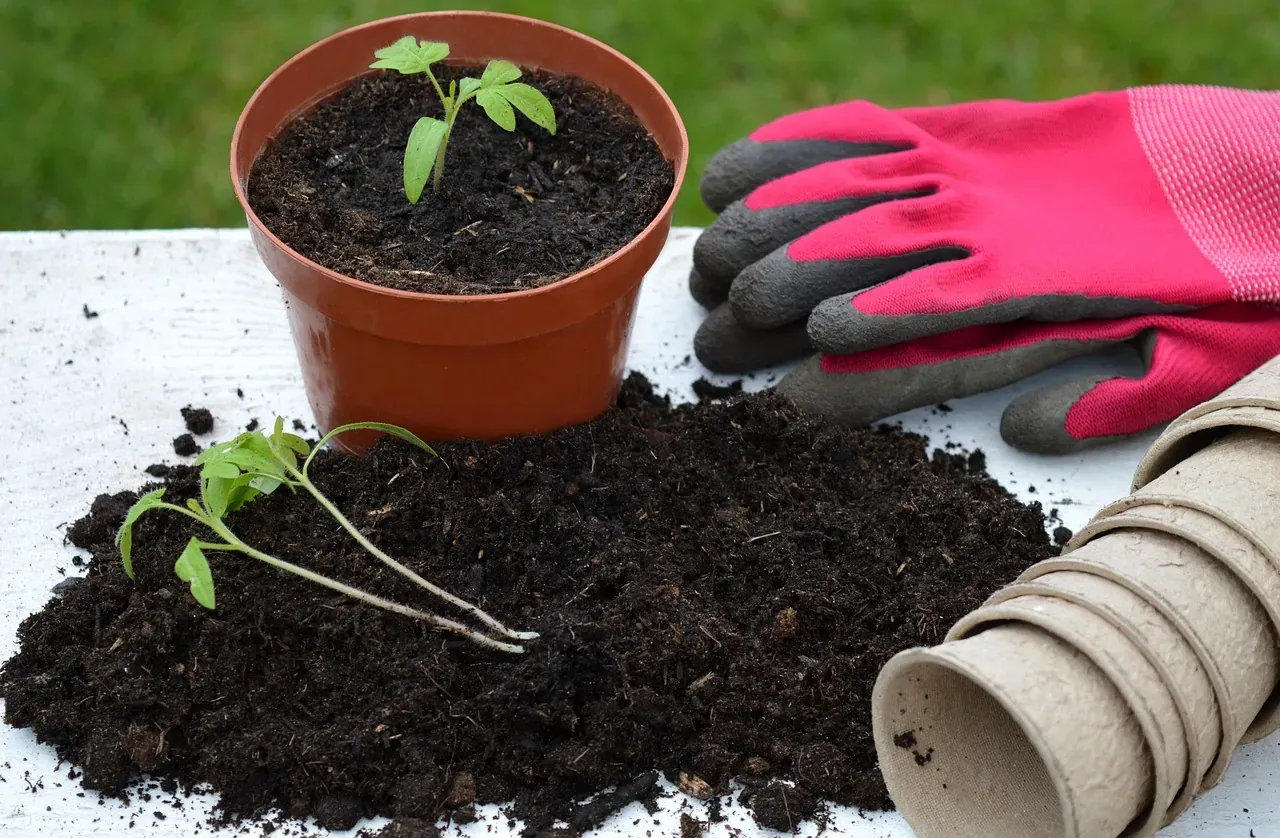
When to pot up. Purdue says to transplant "as soon as seedlings have developed at least one set of true leaves and are large enough to handle." Waiting too long gives "crowded, spindly seedlings." Missouri Botanical Garden thins to one plant per cell when the second set of leaves appears, then moves plants from small plug trays into bigger pots so roots have room.
How. Purdue lifts seedlings with a wooden label, holds them by the leaves (not the stems) and replants at the same depth, 1 inch apart for small plants and about 2 inches for fast growers. In peat pots, snip extra seedlings with scissors.
Feeding. The sources differ, so here are all three:
- Purdue: a soluble houseplant fertilizer such as 15-30-15 at "about half of the recommended strength a few days after seedlings have germinated," then every 2 weeks at the label rate.
- Clemson: a liquid starter fertilizer at every other watering, starting when the first true leaves appear.
- Missouri Botanical Garden: fertilize weekly once seedlings are under lights.
Hardening off and transplanting#
The last step in how to start seeds indoors happens outside, slowly.
 Seedlings in peat pots set outside on a sunny table beside a garden lawn
Photo: JillWellington / Pixabay
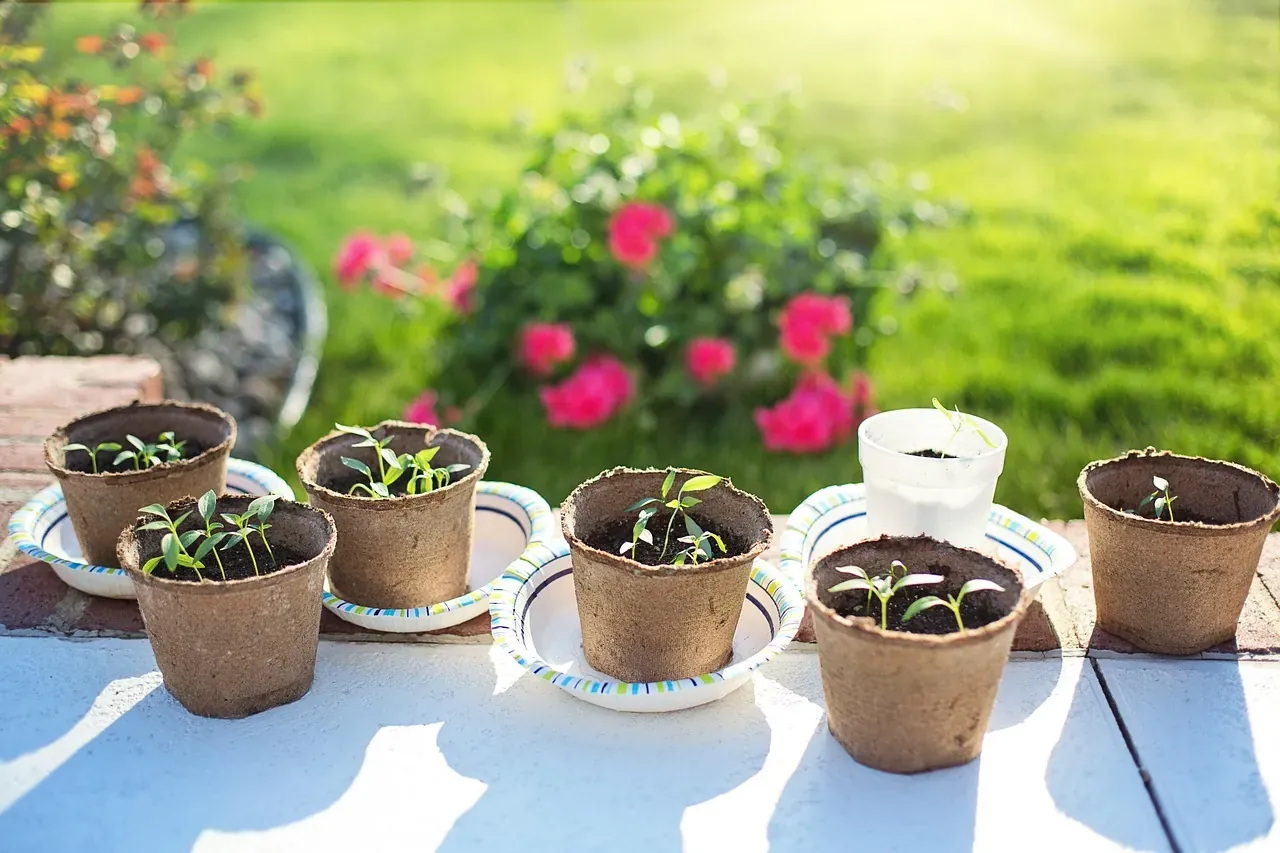
- Purdue: start "2 weeks before planting in the garden." Begin in shade, then add short periods of sun, longer each day. Skip windy days and days below 45°F, and water less often without letting plants wilt.
- Clemson: two weeks before planting, put plants in a protected spot with part sun, and bring them in each evening until nights stay at or above 50°F.
- Missouri Botanical Garden: add a few hours of outdoor temperature, wind and light each day, usually over "a week to 10 days."
Transplant day. Purdue sets plants at the depth they grew, though leggy tomatoes can go deeper because they root along the stem. It gives each about a cup of starter solution (1 tablespoon of high-phosphorus fertilizer per gallon of water). Bury or tear off peat pot rims so they do not wick moisture away, and plant on a cloudy day if you can. Filling a new bed? See how much soil a 4x8 raised bed needs.
Common mistakes in how to start seeds indoors#
- Starting too early. Iowa State says "do not start the seed too early." Count from your ZIP's frost date, not a zone guess.
- Using garden soil instead of a soilless mix (Clemson).
- Relying on a window for light (Clemson).
- Too warm, too crowded, too much water or fertilizer. Iowa State lists all of these, plus poor light, as causes of tall, spindly seedlings.
- Letting the mix dry out during germination (Clemson).
- Skipping hardening off. Purdue says indoor plants "cannot be planted abruptly into the garden without danger of injury."
FAQ#
When should I start seeds indoors?#
For how to start seeds indoors on time, count back from your median last frost date: about 16 weeks for onions (Oregon State), 7 to 10 for lettuce, 6 to 8 for tomatoes and peppers, and 4 to 6 weeks before planting out for basil. Get your date from the planting calendar.
Do seedlings need fertilizer?#
Yes, lightly. Purdue starts at half strength a few days after germination, then feeds every 2 weeks; Clemson uses a liquid starter fertilizer at every other watering once true leaves appear.
How do I harden off seedlings?#
Set them outside in shade or part sun, adding a little more sun, wind and time each day. Purdue and Clemson start 2 weeks before planting; Missouri Botanical Garden allows a week to 10 days. Avoid days below 45°F (Purdue).
What are common mistakes when starting seeds indoors?#
Sowing too early, using garden soil, relying on window light, overwatering (which invites damping off) and skipping hardening off. Most of how to start seeds indoors well is avoiding these and counting from the right date.
Sources#
- HO-14-W: Starting Seed Indoors (Purdue Extension)
- FAQs about Starting Vegetable Seeds Indoors (Clemson Cooperative Extension, HGIC)
- Basil (HGIC 1327) (Clemson Cooperative Extension, HGIC)
- Guide to Starting Seed Indoors (Iowa State University Extension and Outreach)
- Will a fluorescent light fixture provide sufficient light for seedlings? (Iowa State University Extension and Outreach)
- Why are my indoor seedlings tall and spindly? (Iowa State University Extension and Outreach)
- Why do seedlings collapse after germination? (Iowa State University Extension and Outreach)
- When should I sow onion seeds indoors? (Iowa State University Extension and Outreach)
- Starting Plants from Seed Indoors (Missouri Botanical Garden)
- Safeguard Your Seedlings from Damping-Off (Penn State Extension)
- When to start seeds indoors in central Oregon (Oregon State University Extension Service)
- Eastern Oregon seed-starting schedule (Oregon State University Extension Service)
- Vegetable Planting Guide (CMG GardenNotes #720) (Colorado State University Extension)
- Suggested Vegetable Planting Dates for Utah (Utah State University Extension)
- Basil (Herb Gardening) (University of Illinois Extension)
- Garlic, Allium sativum (University of Wisconsin-Madison Extension)
- Tips for garlic planting season (University of Minnesota Extension)
- PlantAlong analysis of NOAA 1991-2020 climate normals (methodology)
Featured photo: Manon25s / Pixabay.


Check your inbox
We sent a confirmation link to . Click it and your planting calendar PDF is on its way. Nothing there in a few minutes? Check your spam or promotions folder.
Crops in this article

No comments yet. Tried this in your garden, or found a date that worked better? Start the thread.
Leave a comment