 PlantAlong

In short
- University of Maryland Extension says a raised bed on hardscape or heavily compacted soil should be 12 to 24 inches deep for tomatoes.
- On native soil or lawn, UMD notes that roots grow through the raised bed into the ground below, so the bed can be shallower.
- University of Nebraska-Lincoln Extension lists a 24-inch effective root zone for tomatoes in unrestricted soil, versus 18 inches for peppers.
- No source we read gives different bed depths for determinate and indeterminate tomatoes.
- UMD allows topsoil up to 20% of the mix only in beds at least 16 inches deep on hardscape.
On this page
- Raised bed depth for tomatoes at a glance
- How deep do tomato roots grow?
- Bed on soil vs bed on concrete
- Determinate vs indeterminate: does depth change?
- What to do if your bed is shallow
- How much soil: 12 vs 18 vs 24 inches
- FAQ
- Can you grow tomatoes in a 12 inch raised bed?
- How deep do tomato roots grow in a raised bed?
- How deep should a raised bed be for tomatoes and peppers?
- Plan the rest of your tomato season
- Sources
The right raised bed depth for tomatoes depends on what is under the bed. University of Maryland Extension says a bed on hardscape or heavily compacted soil should be 12 to 24 inches deep for tomatoes, while a bed on loose soil can be shallower because roots grow through it into the ground below. Nebraska Extension lists a 24-inch effective root zone for tomatoes, which is why the deeper end of that range matters most on concrete.
Raised bed depth for tomatoes at a glance#
University of Maryland Extension (UMD) sorts raised beds by what they sit on. Here is what it says for each case, plus one Texas guide:
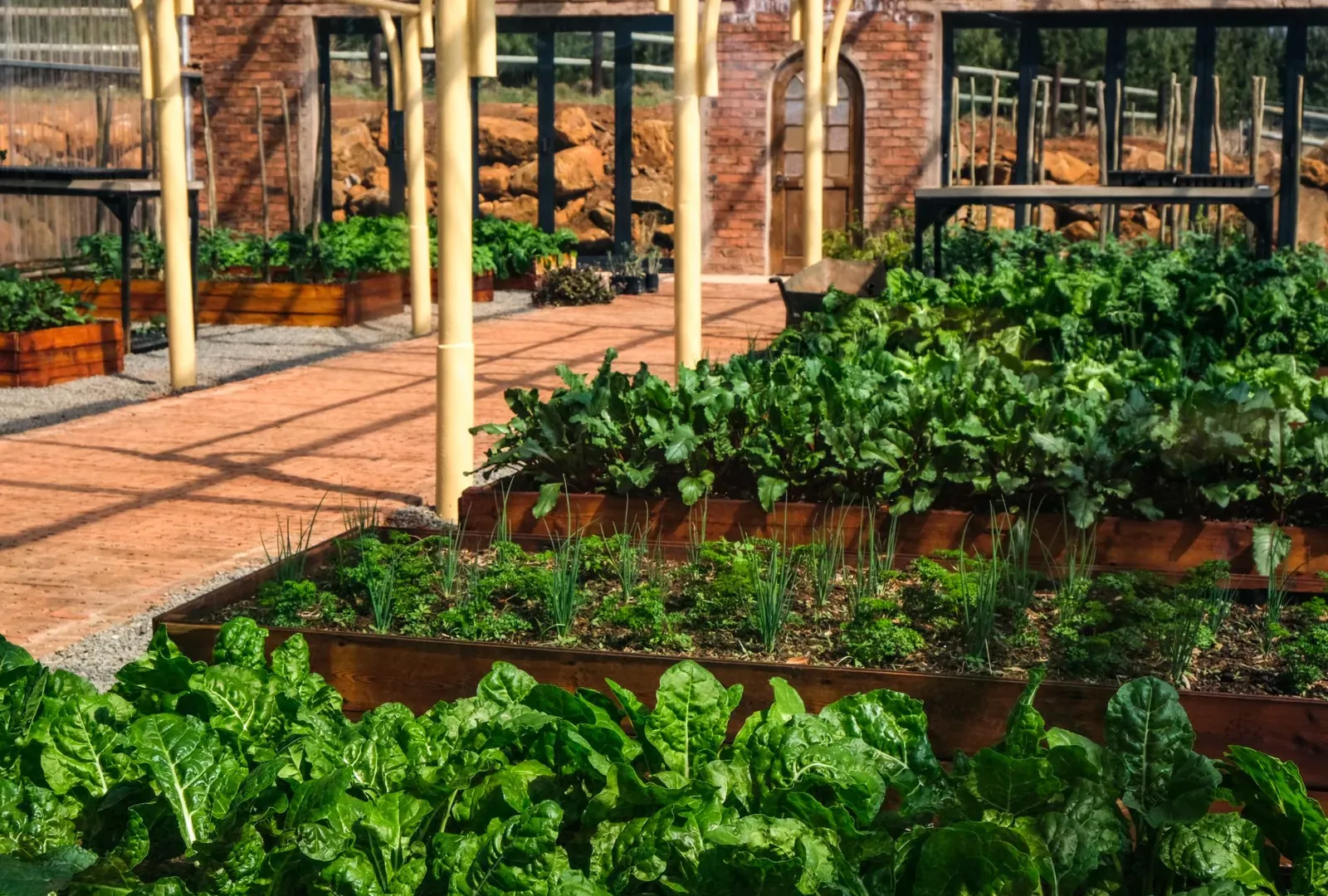 Wooden raised beds of chard and leafy greens set beside a brick-paved garden path
Photo: Magda Ehlers / Pexels
- On concrete, a patio or heavily compacted soil: 12 to 24 inches deep for tomato, pepper and squash (UMD). Leafy greens, beans and cucumber need at least 8 inches.
- On existing garden soil in good shape: add 4 to 6 inches of compost and mix it into the top 4 inches of soil (UMD). The example bed in that scenario sits almost 6 inches above grade.
- On a lawn: smother the grass first. If the bed is at least 6 inches deep and it is time to plant, UMD says you can cut the grass and weeds at ground level and cover them with growing mix. Roots grow through the bed into the soil below.
- No frame at all: UMD describes pulling loose topsoil into a bed 2 to 6 inches high. Texas A&M (E-517) plants tomatoes on beds raised about 6 inches.
So there is no single number. A shallow bed on good soil and a deep bed on concrete can both grow tomatoes, because the plant's real root zone is different in each.
How deep do tomato roots grow?#
University of Nebraska-Lincoln Extension (publication G2189) groups crops by rooting depth. Shallow-rooted crops reach 12 to 18 inches, moderate-rooted crops 18 to 24 inches, and deep-rooted crops 24 inches or more.
Its table lists tomatoes at 24 inches. For comparison, peppers are 18 inches and lettuce 6. Note what that number measures: the table describes the effective root zone in unrestricted soil, defined as the top 50 percent of the root zone. Some roots go deeper than that. The deeper root zone lines up with UMD asking more raised bed depth for tomatoes (12 to 24 inches on hardscape) than for leafy greens and beans (8 inches).
Planting method also shapes the roots. Penn State Extension says deep planting increases a tomato's root structure, and that any part of the stem touching the ground can root. Texas A&M advises watering slowly and deeply to build a strong root system.
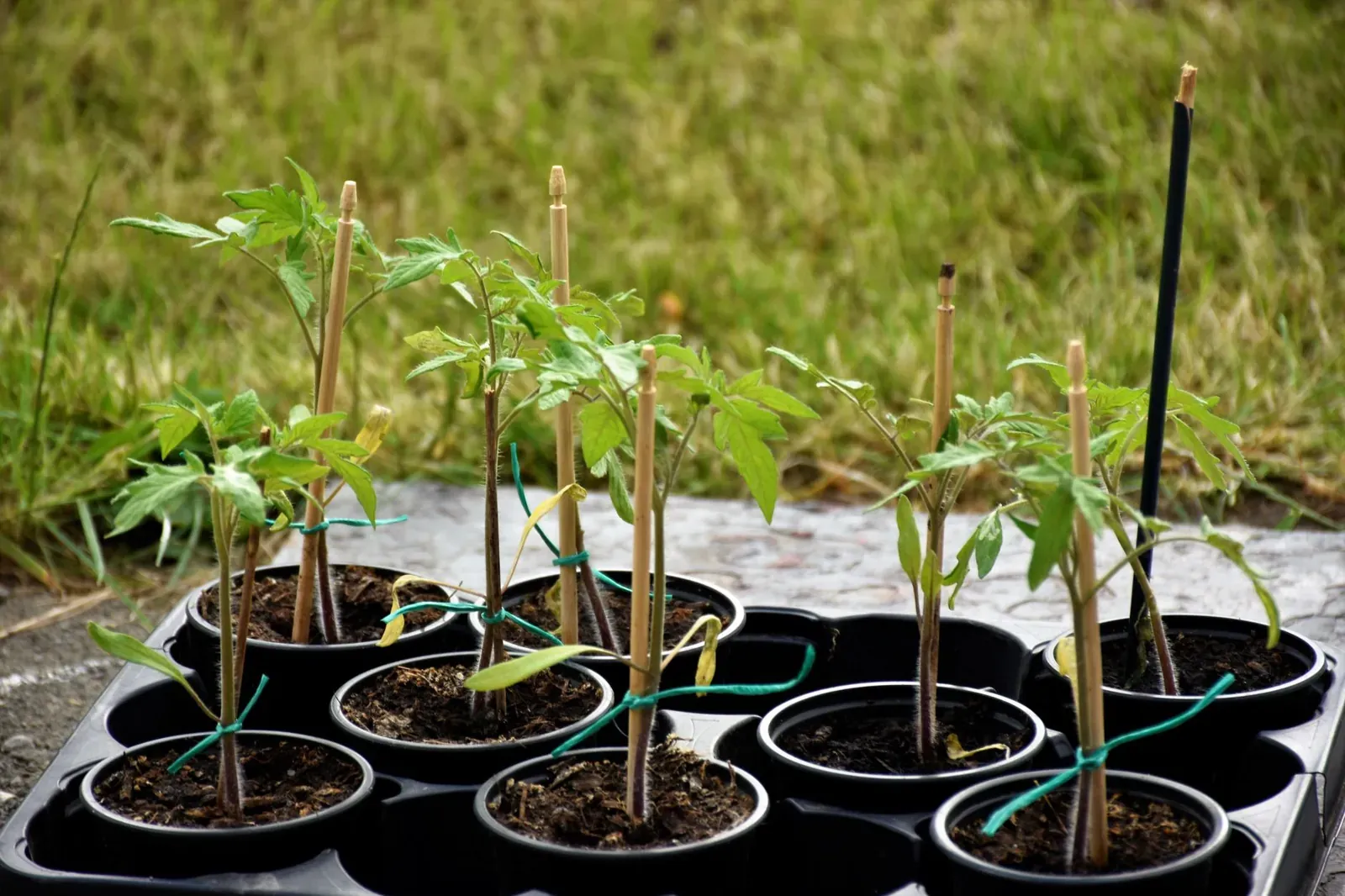 Staked tomato seedlings in black pots waiting to be planted out beside a lawn
Photo: Dariusz Sbirenda / Pexels
Shop the essentials
What you'll need
Supplies for the steps in this guide.
 Build the bedRaised bed kit, 4 × 8 ftA ready-to-assemble bed frame.: check price on Amazon (opens in a new tab)
 At transplantTomato cagesSturdy supports for tall tomato plants.: check price on Amazon (opens in a new tab)
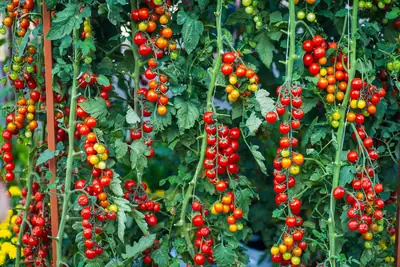 To sowTomato seedsSeed packets from many sellers: compare varieties and days to maturity.: check price on Amazon (opens in a new tab)
 Fill the bedBagged compostCompost to mix into a new bed.: check price on Amazon (opens in a new tab)
As an Amazon Associate I earn from qualifying purchases. Photos show the type of product, not a specific listing. How we choose
Bed on soil vs bed on concrete#
On native soil, the bed is only the top layer of the root zone. UMD notes that plant roots grow through the raised bed soil into the ground below. Over time, the soil under the bed improves as organic matter is added and crop roots grow through it.
On hardscape, the bed is the whole root zone, so raised bed depth for tomatoes matters most there. That is the case UMD's 12 to 24 inch figure covers. UMD shows an example: a bed about 16 inches deep on a concrete library balcony, growing a good crop of tomatoes.
For beds on hardscape, UMD fills with compost and a soilless growing mix in a 1:1 ratio. Topsoil can make up to 20% of the volume, but only in beds at least 16 inches deep. For how bagged bed fill differs from potting mix, see raised bed soil vs potting soil.
Determinate vs indeterminate: does depth change?#
None of the sources we read gives a different raised bed depth for tomatoes by type. UMD's 12 to 24 inch figure covers tomatoes as a group, and Nebraska's table has a single tomato row.
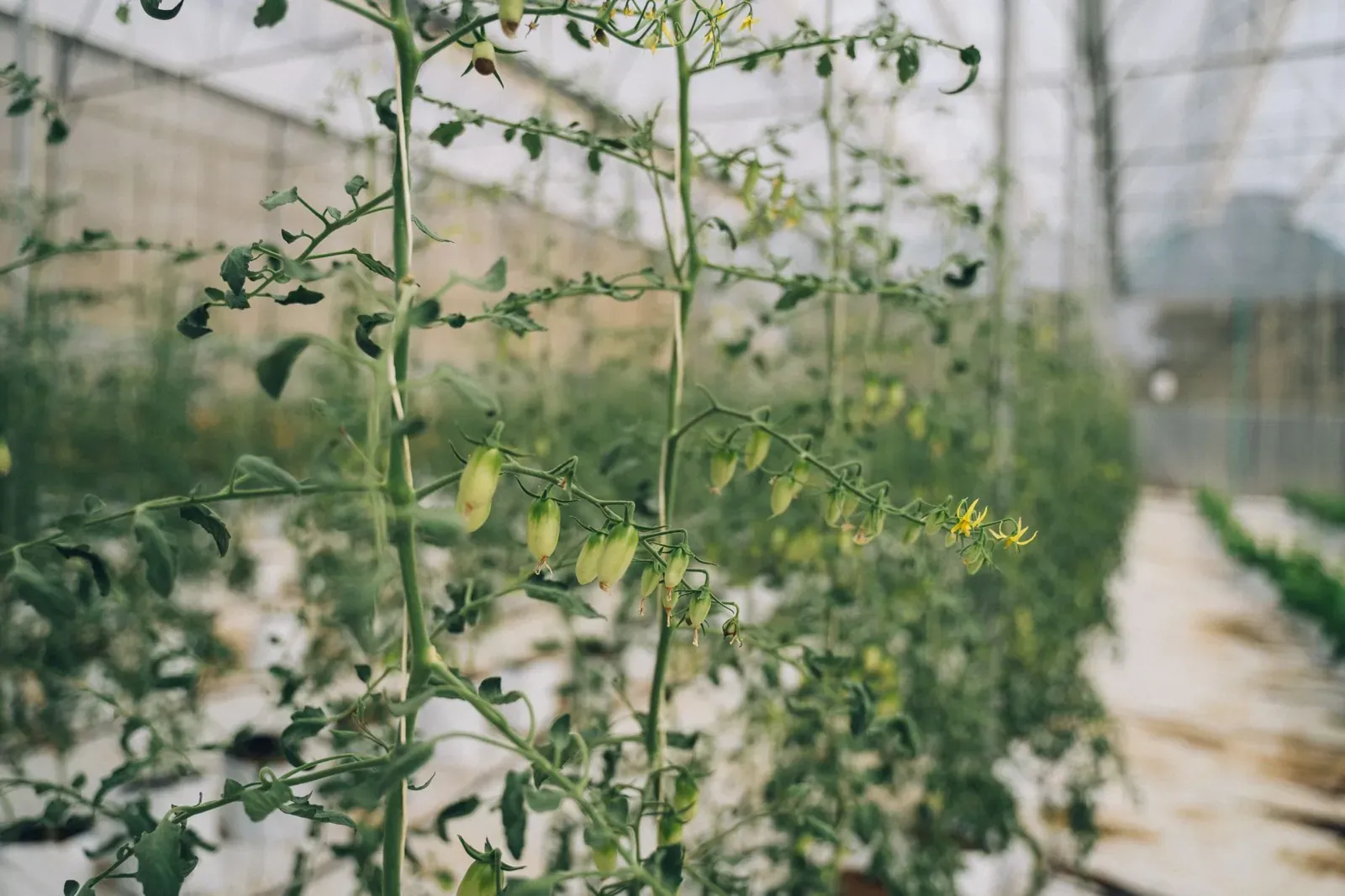 Tall indeterminate tomato vines with small green fruit trained upward inside a greenhouse
Photo: Anna Tarazevich / Pexels
What does differ is height. University of Illinois Extension says most modern determinate tomatoes grow 3 to 4 feet tall, while indeterminates easily reach at least 6 feet. Penn State suggests 2- to 3-foot supports for determinates and about 5 feet for indeterminates.
Stakes need anchoring too. Penn State pounds 6-foot stakes 12 inches into the ground, and Texas A&M sets a 6-foot stake 10 inches deep. On a bed over concrete, that anchoring has to come from the bed itself. We found no extension guidance on staking in a bed over hardscape, so treat this as a planning question rather than a rule.
What to do if your bed is shallow#
If you can't reach the ideal raised bed depth for tomatoes, the fix depends on what is underneath.
- Shallow bed on garden soil: UMD suggests loosening clay soil before adding compost. Push a garden fork in, rock it back and forth, move 6 to 8 inches and repeat across the bed. UMD also advises keeping digging and tilling to a minimum, since disturbed soil brings weed seeds to the surface.
- Shallow bed on lawn: smother the turf as UMD describes, and roots will continue into the ground.
- Shallow bed on concrete: we found no sourced workaround. The only guidance is the 12 to 24 inch range, so the practical fix is a deeper bed.
Plan a little headroom when you fill. UC Cooperative Extension (Inyo and Mono Counties) recommends leaving at least 2 inches at the top of the bed for mulch.
How much soil: 12 vs 18 vs 24 inches#
Once you pick a raised bed depth for tomatoes, the soil volume is simple arithmetic: length (ft) x width (ft) x depth (ft) = cubic feet. Divide by 27 for cubic yards, since 1 cubic yard is exactly 27 cubic feet (NIST Handbook 44).
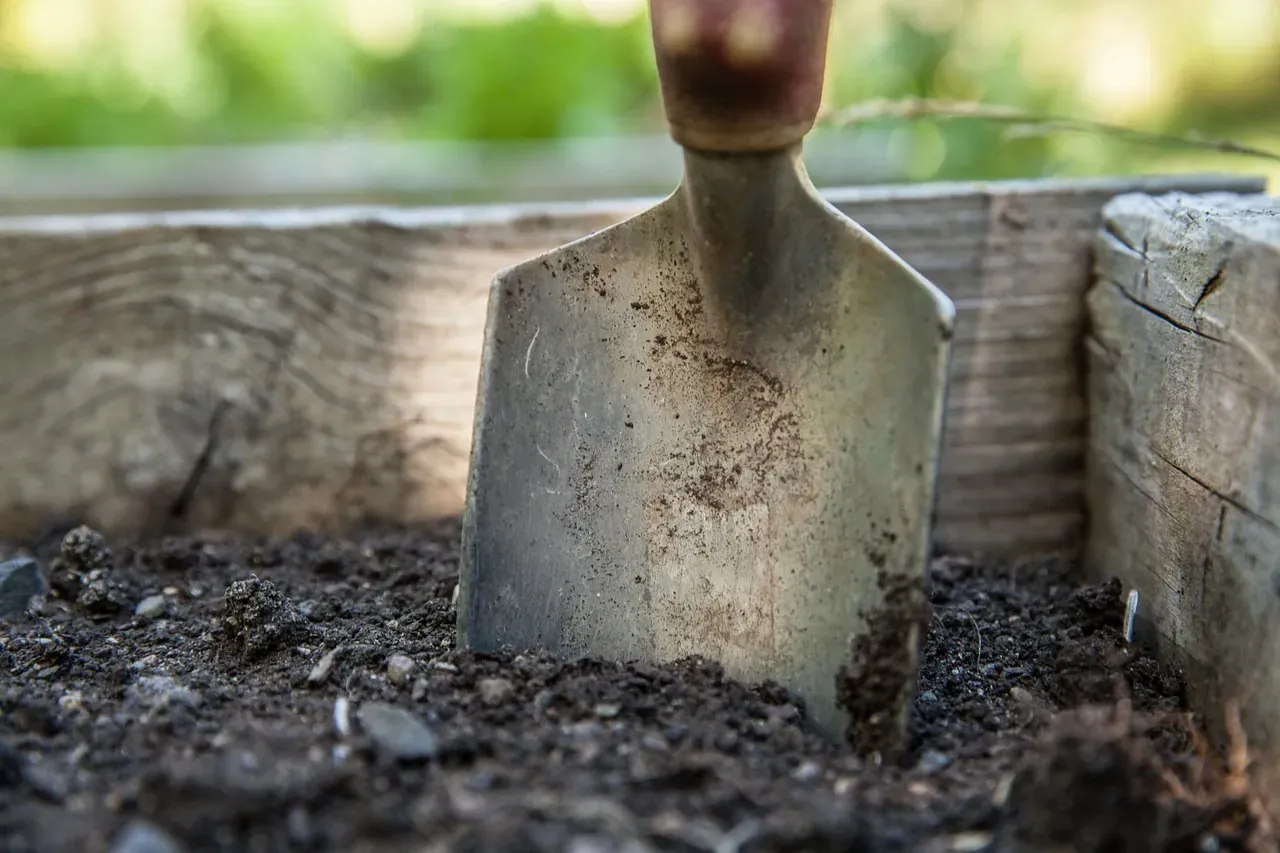 Metal hand trowel pushed into dark loose soil inside a weathered wooden raised bed
Photo: sessions-photography / Pixabay
| Bed size | 12 in deep | 18 in deep | 24 in deep |
|---|---|---|---|
| 4 x 4 ft | 16 cu ft (0.59 cu yd) | 24 cu ft (0.89 cu yd) | 32 cu ft (1.19 cu yd) |
| 3 x 6 ft | 18 cu ft (0.67 cu yd) | 27 cu ft (1.00 cu yd) | 36 cu ft (1.33 cu yd) |
| 4 x 8 ft | 32 cu ft (1.19 cu yd) | 48 cu ft (1.78 cu yd) | 64 cu ft (2.37 cu yd) |
| 4 x 12 ft | 48 cu ft (1.78 cu yd) | 72 cu ft (2.67 cu yd) | 96 cu ft (3.56 cu yd) |
These are full-to-the-rim volumes. If you leave 2 inches for mulch, a 4 x 8 bed that is 12 inches deep takes 10 inches of mix, or about 26.7 cubic feet.
Worked example: a 4 x 8 bed, 18 inches deep, on a patio holds 48 cubic feet. At UMD's 1:1 ratio, that is 24 cubic feet of compost and 24 of soilless mix. Because the bed is deeper than 16 inches, up to 9.6 cubic feet (20%) could be topsoil instead.
Bag sizes vary, so read the label. Under NIST Handbook 130, a compressed peat bale lists its volume in the compressed state, so the cubic feet on the bag is not the loose fill you get. Our raised bed soil calculator handles bed size, depth and bags for you.
Related: How to Grow Tomatoes: Planting to Harvest by Frost Date
FAQ#
Can you grow tomatoes in a 12 inch raised bed?#
Yes. On hardscape, 12 inches is the low end of UMD's 12 to 24 inch range for tomatoes. On loose soil or lawn, a 12-inch bed is plenty of raised bed depth for tomatoes, because roots keep growing into the ground below.
How deep do tomato roots grow in a raised bed?#
Nebraska Extension lists a 24-inch effective root zone for tomatoes in unrestricted soil. In a bed over concrete, roots can only use the depth of the bed. Over native soil they can continue below it.
How deep should a raised bed be for tomatoes and peppers?#
UMD groups them together: 12 to 24 inches on hardscape or compacted soil. Nebraska's table gives peppers a shallower root zone than tomatoes, 18 inches versus 24.
Plan the rest of your tomato season#
Raised bed depth for tomatoes is set once; timing changes every year. Tomatoes are frost-tender, and frost dates vary a lot within one hardiness zone, so look up your own dates on the planting calendar. For more on growing tomatoes, see the tomato growing guide.
Sources#
- Filling Your Raised Bed (University of Maryland Extension, Home and Garden Information Center)
- Water Wise: Vegetable and Fruit Production (G2189) (University of Nebraska-Lincoln Extension)
- Tomatoes: From Seedlings to Fruit (Penn State Extension)
- Tomato (University of Illinois Extension)
- Easy Gardening: Tomatoes (E-517) (Texas A&M AgriLife Extension)
- Building Raised Beds Workshop (UC Cooperative Extension, Inyo and Mono Counties Master Gardeners)
- NIST Handbook 44 (2026), Appendix C: General Tables of Units of Measurement (National Institute of Standards and Technology)
- NIST Handbook 130 (2026), Method of Sale of Commodities (National Institute of Standards and Technology)
Featured photo: Karen F / Pexels.
A 12-part series
Everything tomatoes, chapter by chapter
- Chapter 1
How to Grow Tomatoes: Planting to Harvest by Frost Date
A complete, extension-sourced tomato guide: when to plant by your frost date, how deep and how far apart, support, watering, feeding, pruning, common problems and harvest.
✓ Read - Chapter 2
Raised Bed Depth for Tomatoes: How Deep Is Enough?
On concrete or compacted soil, tomatoes need a raised bed 12 to 24 inches deep; on loose soil the roots grow on into the ground. Root depth data, fixes for shallow beds and a soil volume table.
You're reading this✓ Read - Chapter 3
When to Start Tomato Seeds Indoors: Dates by Zone and ZIP
Start tomato seeds indoors 6 to 8 weeks before your last frost. Here are example sow windows for zones 4a to 9a from NOAA frost data, and how to get the exact window for your ZIP code.
✓ Read - Chapter 4
Fertilizer for Tomato Plants: What, When and How Much
Extension-sourced tomato feeding: soil test first, pre-plant rates per 100 square feet, side-dressing once fruit sets, organic options, container feeding and a simple season schedule.
Coming soon · November 27✓ Read - Chapter 5
How Many Tomato Plants per Person? Fresh vs Canning
Extension charts suggest 2 to 5 tomato plants per person for fresh eating and 5 to 10 for canning. Here is each source side by side, family-of-4 math and the bed space you need.
Coming soon · December 1✓ Read - Chapter 6
Growing Tomatoes Indoors in Winter: Light and Pollination
Small varieties, 16 or more hours of light, 70 to 80°F days and a daily shake for pollination: an extension-sourced guide to winter tomatoes indoors, from pot size to harvest timing.
Coming soon · December 2✓ Read - Chapter 7
Tomato Hornworm: How to Spot, Remove and Prevent It
How to identify tomato and tobacco hornworms, read the damage and droppings, find them at night with a blacklight, remove them, spare the wasp-parasitized ones, and stop next year's crop.
Coming soon · December 3✓ Read - Chapter 8
How to Prune Tomato Plants (and When Not To)
Which tomato suckers to pinch, how many stems to keep on staked and caged plants, why determinate types need little pruning, and when to top plants late in the season.
Coming soon · December 6✓ Read - Chapter 9
Determinate vs Indeterminate Tomatoes: Which to Grow
Bush or vine? How determinate and indeterminate tomatoes differ in height, harvest window, support and pruning, plus semi-determinate types and how to pick by season length.
Coming soon · December 9✓ Read - Chapter 10
Yellow Leaves on Tomato Plants: 7 Causes and Fixes
Where the yellow starts tells you the cause. A quick diagnosis table for nitrogen shortage, watering, early blight, Septoria, wilt and transplant shock, with sourced fixes.
Coming soon · December 12✓ Read - Chapter 11
How Often to Water Tomato Plants (Beds vs Pots)
Extension guides put tomatoes at about 1 to 2 inches of water a week. How that translates for beds, raised beds and pots, how to check the soil, and why steady moisture prevents cracking and blossom end rot.
Coming soon · December 15✓ Read - Chapter 12
Blossom End Rot on Tomatoes: Causes and How to Stop It
Blossom end rot is a calcium problem inside the fruit, usually caused by uneven watering, not poor soil. How to spot it, prevent it, and which popular fixes extension specialists say do not work.
Coming soon · December 18✓ Read
3 of 12 chapters are out; new ones appear here as they publish.



Check your inbox
We sent a confirmation link to . Click it and your planting calendar PDF is on its way. Nothing there in a few minutes? Check your spam or promotions folder.
Crops in this article

No comments yet. Tried this in your garden, or found a date that worked better? Start the thread.
Leave a comment