 PlantAlong

In short
- Clemson Extension says peppers need moderate fertilizer, with amounts set by a soil test and a target pH of 6.0 to 6.5.
- UF/IFAS lists 1½ to 2 pounds of 10-10-10 per 100 square feet before planting peppers.
- Clemson side-dresses ½ pound of calcium nitrate per 100 square feet three to four weeks after planting, then again three to four weeks later; Missouri side-dresses after the first fruits set.
- Too much nitrogen gives leafy plants with few fruit and delays fruit set, according to Clemson and Utah State.
- Blossom-end rot comes from poor calcium movement into the fruit, usually because of uneven watering, so steady moisture matters more than extra fertilizer.
- In pots, N.C. A&T feeds peppers weekly after the potting mix's two-week fertilizer charge runs out, while Illinois Extension says every two weeks or so.
On this page
- Start with a soil test
- Fertilizer for pepper plants at planting
- Side-dressing peppers
- Too much nitrogen: big plants, few peppers
- Blossom-end rot is about calcium and water
- Liquid fertilizer for pepper plants in pots
- Organic fertilizer for pepper plants: compost, manure and meals
- A pepper feeding schedule
- FAQ
- Is Epsom salt good for pepper plants?
- Are coffee grounds a good fertilizer for pepper plants?
- What N-P-K numbers are best for peppers?
- When should I fertilize pepper plants after transplanting?
- Sources
The best fertilizer for pepper plants is the one your soil test asks for: a moderate pre-plant dose worked into the bed, then a light side-dressing of nitrogen once the first fruits set. Peppers need less than many gardeners give them, and extension services warn that too much nitrogen trades peppers for leaves.
Below are the actual rates and timings from university extension services, where they agree, where they differ, and what to do for peppers in pots. If you are still planning the season, start with our guide to growing bell peppers and the pepper crop page.
Start with a soil test#
Clemson Extension puts it plainly: "Peppers require moderate amounts of fertilizer," and the amount should follow a soil test. Utah State University Extension agrees: test first, then follow the recommendations on the report.
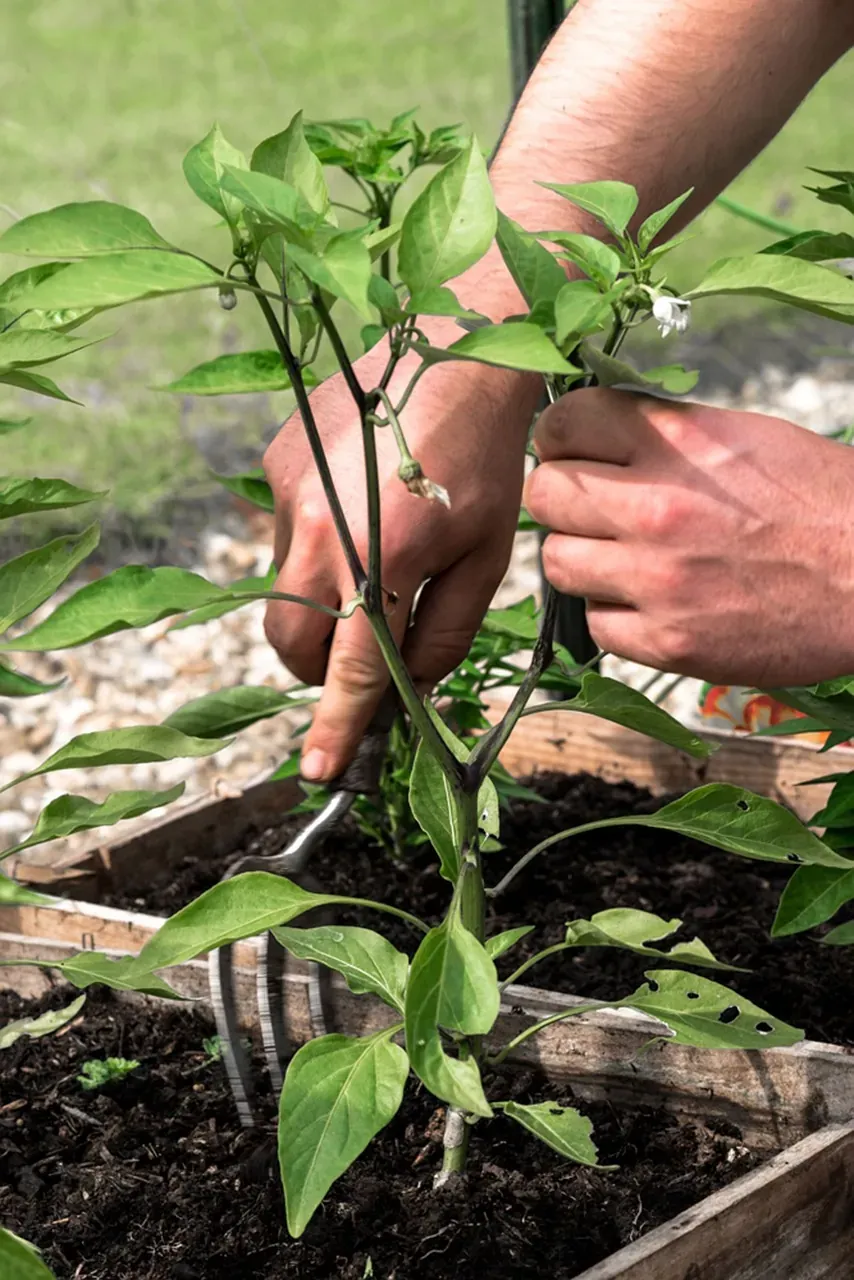 Gardener's hands loosening soil with a hand fork around a young pepper plant in a raised bed
Photo: LidiaSteffy / Pixabay
A soil test shows your pH, phosphorus and potassium. Clemson recommends a pH between 6.0 and 6.5 for peppers. UGA Extension says most vegetables do best between 6.2 and 6.8, so the ranges overlap at 6.2 to 6.5.
To sample, UGA says to take soil from 4 to 6 inches deep at eight to ten spots, mix it, and send it to your state's land-grant lab several months before planting.
The results also change which fertilizer for pepper plants makes sense. UF/IFAS Extension says that if phosphorus tests high, you can swap 10-10-10 for a fertilizer with little or no phosphorus. The University of Maryland Extension advises a nitrogen-only fertilizer when both phosphorus and potassium test high.
Fertilizer for pepper plants at planting#
Pre-plant fertilizer is broadcast over the bed and mixed in before transplanting. Clemson and Utah State both say to work it into the top 6 inches of soil.
Published rates vary by region:
- UF/IFAS Extension (Florida): 1½ to 2 pounds of 10-10-10 per 100 square feet for peppers and eggplant.
- UGA Extension (Georgia): about 30 pounds of 13-13-13 per 1,000 square feet at planting, which is 3 pounds per 100 square feet.
- University of Maryland Extension: 0.2 pounds (3.2 ounces) of actual nitrogen per 100 square feet as the general vegetable rate.
- Iowa State Extension: 0.20 pounds of nitrogen per 100 square feet where soil organic matter is under 3 percent, or 0.15 pounds at 3 to 19 percent.
The last two are pounds of nitrogen, not pounds of product. A 10-10-10 fertilizer is 10 percent nitrogen, so 0.2 pounds of nitrogen equals 2 pounds of 10-10-10, which lands inside the Florida range. The raised bed soil calculator gives you the square footage of your beds.
On transplant day, UF/IFAS suggests a starter solution: 2 tablespoons of water-soluble starter fertilizer per gallon of water, with 1 cup poured around each transplant. Seedlings still indoors get half-strength soluble fertilizer once a week, per Utah State. Our pepper seed starting guide covers that stage, and the planting calendar gives your transplant date by ZIP code.
Side-dressing peppers#
Side-dressing means scattering fertilizer beside established plants, mostly extra nitrogen for peppers. Timing matters more than the product, and sources differ:
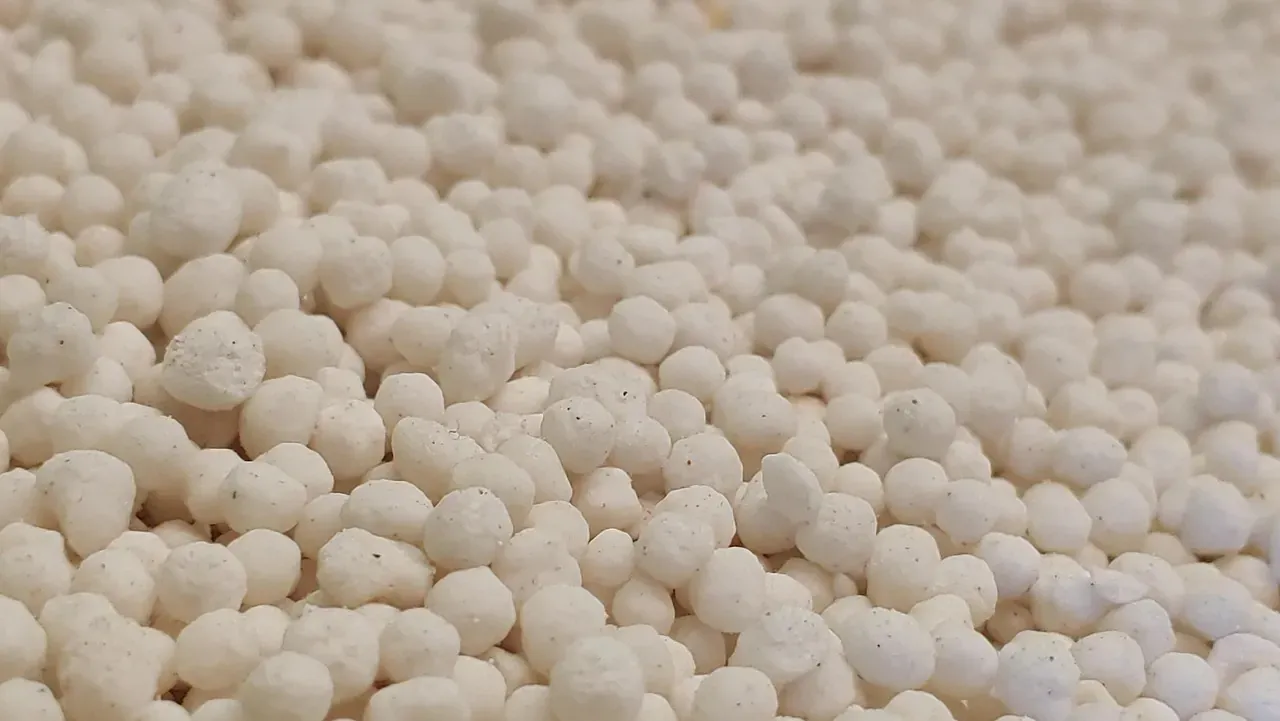 Close-up of white granular fertilizer pellets piled together
Photo: fabersam / Pixabay
| Source | First side-dress | Product and rate | Repeat |
|---|---|---|---|
| Clemson (SC) | 3 to 4 weeks after planting | ½ lb calcium nitrate (15.5-0-0) per 100 sq ft or 30 ft of row | Same amount 3 to 4 weeks later |
| Utah State | 4 weeks after transplanting | ¼ tablespoon of 21-0-0 per plant | Again at 8 weeks |
| Missouri (K-State table) | After first fruits set | About 1 lb ammonium nitrate, or about 3 lb of 12-12-12, per 100 ft of row or 100 sq ft | Not stated |
| UGA | Peppers about the size of a dime | 3 to 5 lb per 100 linear feet (general rate) | Not stated for peppers |
| UF/IFAS (FL) | Not tied to a stage | 1 to 1½ lb of 10-10-10 per 25 ft of row | Every 3 to 4 weeks |
In practice, dime-size fruit (UGA's cue) often shows up a few weeks after transplanting, so the approaches overlap.
Clemson says to place side-dress fertilizer 4 to 6 inches from the plants to avoid burning roots; Missouri and Utah State say at least 6 inches. Water it in. In a mulched bed, Missouri's advice is to pull the mulch back, apply the fertilizer along the row, and replace the mulch.
Shop the essentials
What you'll need
Supplies for the steps in this guide.
 FeedOrganic vegetable fertilizerA balanced fertilizer for vegetable beds. Follow the bag rate.: check price on Amazon (opens in a new tab)
 Before plantingSoil test kitChecks your soil’s pH and nutrients at home.: check price on Amazon (opens in a new tab)
 To sowPepper seedsSeed packets from many sellers: compare varieties and days to maturity.: check price on Amazon (opens in a new tab)
 Start indoorsSeed-starting trays with lidsCell trays with clear domes for sowing seeds indoors.: check price on Amazon (opens in a new tab)
As an Amazon Associate I earn from qualifying purchases. Photos show the type of product, not a specific listing. How we choose
Too much nitrogen: big plants, few peppers#
More is not better. Clemson notes that lots of foliage with few blooms and fruit indicates too much nitrogen. Utah State warns that over-fertilizing "encourages excessive foliage growth and delays fruit set and maturity."
If your peppers are tall, dark green and flowerless in midsummer, skip the next side-dressing. A high-nitrogen fertilizer for pepper plants only makes sense when a soil test or pale, slow growth says nitrogen is short.
Blossom-end rot is about calcium and water#
Blossom-end rot is the dark, leathery patch on the bottom of the fruit. Clemson describes it as a calcium deficiency within the plant that does not necessarily mean a deficiency in the soil. Calcium moves to the fruit with water, so "if the water supply is interrupted, calcium is unable to be absorbed by the plant and move to the fruit."
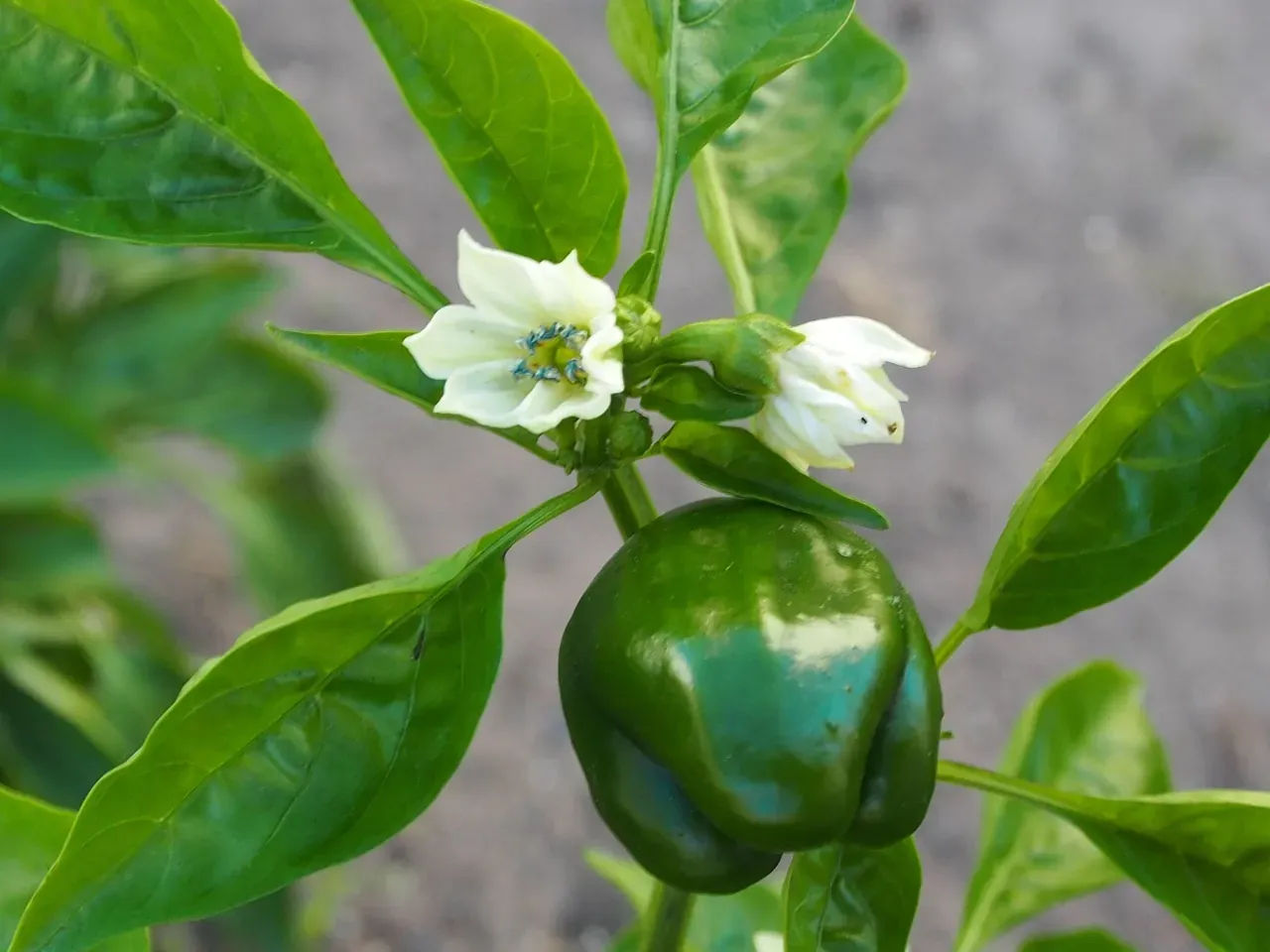 Bell pepper plant with white flowers and a young green fruit setting below them
Photo: s-ms_1989 / Pixabay
Utah State lists poor water management and excessive nitrogen among the causes. Steady watering is the main fix, not more fertilizer. Clemson recommends moistening the soil at least 6 inches deep, keeping it uniformly moist but not saturated while fruit develops, and mulching to hold moisture. It also advises a soil test before planting to confirm calcium levels.
Liquid fertilizer for pepper plants in pots#
Potting mix holds fewer nutrients than garden soil, and University of Illinois Extension notes that frequent watering leaches nutrients out of containers. How often to feed depends on the source:
- N.C. A&T Cooperative Extension: most commercial potting media carry a fertilizer charge that lasts about two weeks. After that, feed peppers weekly with a water-soluble fertilizer, using a balanced 1-1-1 ratio (such as 20-20-20) until flowering, then a high-potassium fertilizer. Most tomato fertilizers fit.
- University of Illinois Extension: reapply liquid fertilizer "every two weeks or so," or feed at half strength with every watering. Apply it when the mix is moist, and occasionally water with plain water to flush the pot.
Mix any liquid fertilizer for pepper plants at the label rate and adjust by how the plant looks. Pot size, mix and watering are covered in growing peppers in containers.
Organic fertilizer for pepper plants: compost, manure and meals#
Compost improves soil but is not a complete feeding plan. Utah State caps it at no more than 1 inch of well-composted organic matter per 100 square feet.
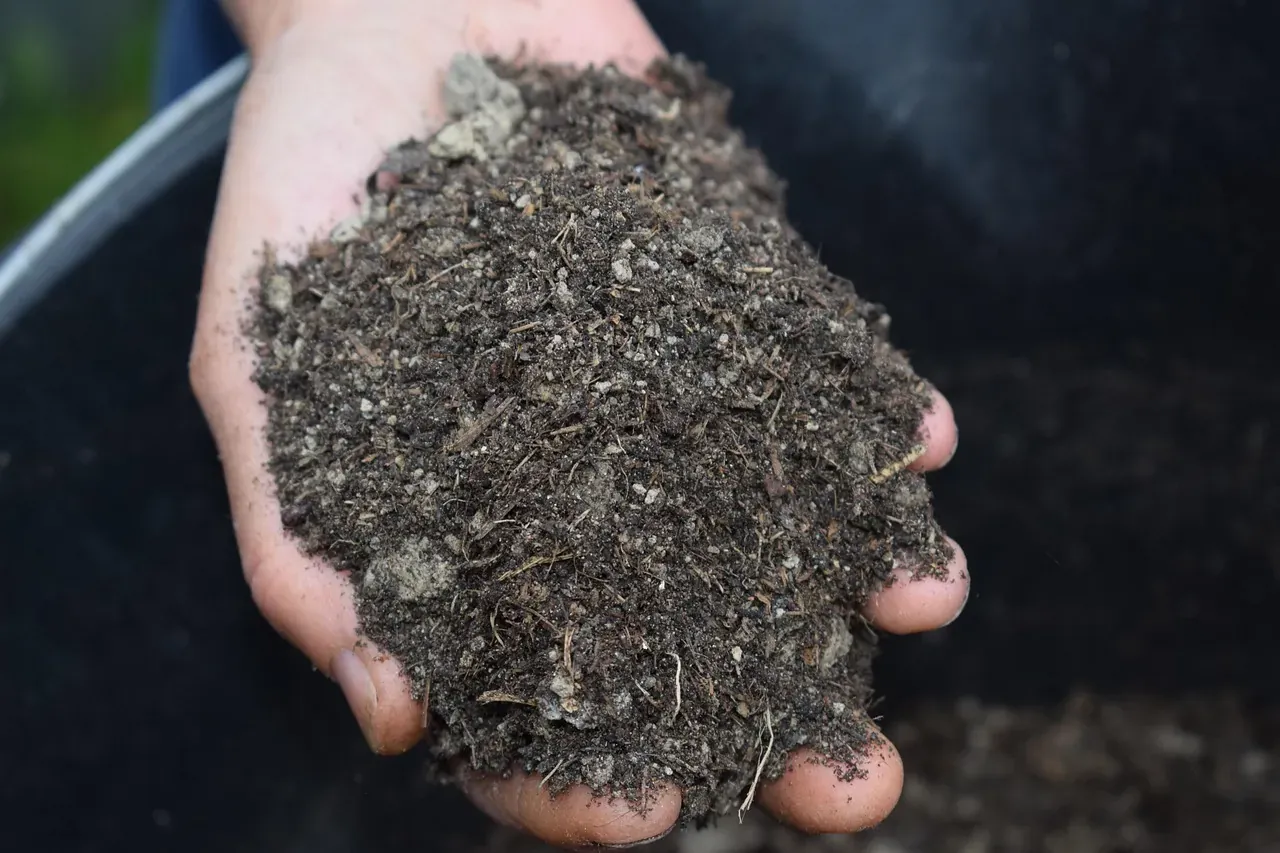 Open hand holding a pile of dark, crumbly compost over a bin
Photo: JennyJohansson / Pixabay
For an organic side-dress, Missouri lists about 2 pounds of blood meal or about 3 pounds of cottonseed meal per 100 feet of row.
Manure needs care for food safety:
- Iowa State and University of Maine Extension say to apply raw manure at least 120 days before harvesting crops that touch the soil, and 90 days before harvest for crops that do not.
- Maine says never to use raw manure as a side-dress on growing plants; fall application is the safer timing.
- Both say never to use cat, dog or pig manure in gardens or compost.
- Iowa State notes that well-composted manure lowers the risks and the chance of fertilizer burn.
A pepper feeding schedule#
Here is the extension advice on fertilizer for pepper plants in order. Use your soil test rates where you have them.
| When | What to do | Source |
|---|---|---|
| Months before planting | Soil test; adjust pH toward 6.0 to 6.5 | Clemson, UGA |
| Before transplanting | Broadcast pre-plant fertilizer, work into top 6 inches | Clemson, Utah State, UF/IFAS |
| Transplant day | Starter solution, 1 cup per plant | UF/IFAS |
| 3 to 4 weeks after planting, or first fruit set | Nitrogen side-dress, 4 to 6 inches from stems | Clemson, Missouri, UGA |
| 3 to 4 weeks later | Second side-dress if plants are not too leafy | Clemson, Utah State |
| All season, pots only | Liquid feed weekly to every two weeks | N.C. A&T, Illinois |
FAQ#
Is Epsom salt good for pepper plants?#
Usually not, and it is not a general fertilizer for pepper plants. Clemson Extension says magnesium levels in most gardens are already sufficient, research does not support Epsom salt for boosting yields or stopping blossom-end rot, and extra magnesium can reduce calcium uptake and worsen blossom-end rot on peppers. Only a soil test showing low magnesium justifies it.
Are coffee grounds a good fertilizer for pepper plants?#
Only in small amounts. Cornell Cooperative Extension says composted grounds have about 2 percent available nitrogen, fresh unused grounds can sharply lower soil pH, and you should never add more than a few ounces per square foot. Composting them first is the safer route.
What N-P-K numbers are best for peppers?#
The three numbers are the percentages of nitrogen, phosphate and potash, and no single ratio is best. The extension rates above use balanced fertilizers like 10-10-10 before planting and nitrogen sources like calcium nitrate (15.5-0-0) for side-dressing. In pots, N.C. A&T suggests 1-1-1 before flowering, then high potassium.
When should I fertilize pepper plants after transplanting?#
Clemson says to side-dress three to four weeks after planting, Utah State at four and eight weeks after transplanting, and Missouri after the first fruits set. If you used a starter solution on transplant day, wait for those milestones before adding more.
Sources#
- Pepper, HGIC 1316 (Clemson Cooperative Extension)
- Peppers in the Garden (Utah State University Extension)
- Fertilizing the Home Garden, C1179 (University of Georgia Extension)
- Vegetable Gardening Fertilization (UF/IFAS Extension)
- Fertilizer for Vegetables (University of Maryland Extension)
- Fertilizer Rates and Requirements for the Home Garden (Iowa State University Extension)
- Wet Spring Adds Importance to Side-Dressing (University of Missouri IPM)
- Growing Fruiting Vegetables in Containers (N.C. A&T Cooperative Extension)
- Fertilizing Container Gardens (University of Illinois Extension)
- Using Manure in the Home Garden (Iowa State University Extension)
- Guidelines for Using Manure on Vegetable Gardens (University of Maine Cooperative Extension)
- Epsom Salt in the Garden: Is It Truly Needed? (Clemson Cooperative Extension)
- Coffee Grounds for Nitrogen (Cornell Cooperative Extension)
Featured photo: ClickerHappy / Pixabay.
A 5-part series
Everything peppers, chapter by chapter
- Chapter 1
Growing Bell Peppers: Planting Dates, Spacing and Care
Bell peppers go out about two weeks after your last frost into warm soil, need 1-2 inches of water a week, and are ready about 70-85 days after transplanting. Here is the full season, sourced from extension guides.
✓ Read - Chapter 2
How to Overwinter Pepper Plants Indoors
Peppers are frost-tender perennials. Bring them in by your ZIP's first-frost P10 date, cut them back, keep them at 40-55°F with little water, and replant two weeks after your last frost.
✓ Read - Chapter 3
When to Start Pepper Seeds Indoors in Zone 6
Peppers go in about 6 to 8 weeks before your last frost, but zone 6 frost dates span more than three weeks. Here are sourced rules and example sowing dates for 6a and 6b.
✓ Read - Chapter 4
Fertilizer for Pepper Plants: What to Use and When
Extension rates and timing for feeding peppers: soil test first, a moderate pre-plant dose, a nitrogen side-dress around first fruit set, and liquid feed for pots.
You're reading this✓ Read - Chapter 5
Growing Peppers in Containers: Pot Size, Soil and Care
What extension guides say about growing peppers in pots: how big a container, which mix, when to move it outside, how often to water and feed, and when to bring it in.
✓ Read
5 of 5 chapters are out; new ones appear here as they publish.



Check your inbox
We sent a confirmation link to . Click it and your planting calendar PDF is on its way. Nothing there in a few minutes? Check your spam or promotions folder.
Crops in this article

No comments yet. Tried this in your garden, or found a date that worked better? Start the thread.
Leave a comment